
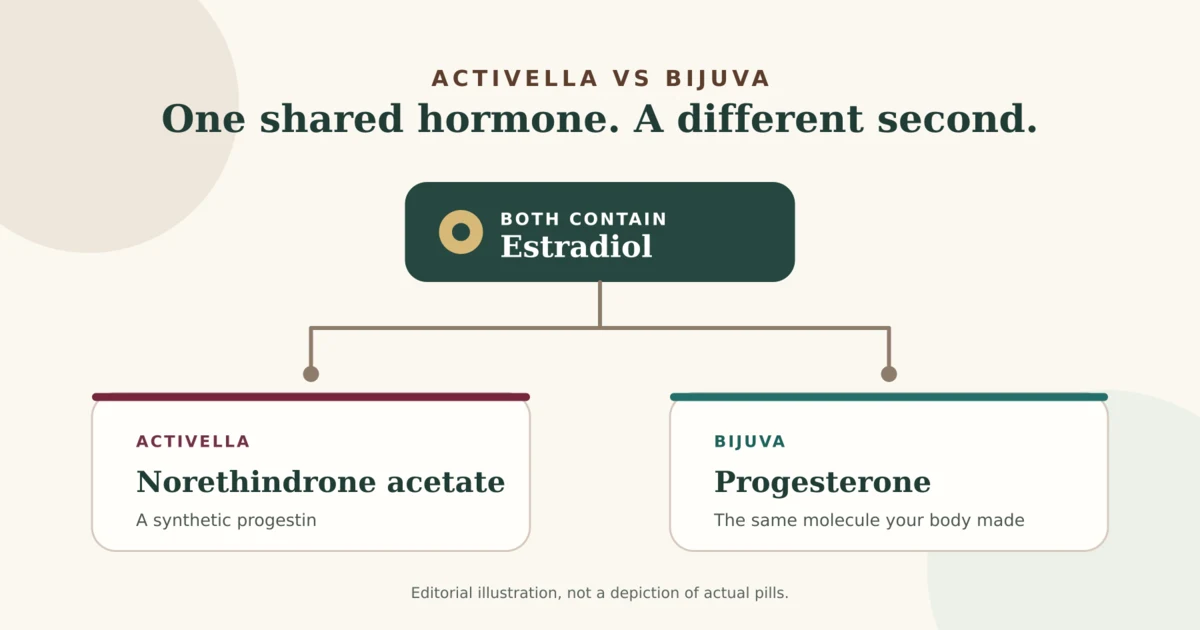
Activella vs Bijuva comes down to the second hormone when oral HRT fits: both contain estradiol, but Activella adds norethindrone acetate, a synthetic progestin, while Bijuva adds progesterone, the same hormone your body made. Both treat moderate to severe menopausal hot flashes in women with a uterus. Activella has lower-cost generics; neither has been shown safer in a head-to-head trial.
Activella (or its generic) may suit you if cost matters, your insurance prefers generics, or you also want a product labeled for bone-loss prevention. The 1 mg/0.5 mg strength is also labeled for moderate to severe vaginal dryness and thinning.
Bijuva may suit you if you want the progesterone your body made, you didn't do well on a synthetic progestin, or you need an oral progesterone option without peanut oil.
Neither fits if you've had a hysterectomy, you want a patch, or you've had a blood clot, stroke, heart attack or breast cancer. Those situations start with a different conversation, and we cover them below.
Paying cash? At listed prices, generic Activella 1 mg/0.5 mg runs about $38 to $41 per 30 days. The 0.5 mg/0.1 mg generic runs about $49 to $52; Bijuva runs about $262 to $279. See the full cost math.
Paying cash and don't have a prescriber? See where Gala fits — and where it doesn't.
The HRT Index is the independent decision resource for online menopause and HRT care — comparing telehealth providers on clinical legitimacy, care quality, medication fit, price transparency, and access, with every claim verified and dated, so women can choose the path that fits their situation before their first consult.
What we actually verified · Last verified October 2026 We read, on October 15, 2026: Activella's FDA prescribing information linked from its latest listed labeling supplement (approved February 15, 2024; the label itself is revised November 2023), its DailyMed record and FDA marketing-status record; Bijuva's February 2026 FDA label and September 2026 DailyMed record; the FDA's labeling announcement, updated-label list and Bijuva-generic record; Drugs.com cash prices for both combination medicines and separate estradiol and progesterone; the official Bijuva savings-card terms; the full published UK blood-clot study and the publisher's E3N study abstract; The Menopause Society's guidance; Gala's hormone-health and $69 HRT offer pages, alternate HRT page and linked terms; Midi's pricing page; and the entry screen and how-it-works page for The HRT Index's Find My HRT Path tool. We kept earlier site research separate: the August 2026 insurance-document comparison is dated where we discuss it. That is not a fresh verification of every insurer's current coverage. We did not: take either medicine, talk to a prescriber, run an insurance claim, check stock at your pharmacy or buy anything from Gala. This is a documentation review, not a patient test. We could not confirm: your pharmacy's price or stock, your plan's coverage, or which exact products, total charge and billing schedule Gala would give you. We did not test the full quiz flow or its data handling.
We may earn a commission if you start care with a provider through some links on this page, including Gala. That doesn't change the facts or limits we report. How we make money.
One honest limit before you read on. We did not find a study that tested Activella and Bijuva against each other. So no one, including us, can name a winner for every woman. What we can do is show you the real difference, what each one is approved to treat, what each costs for the same number of days, and the questions that settle the rest.
On this page: Same and different · Side by side · Which fits you · Cost · Bioidentical · Boxed warning · Safety evidence · Hot flash relief · Bleeding and side effects · When neither fits · Questions to ask · Online care and Gala · How we checked · Quick answers
Activella vs Bijuva: what's the same and what's different?
Activella and Bijuva are both FDA-approved, once-a-day pills used as hormone replacement therapy (HRT) for menopausal symptoms in women who still have a uterus, and both contain estradiol, the main estrogen your ovaries made before menopause. The difference is the second hormone, the one that protects the lining of the uterus. Activella uses norethindrone acetate, a lab-made progestin. Bijuva uses progesterone, the same molecule your body made.
That swap explains the "bioidentical" distinction. The price gap also depends on generic access, while the approved uses and warning changes come from each product's evidence and labeling history.
A few words first, because the names are a mouthful:
- Estrogen is the hormone that calms hot flashes and night sweats.
- Progestogen is the umbrella word for any hormone that protects the uterine lining.
- Progestin means a lab-made progestogen. Norethindrone acetate is one.
- Progesterone is the natural one, the same molecule your body made.
- Systemic means the medicine travels through your whole bloodstream. Both pills are systemic.
- Continuous combined means you take both hormones every day, with no planned break. Both pills work this way.
Why both pills need a second hormone
If you still have a uterus, estrogen alone can make its lining grow too thick. Doctors call that endometrial hyperplasia. Over time it can lead to uterine cancer. A progestogen keeps the lining in check.
Activella's own study shows how much this matters. After 12 months, 14.6% of women taking estradiol 1 mg alone had hyperplasia. On Activella 1 mg/0.5 mg, it was 0.4% (1 of 241 women) (Activella prescribing information). In Bijuva's study, it was 1 of 303 women on the lower strength and 1 of 281 on the higher strength over up to 12 months (Bijuva prescribing information).
Both second hormones did their main job in their own trials. That's the floor both medicines stand on.
"Does any Activella contain progesterone?" No.
You may see this claim in online forums. It isn't right. Every Activella tablet, and every generic estradiol/norethindrone acetate tablet, contains norethindrone acetate as its second hormone. That's what the label says. Bijuva combines progesterone with estradiol in one FDA-approved capsule. An approved generic exists in FDA records, but we did not confirm a currently marketed generic fill (generic status).
Who makes them, and what the names on your bottle mean
- Activella is the brand name. It was first approved by the FDA in 1998. Its DailyMed record lists Amneal as the distributor, and the Activella trademark belongs to Novo Nordisk (DailyMed). The FDA product record lists the 1 mg/0.5 mg brand as prescription-marketed but the 0.5 mg/0.1 mg brand as discontinued—not withdrawn for safety or effectiveness. Generics of the lower strength still appear in current price listings.
- Generic Activella is sold as estradiol/norethindrone acetate tablets. Drugs.com lists names such as Mimvey, Amabelz, Lopreeza, Abigale and Etyqa for this ingredient pair. Your pharmacy label will show which one you received. That name list is not proof that every listed product is currently marketed or substitutable; ask your pharmacist to confirm the exact product and FDA equivalence.
- Bijuva was first approved in 2018. Mayne Pharma markets it. Drugs.com lists it as brand-only.
Here's the simplest picture to hold onto:
| Hormone 1 | Hormone 2 | |
|---|---|---|
| Activella (and generics) | Estradiol | Norethindrone acetate (a progestin) |
| Bijuva | Estradiol | Progesterone |
Activella vs Bijuva side by side: what the FDA labels say
The labels differ most in three places: what each medicine is approved to treat, how and when you take it, and how the warnings are laid out in 2026. Activella's 1 mg/0.5 mg strength is approved for hot flashes, vaginal dryness and thinning, and bone-loss prevention. Bijuva is approved for hot flashes only.
Most comparison pages don't separate Activella's two strengths. They have different approved uses, so we split them.
Table 1. Activella vs Bijuva by strength, from the FDA labels (checked October 15, 2026)
| Activella 1 mg / 0.5 mg | Activella 0.5 mg / 0.1 mg | Bijuva 0.5 mg / 100 mg | Bijuva 1 mg / 100 mg | Who this row matters to | |
|---|---|---|---|---|---|
| Estrogen | Estradiol 1 mg | Estradiol 0.5 mg | Estradiol 0.5 mg | Estradiol 1 mg | Everyone. It's the same molecule. |
| Uterus-protecting hormone | Norethindrone acetate 0.5 mg | Norethindrone acetate 0.1 mg | Progesterone 100 mg | Progesterone 100 mg | Women who care which progestogen they take |
| Form | Tablet | Tablet | Capsule | Capsule | Pill-size or swallowing preferences |
| How the label says to take it | One tablet once a day, at the same time each day | Same | One capsule each evening with food | Same | Your daily routine |
| Label's starting advice | — | — | Generally start at this strength | — | Your prescriber's first dose choice |
| Moderate to severe hot flashes and night sweats | Approved | Approved | Approved | Approved | Everyone on this page |
| Moderate to severe vaginal and vulvar dryness and thinning | Approved | Not approved | Not approved | Not approved | Women with dryness or painful sex too |
| Prevention of bone loss after menopause | Approved | Approved | Not approved | Not approved | Women with bone-loss concerns |
| Who it's labeled for | Women with a uterus | Same | Same | Same | Had a hysterectomy? Neither is meant for you. |
| Boxed warning on the current label | Yes | Yes | Removed February 2026 | Removed February 2026 | Everyone (what that means) |
| Standard pack | 28 tablets | 28 tablets | 30 capsules | 30 capsules | Anyone comparing prices |
| Inactive ingredients worth knowing | Lactose, corn starch | Lactose, corn starch | Bovine gelatin, soybean lecithin, FD&C Red #40; no peanut oil listed | Same | Allergies, sensitivities or dietary rules |
| Brand / generic access | FDA lists the brand and prescription generics | FDA lists the brand strength as discontinued; generics are listed | Brand; no marketed generic confirmed | Brand; approved generic record is discontinued | Confirm the exact strength and pharmacy stock |
| Listed cash price (Drugs.com, Oct 15, 2026) | Brand from $282.33 / 28; generic from $38.15 / 28 | Generic from $48.76 / 28 | From $278.91 / 30 | From $262.33 / 30 | Cash payers (full math) |
| First FDA approval of the branded product (not each strength) | 1998 | Same product | 2018 | Same product | Product history, not a strength-specific approval date |
| Shown better than the other in a head-to-head trial? | Not established | Not established | Not established | Not established | Your situation decides |
Source: Activella prescribing information on DailyMed and the FDA label; Bijuva prescribing information, FDA and DailyMed; FDA Activella record and FDA Bijuva record for approval and marketing status; Drugs.com price guides for Activella, estradiol/norethindrone and Bijuva. All read October 15, 2026.
What this table can and can't decide
It can narrow your conversation. If vaginal dryness or bone protection is part of why you want treatment, only Activella 1 mg/0.5 mg is labeled for all three uses. Of these two branded products, only Bijuva combines progesterone with estradiol in one capsule. If price is the problem, the generic row speaks for itself.
It can't tell you which pill your body will handle better. It can't clear you for hormone therapy. And it isn't permission to switch on your own. Those are decisions for you and a clinician who knows your history.
Which one fits your situation?
Generic Activella is the lower-cost combination pill in these listings and is worth discussing when insurance favors generics or bone-loss prevention matters. Its 1 mg/0.5 mg strength is also labeled for vaginal dryness and thinning. Bijuva is worth discussing when you specifically want progesterone, haven't tolerated a synthetic progestin, or need a formulation with no peanut oil listed. Many cash payers can also ask about separate estradiol and progesterone prescriptions.
Start with the problem you're trying to solve, not with a brand's reputation. A pill that's working, an unwanted side effect, a coverage problem and a wish for a patch are four different reasons to review your care. They don't lead to the same next step.
Table 2. Your situation and the path worth discussing first (editorial judgment, built from the labels and prices)
| Your situation | Worth discussing first | Why | Your next step |
|---|---|---|---|
| Hot flashes are the main problem and you're paying cash | Generic estradiol/norethindrone acetate | About $38 to $52 per 30 days at listed prices | Ask your prescriber to allow the generic, then price it (cost) |
| You're on Activella or its generic, feel well, and it's covered | Staying on it, with a regular review | Nothing shows that switching helps someone who's doing well | Bring the question list to your next visit |
| You want the progesterone your body made | Bijuva, or separate estradiol and progesterone | Bijuva puts both hormones in one FDA-approved capsule; a marketed generic was not confirmed | Price both; ask about the Bijuva savings card if you're insured |
| You have spotting, breast tenderness or mood changes on Activella | A talk with your prescriber about dose, progestogen type or route | Each of those is a real lever, and only your prescriber can pull it | Write down what you notice and when (side effects) |
| You have a peanut allergy and want oral progesterone | Ask about Bijuva and have the pharmacist verify its ingredients | Its label lists no peanut oil; Prometrium, the best-known progesterone capsule, contains it | Ask your pharmacist to check the exact product |
| You're lactose-sensitive | Ask your pharmacist first | Activella tablets contain lactose | Check the inactive ingredients on the generic you'd receive |
| You avoid animal products or soy | Ask your pharmacist first | Bijuva's capsule contains bovine gelatin and soybean lecithin | Ask what alternatives fit your needs |
| You also want vaginal dryness treated by the same labeled product | Activella 1 mg/0.5 mg | It's the only strength here approved for that use | Ask whether low-dose vaginal estrogen alone could do the job (vaginal estrogen guide) |
| Bone-loss prevention matters to you | Activella (either strength) | Bijuva isn't labeled for bone | The label says to consider non-estrogen bone medicines if bone is the only goal |
| Your plan excludes Bijuva | Generic Activella or separate estradiol and progesterone, when clinically suitable | Coverage may change the affordable options, but the hormone and formulation still matter | See what 10 plans said about Bijuva |
| You'd rather use a patch, or blood clots worry you | Discuss the route before choosing either pill | Clot risk may be lower with estrogen through the skin, but a clot history needs clinical review before any systemic HRT | See Bijuva vs an estradiol patch and progesterone |
| You've had a hysterectomy | Neither | Both are made only for women with a uterus | Ask about estrogen-only options |
| You've had a clot, stroke, heart attack, breast cancer, liver disease, or bleeding no one has explained | In-person care first | These are listed reasons not to use either medicine | Start with your doctor; ask about non-hormonal options |
A 20-second pause before you choose
Two quick questions sort most readers. Nobody sees your answers.
- Am I choosing a medicine, or looking for someone to help me choose? If you have a prescriber, take this page to them. If you don't, the care question comes first.
- Must it be one of these two exact brands? If yes, you need a prescriber who will write that brand and a pharmacy that stocks it. If you're open to the same hormones in a different form, more doors open, including lower-cost ones.
And three facts change the answer more than anything else:
- Do you still have a uterus?
- Is your main problem hot flashes alone, or also vaginal dryness or bone loss?
- Are you paying cash, or does your insurance cover brand medicines?
If the medicine question is settled but the care question isn't, that's a separate decision with its own answer. The right online menopause care isn't the same for every woman — it depends on your symptoms, what you've already tried, your age, your state and your health history. Some situations belong with an in-person clinician first. Use The HRT Index's Find My HRT Path tool to explore a featured care option for your situation — and to flag when online care isn't the right starting point — before your first consult.
It's free, takes about 60 seconds and doesn't ask for your email. It asks five things: what's bothering you most, what you've tried, your age, your state and any health history a clinician should know about. Then it shows a featured online option, or guidance when online care isn't the right next step. It doesn't choose Activella, Bijuva or a dose, and it doesn't decide whether you should take hormones. A clinician does that. We may earn a commission from the providers it features, which affects which ones appear. The tool's how-it-works page says your answers stay in your browser.
How much do Activella and Bijuva cost?
At listed cash prices, generic Activella (estradiol/norethindrone acetate 1 mg/0.5 mg) costs about $38 to $41 for 30 days, while Bijuva costs about $262 to $279 for 30 days. Brand-name Activella costs about $302 for 30 days. Insurance and Bijuva's savings card can change your price a lot; Drugs.com lists no manufacturer savings program for Activella.
Compare the same number of days, not "a month"
Activella comes in 28-tablet packs. Bijuva comes in 30-capsule packs. So a pack of Activella that looks cheaper covers two fewer days.
The fair way to compare: divide the price by the days it covers, then multiply by 30.
Pack size also changes how often you pay. Here's the supply math alone, before any prices, if you fill on day 1 with nothing at home and refill each time a pack runs out:
Table 3. How 28-day and 30-day packs add up (our arithmetic; one tablet or capsule a day)
| 28-day pack (Activella and its generics) | 30-day pack (Bijuva) | |
|---|---|---|
| Days covered by 3 packs | 84 | 90 |
| Days short of 90 after 3 packs | 6 | 0 |
| Packs you buy to cover at least 90 days | 4 | 3 |
| Pills left over at day 90 | 22 | 0 |
| Fills through day 365, counting the first | 14 | 13 |
| Fair 30-day price | (price ÷ 28) × 30 | the pack price |
This is supply arithmetic, not dosing advice. Your pharmacy may dispense 84 or 90 at a time, which changes the rhythm.
The full cost table
Table 4. Cash cost by path (listed prices; our math)
Totals assume one pill a day, no supply on hand, a first fill on day 1, and the same price at every refill. They are medicine costs only. Visits and any labs are separate.
| Path | What you buy | Listed price | Per day | Per 30 days | Cash in the first 90 days | Cash through day 365 (incl. first fill) |
|---|---|---|---|---|---|---|
| Brand Activella 1 mg/0.5 mg | 28 tablets | $282.33 | $10.08 | $302.50 | 4 fills = $1,129.32 | 14 fills = $3,952.62 |
| Generic estradiol/norethindrone 1 mg/0.5 mg | 28 tablets | $38.15 | $1.36 | $40.88 | 4 fills = $152.60 | 14 fills = $534.10 |
| Generic estradiol/norethindrone 1 mg/0.5 mg | 84 tablets | $105.96 | $1.26 | $37.84 | 2 packs = $211.92 (covers 168 days) | 5 packs = $529.80 (covers 420 days) |
| Generic estradiol/norethindrone 0.5 mg/0.1 mg | 28 tablets | $48.76 | $1.74 | $52.24 | 4 fills = $195.04 | 14 fills = $682.64 |
| Generic estradiol/norethindrone 0.5 mg/0.1 mg | 84 tablets | $137.77 | $1.64 | $49.20 | 2 packs = $275.54 (covers 168 days) | 5 packs = $688.85 (covers 420 days) |
| Bijuva 0.5 mg/100 mg | 30 capsules | $278.91 | $9.30 | $278.91 | 3 fills = $836.73 | 13 fills = $3,625.83 (covers 390 days) |
| Bijuva 1 mg/100 mg | 30 capsules | $262.33 (up to $268.97) | $8.74 | $262.33 | 3 fills = $786.99 | 13 fills = $3,410.29 (covers 390 days) |
| Separate generic estradiol 1 mg + generic progesterone 100 mg (example only, if a clinician prescribes it) | 30 or 90 of each | $19.21 for both (30-count); $40.68 for both (90-count) | — | $19.21 (30-count); $13.56 (90-count) | $57.63 (30-count); $40.68 (one 90-count purchase) | $203.40 (five 90-count purchases; covers 450 days) |
Prices: Drugs.com price guides for Activella, estradiol/norethindrone and Bijuva, read October 15, 2026. Separate estradiol and progesterone prices from Drugs.com price guides for estradiol and progesterone, rechecked October 15, 2026. These are listed cash prices using the price-guide discount assumptions, not insurance prices or a completed pharmacy quote. Your pharmacy may charge more or less. Math is ours.
The separate estradiol and progesterone row is not Bijuva and not a dose recommendation. It's a different regimen with its own schedule, and Bijuva's trial tested the combined capsule. The daily 100 mg separate-progesterone example is an off-label regimen in the U.S.; it is not the cyclic schedule in the Prometrium label. We include it because a clinician may offer it, and you deserve to see the price.
It is also worth checking other pharmacies and mail-order routes in our Activella cost guide. Compare the exact strength, days supplied and shipping charge on the day you fill; an older advertised price is not a current quote.
What the numbers mean for you
The headline gap. At listed cash prices, Bijuva 1 mg/100 mg costs about $224 more per 30 days than generic estradiol/norethindrone 1 mg/0.5 mg bought in 84-tablet packs ($262.33 vs $37.84). That's roughly seven times as much. Prorated across 365 days of medicine actually used, the gap is about $2,731, calculated from the unrounded daily rates. The cash paid for whole packs through day 365 is different: $3,410.29 versus $529.80, a $2,880.49 gap, with different amounts left over.
What that money buys. The extra cost doesn't buy proven extra safety or better hot-flash relief. It buys progesterone instead of a progestin, one capsule instead of one tablet, and an evening-with-food routine. For some women, that's worth it. For others, it isn't. You get to decide which you are.
If you're insured, the listed price may barely matter. Your plan's tier, deductible and any prior-authorization rule decide what you pay. Bijuva's coverage varies a lot. When we checked 10 insurance documents in August 2026, Bijuva ranged from excluded to preferred (Does insurance cover Bijuva?). Generic estradiol/norethindrone is often easier to get covered, but check your own plan.
Is there a generic Bijuva? Approval and "on the shelf" are different
This part confuses a lot of people, so here it is in order.
Table 5. Generic status, checked against FDA and Drugs.com records
| Question | What the records show | What it means for you |
|---|---|---|
| Are there generic estradiol/norethindrone acetate tablets? | Yes. Drugs.com lists generics in both strengths. | Ask your pharmacist for the generic and its price. |
| Has the FDA ever approved a generic that copies Bijuva? | Yes. Amneal's estradiol/progesterone 1 mg/100 mg capsule was approved May 16, 2022. | "No Bijuva generic has ever been approved" isn't accurate. |
| Can you buy that generic now? | The FDA lists that product as discontinued, and Drugs.com reports no available Bijuva generic. | Expect brand pricing unless your pharmacist finds otherwise. |
| Does that mean Bijuva is discontinued? | No. The discontinued status belongs to the generic product only. | Brand Bijuva is still sold. |
| Are separate estradiol and progesterone a "generic Bijuva"? | No. They're two different medicines. | A clinician has to choose that regimen on purpose. |
Source: Drugs.com estradiol/norethindrone prices and Bijuva prices, read October 15, 2026; FDA approval letter, ANDA 214293 and the Drugs@FDA record, rechecked October 15, 2026.
Savings cards: who they help, and who they don't
Bijuva's savings card from Mayne Pharma is for people with commercial insurance whose plan covers Bijuva. It doesn't help cash payers, and government plans like Medicare and Medicaid are excluded. The official card terms we read on October 15, 2026 expire December 31, 2026 and include benefit limits and other restrictions. They do not establish one guaranteed copay, so do not budget from a third-party '$35' claim. Read the current terms on Bijuva's savings page before you budget.
Activella: Drugs.com lists no manufacturer coupon or patient-assistance program for brand Activella or the generic. Pharmacy discount cards can lower generic prices, but they aren't insurance.
What to say at the pharmacy
A real quote beats any headline price. Read this to your pharmacist, or paste it into your pharmacy's app:
"Please quote the exact strength my clinician prescribed, the quantity and how many days it covers, and both the cash price and my insurance price. Is a generic available and in stock? Does this need prior authorization? And what will my next refill cost?"
Your cost worksheet
Use this to compare quotes side by side. If a line says "unknown," your total is incomplete. It isn't zero.
MY ACTIVELLA vs BIJUVA COST CHECK (keep this private)

                                   ACTIVELLA / GENERIC     BIJUVA
Exact product and strength:        ______________          ______________
Quantity / days it covers:         ____ / ____             ____ / ____
Pharmacy and date of quote:        ______________          ______________
Paying with: insurance / cash / savings card / discount card
Covered by my plan?                yes / no / PA needed / unknown
Amount due at first fill:          $______                 $______
Amount at later refills:           $______                 $______
Prescriber visit cost:             $______ / unknown       $______ / unknown
Follow-up visits / cost each:      ____ x $______          ____ x $______
Labs, if ordered:                  $______ / unknown       $______ / unknown
Shipping / delivery:               $______ / unknown       $______ / unknown
Membership / other required fees:  $______ / unknown       $______ / unknown
For each cost: confirm $0 / not required / already included where true.
Billing interval and next charge:  ______________          ______________
Cancellation / renewal cutoff:     ______________          ______________
Refills left on my prescription:   ____                    ____
Supply already on hand (days):     ____                    ____

Cost per 30 days = (price ÷ days covered) × 30
Calculate first-fill and later-refill rates separately if prices differ.
                                   $______                 $______
Medicine cash, first 90 days:      $______                 $______
Medicine cash, through day 365:    $______                 $______
ALL-IN, first 90 days:             $______ / INCOMPLETE    $______ / INCOMPLETE
ALL-IN, through day 365:           $______ / INCOMPLETE    $______ / INCOMPLETE
Add only charges actually due in each window. Do not count an included
medicine, visit or shipment twice. Record price-change dates separately.
Any required cost still unknown?  → total is INCOMPLETE, not $0.
A worked example, with made-up round numbers to show the method. Quote A is $90 for 30 days. Quote B is $84 for 28 days. Both work out to $3 a day, or $90 per 30 days. But to cover 90 days from scratch, you'd buy three A packs ($270) or four B packs ($336). The extra $66 on B buys pills that last past day 90. It's not a higher daily price. It's a different payment rhythm.
Private, browser-only cost check
Compare Activella and Bijuva cash costs
Enter prices and dates from your own pharmacy or care quotes. This compares costs only. It does not suggest a medicine, dose or regimen, and unknown amounts are never counted as $0.
- Preset prices are listed cash prices checked October 15, 2026. They are not insurance quotes and do not confirm availability.
- Replace pack assumptions with the actual days supplied on your pharmacy label.
- Medicine already on hand was paid for separately and is not refundable; it only reduces days you still need.
- The model starts a paid fill when on-hand supply runs out, then assumes refills at supply exhaustion. Real pharmacy or insurance timing can differ.
- If one fee includes another category, mark the included category accordingly so it is not counted twice.
Daily and 30-day medicine rates
Activella or generic
- First fill per day
- $1.36
- First fill per 30 days
- $40.88
- Later fills per day
- $1.36
- Later fills per 30 days
- $40.88
Bijuva
- First fill per day
- $8.74
- First fill per 30 days
- $262.33
- Later fills per day
- $8.74
- Later fills per 30 days
- $262.33
| Item | Activella or generic | Bijuva |
|---|---|---|
| Days still needed | 90 | 90 |
| Fills to buy | 4 | 3 |
| Medicine cash paid | $152.60 | $786.99 |
| Value of days used | $122.63 | $786.99 |
| Leftover supply days | 22 | 0 |
| Known care subtotal | $0.00 | $0.00 |
| Known cash total | $152.60 | $786.99 |
| Status | INCOMPLETE | INCOMPLETE |
| Missing items |
|
|
| Difference, medicine cash paid | $634.39 more on the Bijuva side | |
| Difference, value of days used | $664.37 more on the Bijuva side | |
| Difference, known cash total | Not shown until both sides are complete | |
| Item | Activella or generic | Bijuva |
|---|---|---|
| Days still needed | 365 | 365 |
| Fills to buy | 14 | 13 |
| Medicine cash paid | $534.10 | $3410.29 |
| Value of days used | $497.31 | $3191.68 |
| Leftover supply days | 27 | 25 |
| Known care subtotal | $0.00 | $0.00 |
| Known cash total | $534.10 | $3410.29 |
| Status | INCOMPLETE | INCOMPLETE |
| Missing items |
|
|
| Difference, medicine cash paid | $2876.19 more on the Bijuva side | |
| Difference, value of days used | $2694.37 more on the Bijuva side | |
| Difference, known cash total | Not shown until both sides are complete | |
Cash paid counts whole fills bought in the window. Value of days used prorates fills to the days needed and excludes leftover supply. Neither is a judgment about which medicine suits anyone.
Privacy: values stay in this tab's memory only. Nothing is saved, added to the URL, sent anywhere or attached to analytics. Reloading clears them.
If Bijuva's price is the problem and you don't have a prescriber
Some women land here because the Bijuva quote was a shock and they don't have a clinician who can help them weigh options. If that's you, and you're open to having a clinician prescribe estradiol and progesterone as separate medicines rather than Bijuva itself, Gala is worth comparing.
Gala's HRT offer page advertises $69 a month, flat, and says the same price applies for as long as you stay, with no increase when your dose changes. It says your exact plan and price are shown before you pay. Its pages list estradiol as a pill or patch and oral progesterone as options, and say it accepts HSA and FSA cards. It does not bill insurance, and it doesn't list Activella or Bijuva by name. Confirm whether the quoted price covers every medicine in your particular regimen.
One honest note. If you already have a prescriber and a pharmacy, generic Activella 1 mg/0.5 mg at about $38 to $41 per 30 days costs less than $69 for the medicine alone. Gala's value isn't a cheaper Activella. It's access to a clinician and advertised ongoing support for someone who needs the care, too. The exact medicines, full charge and refill terms still need confirming.
Affiliate link. A Gala clinician decides whether any treatment is right for you. Ask which exact products you'd receive before you pay.
Is Activella bioidentical? Is Bijuva?
Bijuva is fully bioidentical: both its estradiol and its progesterone have the same chemical structure as the hormones a woman's body makes. Activella is half bioidentical: its estradiol matches, but norethindrone acetate is a lab-made progestin. "Bioidentical" describes the molecule's shape. It doesn't describe safety, and both pills are FDA-approved finished medicines.
Bioidentical, FDA-approved and compounded are three different questions
These words get mixed together, especially in ads.
- Bioidentical is about the molecule's shape. It matches what your body makes.
- FDA-approved is about the finished product. The actual tablet or capsule in the box was reviewed by the U.S. Food and Drug Administration for safety, effectiveness and consistent quality.
- Compounded means a pharmacy mixes a custom preparation. The FDA says compounded drugs are not FDA-approved, and that it doesn't check their safety, effectiveness or quality before they're sold (FDA).
Bijuva is bioidentical and FDA-approved. Activella is FDA-approved and half bioidentical. A compounded estradiol-and-progesterone cream may be bioidentical, but it isn't FDA-approved, and it isn't a stand-in for either pill. The Menopause Society says custom-compounded hormones are not safer or more effective than approved bioidentical hormones (The Menopause Society). Our compounded vs FDA-approved HRT guide goes deeper.
Does "body-identical" make Bijuva safer?
That hasn't been shown in a head-to-head comparison of these pills. Bijuva's own FAQ acknowledges that data have not established body-identical hormones as superior to synthetic hormones. That's a striking thing for a brand to say about itself. It is a limit on the marketing claim, not independent medical proof.
What "body-identical" does give you is the same molecule your body made before menopause. Some women simply prefer that. That's a fair reason to choose Bijuva. It just isn't a proven safety reason.
Why 100 mg isn't "200 times stronger"
This trips up a lot of readers. Bijuva has 100 mg of progesterone. Activella 1 mg/0.5 mg has 0.5 mg of norethindrone acetate. The numbers look wildly different.
They're different drugs, and different drugs work at very different amounts. Comparing 100 mg of one with 0.5 mg of another is like comparing a cup of flour with a teaspoon of baking soda. Both matter to the recipe. Neither number tells you which is "stronger."
So there's no fixed conversion between them, and no "equal dose" you can work out at home. If you ever switch, your prescriber sets the new dose.
One pill is simpler, but it locks the combination
Both medicines put two hormones in one pill. That's convenient: one thing to remember, one refill. The tradeoff is that you can only use the combinations made. Activella's two strengths change both hormones. Bijuva's two strengths let a clinician change estradiol from 0.5 mg to 1 mg while progesterone stays at 100 mg. Separate prescriptions offer choices beyond those fixed combinations.
Neither choice is better for everyone. A woman who values one simple pill may see this differently from a woman whose clinician wants to adjust one hormone at a time.
Ingredients that can be dealbreakers
- Peanut allergy. Bijuva's label lists no peanut oil. Prometrium, the best-known progesterone capsule, contains peanut oil, and its label says not to use it if you're allergic to peanuts (Prometrium label). This matters if you're weighing Bijuva against separate progesterone. Generic progesterone capsules vary, so ask your pharmacist to check the exact product.
- Animal products and soy. Bijuva's capsule contains bovine (cow-derived) gelatin and soybean lecithin, according to its DailyMed record. It isn't vegan.
- Lactose. Activella tablets contain lactose. Generic tablets may differ, so check the one you receive.
Why does Activella still have a boxed warning when Bijuva doesn't?
On February 12, 2026, the FDA approved new labels for a first group of six menopause hormone products, removing statements about heart disease, breast cancer and probable dementia from the boxed warning. Bijuva was the only estrogen-plus-progestogen pill in that group. Activella's current label still shows its boxed warning. That reflects when each label was updated, not new proof that one medicine is safer.
A boxed warning (often called a black box warning) is the FDA's most prominent warning format. It sits in a bordered box at the top of a drug's prescribing information. For more than 20 years, after the Women's Health Initiative study, menopause estrogen products carried one.
Here's how 2026 unfolded:
- November 2025: the FDA requested changes to the boxed-warning statements about cardiovascular disease, breast cancer and probable dementia on menopause hormone therapy labels.
- After that: at the FDA's request, 29 drug companies submitted proposed label changes.
- February 12, 2026: the FDA approved the first six: Prometrium (progesterone), three systemic estrogens (Divigel, Cenestin and Enjuvia), Estring (a vaginal ring) and Bijuva (FDA announcement; FDA list of updated labels).
- As of October 15, 2026: the FDA's updated-label list still shows only those six. Activella isn't on it.
Table 6. The two labels as we read them (October 15, 2026)
| Activella | Bijuva | |
|---|---|---|
| Label record we read | FDA supplement approved February 15, 2024; label revised November 2023. DailyMed record updated November 30, 2023 | FDA label revised February 2026; DailyMed record updated September 29, 2026 |
| Boxed warning | Yes: cardiovascular disorders, probable dementia, breast cancer and endometrial cancer | Removed in February 2026 |
| Does important risk information remain? | Yes, including the boxed warning | Yes. Cardiovascular and cancer warnings remain; the separate probable-dementia warning was removed, while WHIMS findings remain elsewhere in the label |
| Timing language | — | Consider starting in women under 60 or within 10 years of menopause onset |
| What not to read into it | That Activella became more dangerous | That Bijuva is risk-free |
What the timing language does and doesn't mean
Bijuva's new label says to consider starting it in women younger than 60 or within 10 years of the start of menopause. Notice the "or." It doesn't say both must be true. It also doesn't say women outside that window can't use it, or that every woman inside it should. It's a nudge for the clinician's judgment, not a website eligibility rule.
If you're reading an older comparison
Many comparison pages were written before 2026, and some still say both pills carry the same boxed warning. Check the date on what you're reading. If Activella's label is updated after our check, we'll update this section. Our FDA HRT label change tracker follows each product.
Is Bijuva safer than Activella? What the evidence shows
We did not find a study comparing Activella and Bijuva head to head, so we cannot name a safer pill overall. Observational studies suggest that the estrogen route matters for blood-clot risk and that progestogen type may matter for breast cancer. Those studies can't prove cause or establish a safety ranking for these exact pills.
Let's take each kind of evidence in turn and be clear about what it can and can't tell you.
Table 7. What each kind of evidence can and can't answer
| Evidence | What it studied | What it supports | What it can't tell you |
|---|---|---|---|
| Activella's label studies | Activella vs placebo or estradiol alone | Hot-flash relief, uterine-lining protection, bone density | Whether Activella beats Bijuva |
| Bijuva's label study (REPLENISH) | Bijuva vs placebo, up to 12 months | Hot-flash relief and uterine-lining protection | Whether Bijuva beats Activella, or rare long-term risks |
| Women's Health Initiative | Conjugated estrogens plus medroxyprogesterone acetate, in women aged 50–79, with an average age of 63 | Long-term risks for that specific combination | The same risks for estradiol with norethindrone or with progesterone |
| UK blood-clot study (Vinogradova, 2019) | Medical records of 80,396 women with clots and 391,494 without, 1998–2017 | Clot risk differs by hormone type and route | Clot risk for Bijuva; cause and effect |
| French E3N cohort | Women who chose different hormone combinations, mostly estrogen through the skin | Progesterone had a lower breast cancer signal than synthetic progestins | Proof that oral Bijuva causes fewer cancers than Activella |
| Online reviews | People who chose to post | What frustrates people, and what to ask | Typical results or safety |
Blood clots: the route may matter more than the brand
A large UK study looked at women who developed a blood clot in a vein and compared their hormone use with similar women who didn't. Women taking oral estradiol with norethisterone had about 1.68 times the odds of a clot compared with women not using hormones (95% confidence interval, 1.57–1.80). Norethisterone is called norethindrone in the U.S.; Activella contains its acetate form. The transdermal-HRT group had no clear increase: about 0.93 times the odds (0.87–1.01) (Vinogradova et al., BMJ 2019; full study).
Two things to know about that study. It was observational, so it shows a link, not proof. And it didn't measure oral progesterone as its own group, so it can't tell you Bijuva's number.
The Menopause Society says clot risk may be lower with estrogen through the skin, such as a patch, gel or spray (The Menopause Society). So if clots worry you, the bigger question may be pill or patch, not Activella or Bijuva. Both of these are pills. If you have a uterus, you'd still need a progestogen with a patch. Our Bijuva vs patch comparison walks through that choice.
Breast cancer: progestogen type is a fair question, not a settled answer
A large French study called E3N followed women who used different hormone combinations. Women using progesterone had a lower breast cancer signal than women using synthetic progestins (Fournier et al., 2008).
But there are real caveats. Women chose their own treatments, so other differences between them could explain the results. Most of the estrogen in that study was delivered through the skin, not by mouth like Bijuva. And it didn't test Activella or Bijuva themselves.
The fair summary: the type of progestogen is a reasonable thing to raise with your clinician. It isn't proof that Bijuva is safer than Activella.
Every label says the same humble thing
The biggest trial of combined hormone therapy, the Women's Health Initiative, tested one specific combination, conjugated estrogens with medroxyprogesterone acetate. Neither Activella nor Bijuva was in it. The labels say it isn't known how those results apply to other products and doses. That cuts both ways: the exact risk estimates cannot simply be transferred to these pills, but the risks cannot be ruled out.
Age and timing still matter
The Menopause Society's guidance supports a more favorable balance of benefits and risks when hormone therapy starts before 60 or within 10 years of menopause in women without contraindications. Starting later isn't automatically off the table. It calls for a more careful, one-on-one review. And continuing a medicine you started years ago is a different question from starting fresh.
What needs a clinician's review before either pill
Both labels list reasons not to start, including bleeding from the vagina that no one has explained, a history of breast cancer or certain other cancers, a past blood clot, stroke or heart attack, liver problems, certain inherited or other disorders that raise blood-clot risk, or an allergy to an ingredient (Activella label; Bijuva label). If any of those apply to you, start with an in-person clinician. An online form isn't a medical clearance.
Call 911 for chest pain, sudden shortness of breath, sudden trouble speaking or seeing, sudden weakness or numbness on one side of the body, or a sudden severe headache. These can be signs of a stroke, heart attack or a clot in the lungs. A new painful, swollen leg needs urgent medical assessment; call 911 if it comes with breathing trouble, chest pain, fainting or stroke-like symptoms (CDC blood-clot guidance).
Which works better for hot flashes and night sweats?
Both Activella and Bijuva reduced how often and how strongly hot flashes happened compared with a placebo in their own studies, which is why the FDA approved both for that use. We did not find a trial comparing them with each other, so the evidence reviewed doesn't show either one working better.
Here's what each label reports, in plain words. Vasomotor symptoms is the medical name for hot flashes and night sweats.
Table 8. Hot-flash results from each label (each tested against a placebo, a dummy pill)
| Product | Study | What the label reports |
|---|---|---|
| Activella 1 mg/0.5 mg | 12 weeks, 92 women | The number and intensity of hot flashes dropped significantly by weeks 4 and 12 compared with placebo |
| Activella 0.5 mg/0.1 mg | 24 weeks, 577 women in Europe | The number and severity of hot flashes dropped significantly by weeks 4 and 12 compared with placebo |
| Bijuva 0.5 mg/100 mg | REPLENISH sub-study | Mean weekly hot-flash frequency fell by 53.7 from baseline at week 12, vs 40.2 on placebo |
| Bijuva 1 mg/100 mg | REPLENISH sub-study | Mean weekly hot-flash frequency fell by 55.1 from baseline at week 12, vs 40.2 on placebo |
Source: Activella prescribing information, clinical studies section; Bijuva prescribing information, clinical studies section. Read October 15, 2026.
Notice something in Bijuva's numbers: the placebo group improved a lot too. That's normal in hot-flash studies. It's one reason you can't take a number from one medicine's trial and line it up against another's. The studies used different women, different measures and different lengths.
How long before you know if it's working?
Both labels checked results at weeks 4 and 12. That's the time frame researchers used, not a promise for you. A good plan is to agree with your clinician, before you start, on what "better" means for you and when you'll check in.
Something simple helps. For a week before you start, jot down how many hot flashes you have each day and how many nights you wake up sweating. Do it again a few weeks in. Bring both notes to your follow-up.
Sleep, mood and brain fog
Neither medicine is approved to treat sleep problems, mood or memory. Better nights often follow fewer night sweats, and some women describe progesterone at bedtime as calming. But that's not the same as a proven sleep treatment, and feeling drowsy isn't proof that one pill works better. If sleep or mood is your main problem, say so plainly to your clinician. It may need its own plan.
Bleeding, breast tenderness and other side effects
Spotting and breast tenderness are reported with both medicines, including during early treatment. You can't fairly rank them from their labels, because their trials measured bleeding and side effects in different ways and in different women.
Spotting and bleeding
Some bleeding or spotting is common in the first months of continuous combined hormone therapy. Here's what each label reports, with a big caution right after the table.
Table 9. Bleeding patterns reported in each label
| Product | What the label measured | Result |
|---|---|---|
| Activella 1 mg/0.5 mg | Label reports amenorrhea after treatment and a cycle-based cumulative-amenorrhea figure | About 86% after 12 months |
| Activella 0.5 mg/0.1 mg | Label reports amenorrhea after treatment and a cycle-based cumulative-amenorrhea figure | 88% after 6 months |
| Bijuva 0.5 mg/100 mg | Label reports cumulative amenorrhea, meaning absence of bleeding or spotting over the treatment period | 67.6% at 52 weeks (placebo: 78.9%) |
| Bijuva 1 mg/100 mg | Same | 56.1% at 52 weeks (placebo: 78.9%) |
Why you can't compare these columns. Both labels use the term "cumulative amenorrhea," but the Activella figures describe amenorrhea from a given cycle through the end of follow-up, while Bijuva reports its own treatment-period measure. The studies also used different women, follow-up periods and reporting methods. A lower number for Bijuva therefore doesn't establish that it causes more bleeding than Activella. These are separate study results, not a head-to-head bleeding test.
What you can take from both: early spotting can happen and may settle over months. Report any new bleeding after menopause promptly to your clinician rather than assuming it is just the medicine—especially bleeding that is heavy, keeps going, or starts again after it had stopped.
Breast tenderness and other common side effects
Table 10. Common side effects as each label reports them
| Product | What the label reports |
|---|---|
| Activella 1 mg/0.5 mg | In a 12-month study, breast pain in 24% (vs 10% on estradiol alone). Also headache, back pain, nausea, insomnia, upper respiratory infection, fluid retention and vaginal yeast infection. |
| Activella 0.5 mg/0.1 mg | Vaginal bleeding in 26% (vs 12% on placebo); thickening of the uterine lining in 10% (vs 4%); headache 22% (vs 19%); back pain 10% (vs 4%) |
| Bijuva 0.5 mg/100 mg | Breast tenderness 4.0% (vs 0.7% on placebo); headache 4.0%; nausea 3.5%; pelvic pain 2.8%; vaginal bleeding 2.4% |
| Bijuva 1 mg/100 mg | Breast tenderness 10.4% (vs 0.7%); headache 3.4%; vaginal bleeding 3.4%; vaginal discharge 3.4%; pelvic pain 3.1% |
Source: Activella prescribing information, Tables 1 and 2; Bijuva prescribing information, Table 1. Read October 15, 2026.
Activella's numbers look higher, but its studies counted side effects differently, ran in different groups and, in one case, compared against estradiol alone rather than placebo. Both labels warn against comparing rates across trials. Within Bijuva's study, breast tenderness was reported in 4.0% at the lower strength and 10.4% at the higher strength. That observation does not prove a dose-response for Activella or a safer choice for you. Bijuva's label separately says to generally start at the lower strength; your prescriber makes that decision.
Mood and the "progestin" question
Some women notice mood changes, bloating or irritability on a progestogen and wonder whether a different one would suit them better. That's a reasonable question to raise. It isn't something a label table can settle, and it isn't a reason to swap pills on your own.
Keep a simple symptom log
You don't need an app. A notebook works. For each thing you notice, write:
What I noticed: ______________________
When it started: _____________________
How it affects my day: _______________
Question for my clinician: ___________
Bring it to your follow-up. It turns "I feel off" into something your clinician can act on.
When to get help
Call 911 for chest pain, sudden shortness of breath, trouble speaking or seeing, weakness on one side of the body, or a sudden severe headache. Seek urgent medical assessment for a new painful, swollen leg; call 911 if it comes with breathing trouble, chest pain, fainting or stroke-like symptoms (CDC).
Contact your prescriber promptly for any new vaginal bleeding after menopause, a new breast lump, yellowing of your skin or eyes, or a side effect that won't go away. Don't wait these out, and don't fix them by switching medicines on your own.
When should you look beyond these two pills?
Neither Activella nor Bijuva is meant for women without a uterus, and both are pills, so women who want a patch or need only vaginal treatment may be better served by something else. Sometimes the useful answer is that neither fixed oral combination matches the main problem.
No uterus
Both medicines include a progestogen to protect the uterus. Without one, that second hormone usually isn't needed, and both patient leaflets say not to use the pill after a hysterectomy. Ask about estrogen-only options. A specialist may have a separate reason to consider a progestogen, such as a history of endometriosis; that is not a reason to choose either combination pill on your own.
Vaginal dryness only
If dryness, irritation or painful sex is your only reason for treatment, Activella's own patient information suggests asking whether a vaginal product would be better. Low-dose vaginal estrogen works right where it's needed, and only small amounts reach the rest of your body. It won't do much for hot flashes, though. See our vaginal estrogen guide.
Bone protection only
Activella is approved to help prevent bone loss after menopause. Its label says that when bone is the only goal, a non-estrogen medicine should be considered first, and estrogen should be considered only for women at significant risk of osteoporosis. Bijuva isn't approved for bone protection.
You'd rather use a patch
Neither medicine comes as a patch. If you want estrogen through the skin, a clinician can pair an estradiol patch with a progestogen, or prescribe a combination patch. CombiPatch, for example, contains estradiol and norethindrone acetate delivered through the skin, in different doses from the pills (CombiPatch label). Our FDA-approved HRT medication list compares the combination products.
Still having periods, or could get pregnant
Both medicines are approved for women past menopause. Using either during perimenopause, while periods still come, is a decision some clinicians make, but it would be off-label use, meaning outside what the label covers. And neither pill is birth control. If you could still get pregnant, talk with a clinician about contraception separately. If you're pregnant, breastfeeding or trying to conceive, talk with a clinician before any hormone therapy.
A hormonal IUD
Some clinicians use a 52 mg levonorgestrel hormonal IUD to protect the uterus when a woman takes systemic estrogen. This use is off-label in the U.S., and not every hormonal IUD can fill that role (The Menopause Society). Whether your device and its age provide the protection you need is a clinical call. See can Mirena be used as progesterone for HRT?
Hormones aren't right for you
Non-hormonal medicines can treat hot flashes. One of them, fezolinetant (Veozah), carries a boxed warning about rare but serious liver injury and needs liver blood tests before and during treatment (FDA safety notice). See our non-hormonal options guide.
When shopping isn't the first step
Bleeding that no one has explained, a new breast lump, or a history of clots, stroke or hormone-sensitive cancer comes before any brand comparison or online sign-up. Start with a clinician who can examine you.
Starting or switching: what to ask your clinician and pharmacist
There's no dose-for-dose conversion between Activella and Bijuva on either label, so any switch has to come from your prescriber. A good visit settles why a medicine fits you, how you'll know it's working, what it will cost and who helps if it doesn't.
You might wonder whether you're being difficult by asking. You're not. These are exactly the questions a good clinician wants to hear.
What changes if you move from one to the other
- The estrogen can stay the same. Both pills come in estradiol 0.5 mg and 1 mg.
- The second hormone changes completely. Norethindrone acetate and progesterone are different drugs with different amounts. There's no "equal dose."
- Your routine changes. Activella is one tablet at the same time each day. Bijuva is one capsule in the evening with food.
- Bijuva's label generally starts at 0.5 mg/100 mg. Your prescriber decides what fits you.
- Spotting or breast tenderness may show up while your body adjusts. Write it down.
- Don't double up or leave a gap on your own. Ask your prescriber exactly which day to stop one and start the other.
Source: The HRT Index editorial comparison. Labels and listed prices checked October 15, 2026. This browser print uses only the visible question cards.
Your clinician conversation card
| Question to ask | What it helps you settle |
|---|---|
| What's our main goal, and how will we know it's working? | Avoids vague promises about every menopause symptom |
| Why this second hormone and this form for me? | Makes the real Activella vs Bijuva difference concrete |
| Would the generic, or separate estradiol and progesterone, work for me? | Opens cheaper paths without dropping the medicine you need |
| Does a pill fit my history, or should we talk about a patch? | Separates the route question from the brand question |
| Do I need help with vaginal dryness or bone loss too? | Decides whether Activella's extra approved uses matter |
| Which past reactions, medicines and supplements should we review? | Supports a real check for interactions and tolerance |
| What bleeding or changes should make me call you, and how fast? | Gives you a plan instead of guesswork |
| Are any tests needed, why, and what do they cost? | Keeps tests tied to a reason |
| When's my follow-up, and are messages or refills charged separately? | Makes ongoing cost and support clear |
| If we change something, what exact instructions will you give me? | Prevents self-directed swaps or dose guessing |
About labs: most women don't need routine hormone blood tests to start or adjust these medicines. The Menopause Society says serum hormone testing is rarely needed (position statement). A clinician may order specific tests for specific reasons. It's fair to ask what a test is for and what it costs.
About follow-up: both labels' patient leaflets say to talk with your clinician regularly about your dose and whether you still need treatment, giving every 3 to 6 months as an example. Your clinician should set your actual review and refill plan.
Your pharmacy and refill card
- Exact product and strength on the prescription
- Quantity, and how many days it covers
- Cash price and insurance price
- Generic available? In stock?
- Prior authorization needed?
- Refills left, and how long a refill takes
- Price of the next refill
An example of putting it to use: "My pharmacy quoted $262 for Bijuva. Is that my deductible, a plan exclusion or a prior-authorization problem? If it's an exclusion, would generic estradiol/norethindrone, or estradiol plus progesterone, be reasonable for me?"
Can you get the care you need online, and where does Gala fit?
Online care helps only when the service can handle your situation and the treatment you need. Gala doesn't list Activella or Bijuva, so it is not a verified route to either brand. It advertises a cash-pay HRT offer at $69 a month flat and lists estradiol pills or patches and oral progesterone as options. Confirm your exact medicines and complete price; those options are not Bijuva itself.
Already have a prescriber? Start there
A medicine comparison doesn't by itself mean you need a new service. If you trust your clinician, the question cards above may be all you need. If you don't have one, The Menopause Society keeps a public directory of menopause practitioners.
Where Gala can win for you
Gala is worth comparing for one specific woman: she's paying cash, the brand price is the problem or she has no prescriber, she's open to a clinician-selected regimen, and she's comfortable with online, message-based care. Its state access, exact prescription and written terms still have to fit her.
Here's what Gala publishes (read October 15, 2026). These are Gala's statements, not something we tested:
- Price. Its HRT page advertises "$69 a month, flat," the same for as long as you stay, with no increase when your dose changes. Its main hormone page describes care as all included with no insurance needed; the $69 figure comes from the HRT offer page. It says your exact plan and price are shown before you pay.
- A choice of medication routes. It lists estradiol as a pill or patch, oral progesterone, vaginal estradiol and non-hormonal options, and says it prescribes FDA-approved bioidentical forms. Neither Activella nor Bijuva comes as a patch.
- Ongoing care. It says provider messaging, symptom check-ins and dose changes are included for as long as you're treated, and that support is reachable 7 days a week.
- Speed. It says a provider usually reviews your assessment within a day, with a short video visit required in some states, and that prescriptions ship free.
- HSA and FSA. It says it accepts both.
- Availability. It says it serves most U.S. states and won't charge you if it can't serve yours.
Gala publishes a testimonial from a woman it identifies as Allison, 51, who says: "Gala's provider walked me through the options." That's Gala's own selection, not an independently verified patient account, and it speaks to the care experience she describes, not to how any medicine will work for you.
What we couldn't confirm, and what to ask
Table 11. Gala's HRT offer: what's published and what to ask before you pay
| Topic | What Gala's pages say | Still unclear | Your question |
|---|---|---|---|
| Price | $69 a month, flat; exact plan and price shown before payment | Complete initial charge and billing interval (calendar month or every 28 or 30 days) | "What will you charge today, and how often after that?" |
| First charge and commitment | HRT offer says no contract or membership fee; general refund policy says the first month is charged when intake is completed | Which timing and minimum paid period apply to HRT | "Does completing intake charge me, and what amount am I committing to before a clinician reviews it?" |
| What's included | Visit, prescription and shipping | Whether both estradiol and progesterone, and the patch, are included at $69 | "Does the price cover every medicine I'm prescribed?" |
| Labs and extras | No complete HRT-specific extra-charge schedule was found | Any required testing, extra medicines or extra visits and their charges | "Will I need anything outside this price, and what will it cost?" |
| FDA-approved or compounded | Says FDA-approved bioidentical forms; an alternate Gala HRT page carries a compounded-medication notice, also read October 15, 2026 | Exact products | "What's the exact product name and maker, and is it FDA-approved?" |
| Activella or Bijuva | Not listed | Whether Gala ever prescribes either | "Can you prescribe Bijuva or Activella specifically?" |
| Progesterone ingredients | Not published | Whether the capsule contains peanut oil | "Does the progesterone capsule contain peanut oil?" |
| Cancelling | Cancel anytime from your account; its general refund policy says requests must arrive 72 hours before your billing date | Which terms govern HRT, and whether missing the cutoff triggers another charge | "What's my billing date, and what is the last time I can cancel before the next charge?" |
| Refunds | General policy says no cancellation refunds except medical disqualification, but its disqualification passages describe refunds differently | Full versus partial refund, applicable charges and HRT-specific terms | "What is refunded if no prescription is appropriate, or I cancel after intake?" |
| Refills and continuity | Ongoing messaging and care are advertised; general policy says access continues through the paid cycle after cancellation | Refill quantities, approval timing, next review and prescription handling after cancellation | "How do I avoid a supply gap, and what happens to refills when I cancel?" |
| Insurance | Doesn't bill insurance; HSA and FSA accepted | — | If insurance must pay, look elsewhere |
| States and ages | "Most US states" | No published state list or HRT age range | "Do you serve my state and my age?" |
| Ratings | Gala displays 4.8; its Trustpilot company profile displayed 4.6 from 4,230 reviews on October 15, 2026 | An independently verified HRT-only rating was not established | Do not treat reviews across Gala programs as HRT-only evidence |
Source: Gala hormone health, its $69 HRT offer, alternate HRT page, refund policy (updated February 2026) and terms (updated September 22, 2026), all read October 15, 2026. The legal pages retain GLP branding, so their HRT-specific application needs confirmation. Our Gala Health HRT review covers complaints, refunds and the full checklist.
Gala is the wrong first stop if
- You need Activella or Bijuva by name, and Gala can't confirm it prescribes that brand. Use a prescriber who can.
- You want insurance to pay. Gala is cash only.
- You need the exact product named before paying, and Gala can't name it.
- You have a peanut allergy and Gala can't confirm its progesterone product's ingredients.
- You've had a blood clot, stroke, heart attack, breast cancer, or bleeding no one has explained. That starts with in-person care.
- You already have a prescriber and just want the cheapest medicine. The listed price for generic Activella 1 mg/0.5 mg is lower for the medicine alone; get your actual pharmacy quote.
Your 20-second check
- Am I fine paying cash?
- Am I open to estradiol and progesterone as separate prescriptions if a clinician recommends them?
- Am I free of the red flags above?
Three yeses? Gala is worth a look—not a medical clearance or a prescription promise. Keep Table 11 open while you go through its assessment, and confirm the medicines, state access and written terms before paying.
Affiliate link. A prescription isn't guaranteed. A licensed Gala clinician decides whether any treatment is right for you.
Any no? That's useful to know, and it's fine. If it's a red flag, start with an in-person clinician. If it's insurance, read on.
Need to use insurance?
Check a menopause-care service against your exact plan, then confirm its clinician can prescribe the medicine you need. Midi Health says it's in-network with most PPO plans. Its pricing page, rechecked October 15, 2026, lists self-pay visits at $250 for a first visit and $150 for a follow-up. Its cost FAQ confirms that prescriptions and labs are not included in those visit fees. Midi says it cannot accept Medicaid or Medi-Cal patients. It welcomes Medicare beneficiaries as self-pay patients but says they cannot submit claims related to Midi visits, medications or associated services. Confirm those terms before booking. A Midi visit isn't a promise of Activella or Bijuva specifically.
Check Midi's insurance and visit costs at joinmidi.com/pricing-insurance (not an affiliate link).
The care routes side by side
Table 12. Three ways to get care for this decision
| Gala Health HRT | Midi Health | Your current clinician + pharmacy | |
|---|---|---|---|
| Fits best | Cash payer, open to a clinician-chosen regimen, wants ongoing online support | Wants insurance to cover visits, or a published per-visit price | Already has a working care relationship or wants a named prescription |
| Activella or Bijuva by name | Not listed | Not confirmed in the pages we read | Ask your prescriber and pharmacist |
| Medicines | Lists estradiol pill or patch, oral progesterone, vaginal estradiol, non-hormonal options; exact products unconfirmed | Prescriptions go to your pharmacy | Whatever your prescriber writes |
| Price | $69/month advertised; not a quote for either brand | $250 first visit, $150 follow-up self-pay, or your plan's cost-sharing; medicine and labs extra | Plan, practice and pharmacy-specific |
| Insurance | Not billed; HSA/FSA accepted | Most PPO plans; Medicaid/Medi-Cal patients not accepted; Medicare self-pay with the claims restriction described above | Depends on your plan |
| Ongoing support | Messaging, check-ins and dose changes advertised as included | Visit-based follow-ups | Depends on your practice |
| Due now / billing / extras | Exact initial charge, interval, included regimen and labs need confirmation | Published per-visit fees; confirm other charges and booking terms | Confirm visit and pharmacy charges separately |
| Cancellation / continuity | HRT offer and general policy need reconciling; confirm 72-hour cutoff, refunds and refills | Cancellation terms and required review/refill cadence were not established in the pages checked | Ask about refill count, renewal and appointment terms |
| What to confirm first | Exact products, billing interval, cancellation terms | Your plan, and whether its clinician will prescribe what you need | Coverage, refills, next review date |
Gala and Midi pricing pages read October 15, 2026. Unknown doesn't mean unavailable or free.
How we checked this comparison
We read the FDA prescribing information for Activella and Bijuva, the FDA's 2026 labeling announcement, dated cash prices, a published blood-clot study and Gala's published HRT pages, all dated in the sources below. We didn't take either medicine, run an insurance claim or buy from Gala, so this is a documentation review. We separate label facts, published prices, provider statements and our own judgment throughout.
We use The HRT Index Verification Standard, which looks at five things in this order. They group the more detailed checks in our methodology. For a medicine comparison, here's what each meant:
| Pillar | What it meant on this page |
|---|---|
| 1. Clinical legitimacy | Both medicines are FDA-approved finished products. We read their labels from the FDA and DailyMed. |
| 2. Care quality | A medicine has no care model. For online care, we report what Gala and Midi publish about follow-up and support, labeled as their statements. |
| 3. Medication fit | Ingredients, approved uses by strength, routine, inactive ingredients and reasons not to use each one. |
| 4. Price transparency | Dated cash prices normalized to the same number of days, refill rhythm, savings-program limits, and unknown costs marked as unknown. |
| 5. Access | Generic status, insurance, savings programs and realistic routes to a prescriber. |
This comparison does not score medicines or providers or assign its own star ratings.
How we label claims: "label" or "FDA" means prescribing information or an FDA notice. "Study" means published research. "Gala says" or "Midi says" means that company's own pages. "Our math" means arithmetic we did from dated prices. Anything we couldn't confirm is marked that way.
What would change this page: an update to Activella's label, a Bijuva generic reaching pharmacies, price or savings-program changes, Gala naming its exact products or changing its price, or a new study comparing these medicines or their progestogens.
What's your next step?
Your next step depends on what's still unsettled. If you have a prescriber, the question cards are often all you need. If cost is the problem, a real pharmacy quote, the generic and any savings program come first. If you aren't sure who should be helping you, start there.
Here's the whole comparison in four lines:
- Hormones: both contain estradiol. Activella adds a synthetic progestin; Bijuva adds progesterone.
- Uses: both treat hot flashes. Activella 1 mg/0.5 mg is also approved for vaginal dryness and bone-loss prevention.
- Warnings: Bijuva's boxed warning was removed in February 2026; Activella's label still has one. That's timing, not a trial result.
- Cost: about $38 to $41 per 30 days for generic Activella 1 mg/0.5 mg, or $49 to $52 for the 0.5 mg/0.1 mg generic, vs $262 to $279 for Bijuva at listed cash prices. Insurance or a savings card can change that a lot.
You don't have to settle the whole treatment decision before finding the right place to ask it. Still not sure what kind of care fits you? Use The HRT Index's Find My HRT Path tool. It asks about your symptoms, what you've tried, your age, your state and your health history, then shows a featured care option, or guidance when online care isn't the right starting point. It's free, takes about 60 seconds and doesn't need your email. It doesn't choose a medicine or a dose.
And if you already have a doctor who knows your history, it's always fair to ask them first.
Activella vs Bijuva: quick answers
The main difference is the second hormone, not the estrogen. These answers cover the details that can still change your choice after the comparison; your clinician and pharmacist settle the prescription and fill.
Are Activella and Bijuva the same? No. Both contain estradiol. Activella's second hormone is norethindrone acetate, a synthetic progestin. Bijuva's is progesterone.
Is Activella bioidentical? Half of it is. Its estradiol matches what your body made; norethindrone acetate is lab-made. Bijuva's two hormones are both bioidentical.
Is there a generic Activella? Yes. The FDA lists prescription generics of estradiol/norethindrone acetate, and current price guides list both strengths. At listed cash prices, the 1 mg/0.5 mg generic starts around $38 for 28 tablets. Your pharmacist can confirm the exact product and stock.
Is there a generic Bijuva? Not one you can buy, as far as we could find. The FDA approved a 1 mg/100 mg generic in 2022, but it's listed as discontinued, and Drugs.com reports no available generic.
Has Activella been discontinued? Not as a whole brand. The FDA lists Activella 1 mg/0.5 mg as prescription-marketed, but the 0.5 mg/0.1 mg brand strength as discontinued—not for safety or effectiveness reasons. Generic lower-strength tablets are still listed. Ask your pharmacy about the exact product and stock.
Which is cheaper? The generic 1 mg/0.5 mg Activella formulation, by a wide margin in these cash listings: about $38 to $41 per 30 days vs $262 to $279 for Bijuva. The lower-strength generic is about $49 to $52 per 30 days. Insurance or Bijuva's savings card can change your price.
Which is safer? That hasn't been shown in the evidence we reviewed. We did not find a head-to-head study. Whether you take a pill or a patch may matter more for clot risk than which pill you take.
Does Bijuva still have a black box warning? No. Its label removed the boxed warning in February 2026. Important risks remain in the prescribing information, although the warning sections changed.
Does Activella still have a black box warning? Yes, on the current label we read. It wasn't in the FDA's first group of updated labels.
Can I switch from Activella to Bijuva at the same dose? The estrogen amounts line up, but the second hormones are different drugs with no conversion between them. Your prescriber sets the plan.
Which one causes less spotting? The labels can't answer that, because they measured bleeding in different ways. Spotting is common early with both and often settles.
Does Activella help with bones or vaginal dryness? Activella 1 mg/0.5 mg is approved for hot flashes, vaginal dryness and thinning, and bone-loss prevention. The 0.5 mg/0.1 mg strength is approved for hot flashes and bone-loss prevention. Bijuva is approved for hot flashes only.
Why is Bijuva taken at night with food? That's the labeled routine: one capsule each evening with food. Food changes absorption, especially of its progesterone component. The evening instruction is not proof that Bijuva treats insomnia.
Is Bijuva vegan or peanut-free? Its label lists no peanut oil, but that is not a blanket allergy-safety guarantee—have your pharmacist check the exact product. It isn't vegan: the capsule contains bovine gelatin, and it also contains soybean lecithin.
Is either pill birth control? No. Neither one prevents pregnancy.
Can I take either one after a hysterectomy? Neither is meant for women without a uterus. Ask about estrogen-only options.
Will either one help me lose weight? Neither is approved for weight loss.
Does Gala prescribe Activella or Bijuva? Neither is listed on Gala's HRT pages. Gala lists estradiol and progesterone as separate medicines. Ask Gala directly if you need a specific brand.
Sources
FDA and prescribing information
- Activella (estradiol/norethindrone acetate) prescribing information, DailyMed, distributed by Amneal; record updated November 30, 2023. Read October 15, 2026.
- Activella prescribing information, FDA, linked from the supplement approved February 15, 2024; label revised November 2023. Read October 15, 2026. FDA product, approval and marketing-status record also checked October 15, 2026.
- Bijuva (estradiol and progesterone) prescribing information, FDA, revised February 2026. Read October 15, 2026.
- Bijuva on DailyMed, Mayne Pharma; updated September 29, 2026. Read October 15, 2026.
- Prometrium (progesterone) prescribing information, FDA, revised February 2026.
- FDA: FDA Approves Labeling Changes to Menopausal Hormone Therapy Products, February 12, 2026.
- FDA: Menopausal Hormone Therapies with Updated Prescribing Information. Read October 15, 2026.
- FDA approval letter, ANDA 214293, May 16, 2022, and Drugs@FDA record. Rechecked October 15, 2026.
- FDA: Compounding and the FDA, Questions and Answers.
- CombiPatch prescribing information, description checked October 15, 2026.
- FDA Veozah liver-injury safety communication, including the December 16, 2024 boxed-warning update, read October 15, 2026.
Medical guidance and research
- CDC: About blood clots, read October 15, 2026, for urgent leg symptoms versus emergency lung-clot symptoms.
- The Menopause Society: Hormone Therapy.
- The Menopause Society: 2022 hormone therapy position statement. Menopause. 2022;29(7):767–794.
- Vinogradova Y, Coupland C, Hippisley-Cox J. Use of hormone replacement therapy and risk of venous thromboembolism. BMJ. 2019;364:k4810. Full article on PMC, read October 15, 2026.
- Fournier A, et al. Unequal risks for breast cancer associated with different hormone replacement therapies: results from the E3N cohort study. Breast Cancer Research and Treatment. 2008;107(1):103–111. Publisher abstract read October 15, 2026; open-access copy.
Prices and savings programs
- Drugs.com price guides for Activella, estradiol/norethindrone and Bijuva, read October 15, 2026; estradiol and progesterone, rechecked October 15, 2026.
- FDA Activella product record and FDA Bijuva product record, checked October 15, 2026, for first-approval dates and marketing status.
- Bijuva cost and savings and official card terms, Mayne Pharma, read October 15, 2026; reviewed card expires December 31, 2026.
Online care providers
- Gala: Hormone health, $69 HRT offer, alternate HRT page, refund policy (updated February 2026) and terms (updated September 22, 2026), read October 15, 2026.
- Gala Health Trustpilot company profile, checked October 15, 2026; not HRT-only.
- Midi Health: Pricing and insurance and How much will my appointment cost?, rechecked October 15, 2026; the cost FAQ is dated May 5, 2026.
- The Menopause Society: Find a menopause practitioner.
The HRT Index
- Find My HRT Path and how it works.
- Activella cost without insurance, last verified July 31, 2026.
- Activella online prescription and Bijuva online prescription.
- Does insurance cover Bijuva?, last updated August 3, 2026.
- Bijuva vs Prempro and Bijuva vs estradiol patch and progesterone.
- FDA HRT label change tracker.
- Gala Health HRT reviews, last verified October 2026.
- Methodology and affiliate disclosure.
The HRT Index is an independent editorial publication. We are not a healthcare provider, pharmacy or telehealth service. Nothing here is medical advice, a diagnosis or a treatment plan. For decisions about starting, stopping or changing hormone therapy, talk with a licensed clinician who knows your history. In an emergency, call 911.
Keep reading:
Open the printable comparison worksheets and question cards
By The HRT Index Editorial Team · Editorial research, not medically reviewed · Evidence checked October 15, 2026
Use these resources with your clinician and pharmacist. They compare quotes and help you ask questions; they do not choose a medicine, dose or switching plan. Keep completed worksheets private. A blank or unknown required charge is not $0.
Table 3. How 28-day and 30-day packs add up (our arithmetic; one tablet or capsule a day)
| 28-day pack (Activella and its generics) | 30-day pack (Bijuva) | |
|---|---|---|
| Days covered by 3 packs | 84 | 90 |
| Days short of 90 after 3 packs | 6 | 0 |
| Packs you buy to cover at least 90 days | 4 | 3 |
| Pills left over at day 90 | 22 | 0 |
| Fills through day 365, counting the first | 14 | 13 |
| Fair 30-day price | (price ÷ 28) × 30 | the pack price |
This is supply arithmetic, not dosing advice. Your pharmacy may dispense 84 or 90 at a time, which changes the rhythm.
The full cost table
Table 4. Cash cost by path (listed prices; our math)
Totals assume one pill a day, no supply on hand, a first fill on day 1, and the same price at every refill. They are medicine costs only. Visits and any labs are separate.
| Path | What you buy | Listed price | Per day | Per 30 days | Cash in the first 90 days | Cash through day 365 (incl. first fill) |
|---|---|---|---|---|---|---|
| Brand Activella 1 mg/0.5 mg | 28 tablets | $282.33 | $10.08 | $302.50 | 4 fills = $1,129.32 | 14 fills = $3,952.62 |
| Generic estradiol/norethindrone 1 mg/0.5 mg | 28 tablets | $38.15 | $1.36 | $40.88 | 4 fills = $152.60 | 14 fills = $534.10 |
| Generic estradiol/norethindrone 1 mg/0.5 mg | 84 tablets | $105.96 | $1.26 | $37.84 | 2 packs = $211.92 (covers 168 days) | 5 packs = $529.80 (covers 420 days) |
| Generic estradiol/norethindrone 0.5 mg/0.1 mg | 28 tablets | $48.76 | $1.74 | $52.24 | 4 fills = $195.04 | 14 fills = $682.64 |
| Generic estradiol/norethindrone 0.5 mg/0.1 mg | 84 tablets | $137.77 | $1.64 | $49.20 | 2 packs = $275.54 (covers 168 days) | 5 packs = $688.85 (covers 420 days) |
| Bijuva 0.5 mg/100 mg | 30 capsules | $278.91 | $9.30 | $278.91 | 3 fills = $836.73 | 13 fills = $3,625.83 (covers 390 days) |
| Bijuva 1 mg/100 mg | 30 capsules | $262.33 (up to $268.97) | $8.74 | $262.33 | 3 fills = $786.99 | 13 fills = $3,410.29 (covers 390 days) |
| Separate generic estradiol 1 mg + generic progesterone 100 mg (example only, if a clinician prescribes it) | 30 or 90 of each | $19.21 for both (30-count); $40.68 for both (90-count) | — | $19.21 (30-count); $13.56 (90-count) | $57.63 (30-count); $40.68 (one 90-count purchase) | $203.40 (five 90-count purchases; covers 450 days) |
Prices: Drugs.com price guides for Activella, estradiol/norethindrone and Bijuva, read October 15, 2026. Separate estradiol and progesterone prices from Drugs.com price guides for estradiol and progesterone, rechecked October 15, 2026. These are listed cash prices using the price-guide discount assumptions, not insurance prices or a completed pharmacy quote. Your pharmacy may charge more or less. Math is ours.
The separate estradiol and progesterone row is not Bijuva and not a dose recommendation. It's a different regimen with its own schedule, and Bijuva's trial tested the combined capsule. The daily 100 mg separate-progesterone example is an off-label regimen in the U.S.; it is not the cyclic schedule in the Prometrium label. We include it because a clinician may offer it, and you deserve to see the price.
It is also worth checking other pharmacies and mail-order routes in our Activella cost guide. Compare the exact strength, days supplied and shipping charge on the day you fill; an older advertised price is not a current quote.
What to say at the pharmacy
A real quote beats any headline price. Read this to your pharmacist, or paste it into your pharmacy's app:
"Please quote the exact strength my clinician prescribed, the quantity and how many days it covers, and both the cash price and my insurance price. Is a generic available and in stock? Does this need prior authorization? And what will my next refill cost?"
Your cost worksheet
Use this to compare quotes side by side. If a line says "unknown," your total is incomplete. It isn't zero.
MY ACTIVELLA vs BIJUVA COST CHECK (keep this private)

                                   ACTIVELLA / GENERIC     BIJUVA
Exact product and strength:        ______________          ______________
Quantity / days it covers:         ____ / ____             ____ / ____
Pharmacy and date of quote:        ______________          ______________
Paying with: insurance / cash / savings card / discount card
Covered by my plan?                yes / no / PA needed / unknown
Amount due at first fill:          $______                 $______
Amount at later refills:           $______                 $______
Prescriber visit cost:             $______ / unknown       $______ / unknown
Follow-up visits / cost each:      ____ x $______          ____ x $______
Labs, if ordered:                  $______ / unknown       $______ / unknown
Shipping / delivery:               $______ / unknown       $______ / unknown
Membership / other required fees:  $______ / unknown       $______ / unknown
For each cost: confirm $0 / not required / already included where true.
Billing interval and next charge:  ______________          ______________
Cancellation / renewal cutoff:     ______________          ______________
Refills left on my prescription:   ____                    ____
Supply already on hand (days):     ____                    ____

Cost per 30 days = (price ÷ days covered) × 30
Calculate first-fill and later-refill rates separately if prices differ.
                                   $______                 $______
Medicine cash, first 90 days:      $______                 $______
Medicine cash, through day 365:    $______                 $______
ALL-IN, first 90 days:             $______ / INCOMPLETE    $______ / INCOMPLETE
ALL-IN, through day 365:           $______ / INCOMPLETE    $______ / INCOMPLETE
Add only charges actually due in each window. Do not count an included
medicine, visit or shipment twice. Record price-change dates separately.
Any required cost still unknown?  → total is INCOMPLETE, not $0.
A worked example, with made-up round numbers to show the method. Quote A is $90 for 30 days. Quote B is $84 for 28 days. Both work out to $3 a day, or $90 per 30 days. But to cover 90 days from scratch, you'd buy three A packs ($270) or four B packs ($336). The extra $66 on B buys pills that last past day 90. It's not a higher daily price. It's a different payment rhythm.
Source: The HRT Index editorial comparison. Labels and listed prices checked October 15, 2026. This browser print uses only the visible question cards.
Your clinician conversation card
| Question to ask | What it helps you settle |
|---|---|
| What's our main goal, and how will we know it's working? | Avoids vague promises about every menopause symptom |
| Why this second hormone and this form for me? | Makes the real Activella vs Bijuva difference concrete |
| Would the generic, or separate estradiol and progesterone, work for me? | Opens cheaper paths without dropping the medicine you need |
| Does a pill fit my history, or should we talk about a patch? | Separates the route question from the brand question |
| Do I need help with vaginal dryness or bone loss too? | Decides whether Activella's extra approved uses matter |
| Which past reactions, medicines and supplements should we review? | Supports a real check for interactions and tolerance |
| What bleeding or changes should make me call you, and how fast? | Gives you a plan instead of guesswork |
| Are any tests needed, why, and what do they cost? | Keeps tests tied to a reason |
| When's my follow-up, and are messages or refills charged separately? | Makes ongoing cost and support clear |
| If we change something, what exact instructions will you give me? | Prevents self-directed swaps or dose guessing |
About labs: most women don't need routine hormone blood tests to start or adjust these medicines. The Menopause Society says serum hormone testing is rarely needed (position statement). A clinician may order specific tests for specific reasons. It's fair to ask what a test is for and what it costs.
About follow-up: both labels' patient leaflets say to talk with your clinician regularly about your dose and whether you still need treatment, giving every 3 to 6 months as an example. Your clinician should set your actual review and refill plan.
Your pharmacy and refill card
- Exact product and strength on the prescription
- Quantity, and how many days it covers
- Cash price and insurance price
- Generic available? In stock?
- Prior authorization needed?
- Refills left, and how long a refill takes
- Price of the next refill
An example of putting it to use: "My pharmacy quoted $262 for Bijuva. Is that my deductible, a plan exclusion or a prior-authorization problem? If it's an exclusion, would generic estradiol/norethindrone, or estradiol plus progesterone, be reasonable for me?"
Keep a simple symptom log
You don't need an app. A notebook works. For each thing you notice, write:
What I noticed: ______________________
When it started: _____________________
How it affects my day: _______________
Question for my clinician: ___________
Bring it to your follow-up. It turns "I feel off" into something your clinician can act on.
Resource sources
Activella FDA prescribing information, Bijuva FDA prescribing information, and the linked Drugs.com price guides were read October 15, 2026. Pack/refill calculations are our arithmetic under the printed assumptions, not pharmacy transactions or medical advice. The round-number example is hypothetical, not a live price.
The Menopause Society's 2022 hormone therapy position statement supports the context for hormone testing; individual testing, follow-up and medicines remain clinician decisions. See the full article for safety context, labeled uses, off-label distinctions, commercial limits and the complete source list.