
Minivelle vs Dotti: What Changed, What's Different, and What You Can Actually Fill
By The HRT Index Editorial Team. Last verified: July 10, 2026. Editorial research. Not medically reviewed by a clinician. Educational only — not medical advice. U.S. products, labeling, pricing, and pharmacy rules.
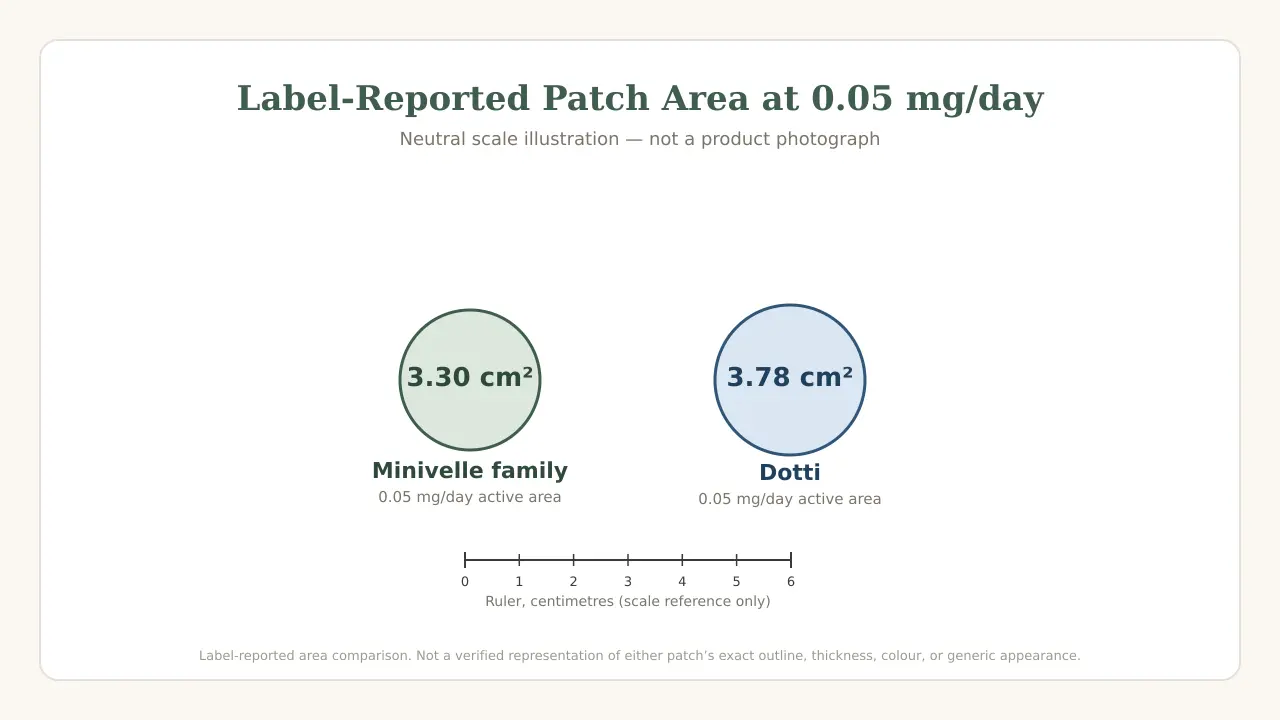
Minivelle vs Dotti is not a brand-versus-generic choice.Both are twice-weekly estradiol patches, but brand-name Minivelle is no longer being marketed; Noven now offers an FDA-approved authorized generic instead. Dotti is Amneal's separately approved generic of Vivelle-Dot. At matched strengths, the Minivelle-family patch has about 12.6% less active surface area than Dotti.
That's the short answer. Here's the part that catches people.
Your pharmacy's computer may still say “Minivelle.” A coupon site may still quote you a Minivelle price. Your doctor may still write it out of habit. None of that means a box of brand-name Minivelle exists on a shelf near you.
So the real question isn't which patch is better. It's this: which one can you actually get, and is the one they just handed you the same thing you had last month?
We read all three FDA labels to answer that — Minivelle, its authorized generic, and Dotti. Three of the things we found are not on any other page comparing these patches. One of them will change what you say at the pharmacy counter.
Some provider links below are affiliate links, and we may earn a commission at no extra cost to you. What appears on this page is decided under The HRT Index Verification Standard — never by payout. No provider on this page is presented as guaranteeing a specific manufacturer, NDC, or pharmacy stock.
Best for you / not for you
Dotti may be the more practical choice if:
Your prescribed strength is obtainable, your plan prefers it, or a matched quote for your exact strength, quantity, and pharmacy comes back lower. Dotti also carries four FDA-approved uses to the Minivelle family's two. That broader labeling does not mean Dotti works better for the two uses they share.
Ask about the Minivelle authorized generic if:
A smaller patch matters to you, you did well on Minivelle before and want the same formulation, or your skin has reacted to a different manufacturer's patch.
Neither belongs to you if:
- Your only symptoms are vaginal dryness, painful sex, or urinary discomfort. Compare local and systemic routes first → Systemic vs. local estrogen: which do you actually need?
Talk to a clinician before either one if:
You have undiagnosed abnormal genital bleeding, a history of breast cancer or estrogen-dependent cancer, active or past blood clots, active or past stroke or heart attack, hepatic impairment or disease, or a known clotting disorder. Both labels list these among the reasons not to use these patches. That list is not complete — read the full label with your prescriber.
Minivelle vs Dotti, side by side
| What you're deciding | Minivelle and its authorized generic | Dotti |
|---|---|---|
| Can you get it? | Brand Minivelle: no longer being marketed. Authorized generic: marketed through Grove Pharmaceuticals, distributed by Prasco | Marketed by Amneal |
| Approval pathway | New Drug Application, plus an authorized generic of it | Abbreviated New Drug Application — a generic of Vivelle-Dot |
| Shown bioequivalent to | Vivelle | The original estradiol transdermal system formulation |
| FDA-approved uses | 2 | 4 |
| Labeled active surface area | About 12.6% less at matched strengths | Larger |
| Total estradiol loaded in the system | About 31% more at matched strengths — this is not a higher dose or greater potency | Less |
| Coupon price, 0.05 mg/day, 8 patches | $57.44 on a Minivelle-labeled listing | $51.57 |
| Boxed warning on the current label | Yes | Yes |
| Can a pharmacist swap one for the other automatically? | Not established between these two products. Check your prescription and state rules. | |
| Evidence that one works better | No direct comparative trial appears in either label. | |
Prices are coupon-site estimates from SingleCare, captured July 10, 2026. They are not guaranteed pharmacy quotes, and a Minivelle-labeled listing does not prove a pharmacy can dispense brand-name Minivelle. More on that below.
Before we go further
The HRT Index is the independent decision resource for online menopause and HRT care — comparing telehealth providers on clinical legitimacy, care quality, medication fit, price transparency, and access, with every claim verified and dated, so women can choose the path that fits their situation before their first consult.
The right online HRT provider isn't the same for every woman — it depends on your symptoms, what you have tried so far, your age, your state and your health history. Some situations belong with an in-person clinician first. Because a general answer can't resolve those for you, use The HRT Index's Find My HRT Path toolto match your situation to the right provider — and to flag when online care isn't the right starting point — before your first consult.
First, the thing that weakens our own page
We're going to tell you what we found before we tell you why it matters.
Neither of these patches was studied against the other.Minivelle's label says it plainly: “There have been no efficacy and safety trials conducted with MINIVELLE.” It was approved by showing its blood levels matched an older patch, Vivelle. Dotti's label says the same thing about Dotti — “There were no clinical trials conducted with DOTTI” — matched instead to the original Vivelle-Dot formulation.
No direct comparison between the two appears in either label. Not for hot flashes. Not for stickiness. Not for skin reactions.
So when you find a page claiming one of these patches has an “80–90% success rate,” or a higher clot risk than the other, check whether it cites a study. Those claims do not appear in either FDA label. They read like a comparison, but there is nothing behind them.
Here is why that admission helps you.
Because there is no clinical winner, the differences that are documented become the only ones worth acting on. And they are real, specific, and printed in three FDA labels almost nobody opens. How big the patch is. How much hormone it holds. What it is approved to treat. Where the label says to put it. Whether your pharmacist can legally swap it.
Those are things you can use standing at a counter. Everything else is noise.
Let's go.
Is Minivelle discontinued?
Noven Pharmaceuticals states that brand-name Minivelle is “no longer being marketed”and directs patients to an FDA-approved authorized generic. That product is sold as Estradiol Transdermal System, marketed by Grove Pharmaceuticals — Noven's authorized generic division — and distributed through Prasco. It carries the same five strengths and the same labeled active surface areas as Minivelle, under its own NDC numbers.
The source is Noven's own website. Minivelle no longer appears among its marketed products. It now sits under a heading for authorized generics, with a note that the brand is no longer being marketed and an FDA-approved authorized generic version is available.
“No longer marketed” is not “recalled”
This is the part that frightens people, so let's settle it.
A company deciding to stop selling a brand name and a drug being pulled for a safety problem are different events. Noven has published no safety reason for the change. The medicine is still made by Noven, in the same five strengths, with the same labeled patch sizes.
What changed is the name on the box.
What an authorized generic actually is
An authorized generic is a drug marketed under the brand holder's own approved application, without the brand name on it. Noven launched its authorized generic to Minivelle in November 2018. It is called Estradiol Transdermal System, and FDA lists its marketing category as “NDA Authorized Generic” — meaning it rides on Minivelle's original approval, not on a separate generic application.
Put the two labels side by side and they line up:
- Same five strengths: 0.025, 0.0375, 0.05, 0.075, and 0.1 mg per day
- Same labeled active surface areas: 1.65, 2.48, 3.30, 4.95, and 6.6 cm²
- Same estradiol content: 0.41, 0.62, 0.83, 1.24, and 1.65 mg
- Same two approved uses
- Same application sites: lower abdomen below the navel, or buttocks. Never the breasts.
- Same backing: a polyolefin laminate
- Same adhesion data: 208 observations, about 98% at the top adhesion grade over 84 hours
Noven also notes something almost nobody mentions: the 0.025 mg strength is indicated only for preventing osteoporosis after menopause — not for hot flashes. If you're on 0.025 mg and still flashing, that is worth raising with your prescriber. The starting dose for hot flashes on this label is 0.0375 mg per day.
A different distributor, carton, and NDC can all exist even when the underlying drug product is the authorized generic. Which brings us to the thing you actually need.
Why coupon sites still show a Minivelle price
They do. We checked both major ones on July 10, 2026, and both still publish Minivelle listings with prices attached.
A live price listing is not proof of live inventory. Coupon databases carry legacy product entries and route requests through generic-substitution logic. A Minivelle-labeled coupon page does not establish that brand-name Minivelle is what a pharmacy will hand you.
So stop asking for the brand. Start asking for the number on the box.
↓ Find your patch in the identity table below. It takes about thirty seconds and it is the single most useful thing on this page.
How do you tell which estradiol patch you're actually holding?
The most precise identifier on an estradiol patch carton is its NDC — the National Drug Code. A full NDC has three parts: a labeler code, a product code, and a package code. Minivelle and Noven's authorized generic both carry labeler code 68968; Dotti carries 65162. FDA notes that a labeler may be a manufacturer, repackager, or relabeler, so use the complete NDC together with the carton rather than the first block of digits alone.
Here is the trap. Your prescription says one thing. The pharmacy label says another. The box says a third. And when you ask “is this the same as what I had?”, the answer depends on who is standing at the counter.
We built this table by pulling the “How Supplied” section out of each product's FDA label. It is the only place we know of where all three sit together.
| Dose (mg/day) | Minivelle brand (Noven Therapeutics) | Estradiol Transdermal System (Noven authorized generic, via Grove/Prasco) | Dotti (Amneal) |
|---|---|---|---|
| 0.025 | 68968-6625-8 | 68968-3425-8 | 65162-989-08 |
| 0.0375 | 68968-6637-8 | 68968-3437-8 | 65162-992-08 |
| 0.05 | 68968-6650-8 | 68968-3450-8 | 65162-993-08 |
| 0.075 | 68968-6675-8 | 68968-3475-8 | 65162-995-08 |
| 0.1 | 68968-6610-8 | 68968-3410-8 | 65162-997-08 |
How to read it. The first block is the labeler code — the company that put the product on the market. The middle block identifies the product. The last block identifies the package. All three matter.
Why your NDC might not be in this table
Because the table covers three products, and there are more than three twice-weekly estradiol patches. Amneal also markets Lyllana, whose labeling states it is bioequivalent to Vivelle. Viatris, Sandoz, and Zydus market their own estradiol transdermal systems.
There is a second reason. FDA is explicit that a labeler “might be a manufacturer, re-packager or re-labeler,” and that a listing in the NDC Directory does not mean FDA has verified the labeler's information. A repackaged product can carry a labeler code you won't find above.
So don't stop at the first five digits. Read the whole code, keep the carton, and check it against DailyMed or the NDC Directory.
The one question to ask at the counter
“What's the full NDC on this box, and is it the same one I got last time?”
If it's different, you have a right to know before you pay. Not because a manufacturer change means a product is unsafe — a labeler or manufacturer change is not, by itself, evidence of anything wrong. But a different product may have a different labeled active area, a different backing, and a different adhesive against your skin twice a week for the next month. You're allowed to know which.
Write the NDC down. You'll need it twice more on this page — once for pricing, once for supply.
Is Dotti the generic for Minivelle?
No. Dotti is Amneal's generic of Vivelle-Dot, approved under an abbreviated new drug application. Noven's Estradiol Transdermal System is the authorized generic to Minivelle. Because Dotti and Minivelle were each shown bioequivalent to a different reference product, Dotti should not be described as Minivelle's direct equivalent.
This confusion is everywhere, and it is not the reader's fault. Even GoodRx's Minivelle comparison page tells readers the twice-weekly patch “is also available as a generic called Dotti” — inside an article about Minivelle.
Here is the family tree. It's simpler than it looks.
The Vivelle branch. Vivelle came first. Noven later made a smaller version, Minivelle, showed its blood levels matched Vivelle, and got it approved. Its authorized generic is Noven's Estradiol Transdermal System.
The Vivelle-Dot branch. Vivelle-Dot was Noven's other smaller version of Vivelle. Its generics include Amneal's Dotti.
Minivelle and Dotti are cousins. Not twins. Both descend from Vivelle, and neither was ever compared with the other.
What “bioequivalent” actually proves
Bioequivalence is the test a generic passes to show it delivers the drug into the bloodstream at a comparable rate and extent — compared to one specific named product.
Minivelle passed that test against Vivelle. Dotti passed it against the original Vivelle-Dot formulation.
Passing against different comparators is not the same as passing against each other. Nothing in either label establishes that relationship.
What that means for equivalence codes
FDA publishes therapeutic equivalence ratings in a reference called the Orange Book. When more than one reference product exists under the same drug and dosage-form heading, FDA distinguishes them with numbered codes. Products are rated equivalent to the reference drug they were tested against — not automatically to each other.
That has a practical consequence. Routine generic substitution relies on the replacement being therapeutically equivalent to the exact product prescribed. Whether a pharmacy may change your product also depends on how the prescription was written, your state's substitution law, your plan's rules, and pharmacy policy. The Orange Book is a guide for product selection. It is not a statement of every state's law.
Which means: if the box changed, ask how the change was authorized. We'll give you the exact words further down.
Not sure whether online care is even the right starting point for you?
That depends on your symptoms, what you have tried, your age, health history, and state — and no comparison table can resolve those.
Get your personalized HRT action plan with Find My HRT Path →Which patch is smaller at each dose?
The Minivelle-family system has a smaller labeled active surface area at every strength. Minivelle and its authorized generic range from 1.65 to 6.6 cm² across the five doses; Dotti ranges from 1.89 to 7.55 cm². The difference is consistent — between 12.37% and 12.70%, averaging 12.58%. A smaller patch has not been shown to work better.
Women ask about size for reasons that have nothing to do with vanity. Less patch means less adhesive on your skin, fewer edges to catch on a waistband, and more places to rotate through in a week.
Here is every dose. The percentages are ours, calculated from the labeled areas.
| Labeled delivery rate | Minivelle family | Dotti | Minivelle family is smaller by |
|---|---|---|---|
| 0.025 mg/day | 1.65 cm² | 1.89 cm² | 12.70% |
| 0.0375 mg/day | 2.48 cm² | 2.83 cm² | 12.37% |
| 0.05 mg/day | 3.30 cm² | 3.78 cm² | 12.70% |
| 0.075 mg/day | 4.95 cm² | 5.66 cm² | 12.54% |
| 0.1 mg/day | 6.60 cm² | 7.55 cm² | 12.58% |
| Average across all five strengths | 12.58% | ||
One honest limit: active surface area is the area the label specifies. It is not the outer dimension of the patch, and it does not tell you the shape.
And it cannot tell you which patch will stay on your skin. Size is not adhesion. We'll get there, and the answer is less satisfying than you'd like.
Why do Minivelle and Dotti contain different amounts of estradiol at the same dose?
Total estradiol loaded into a transdermal system is not the dose you receive. At 0.1 mg/day, the Minivelle-family patch contains 1.65 mg of estradiol and Dotti contains 1.253 mg — yet both are labeled to deliver 0.1 mg per day. The difference reflects system design and drug-loading density, not strength or potency.
This trips up almost everyone. You flip the box over, see a bigger number, and assume you're getting more hormone.
You aren't.
Two different numbers live on that carton.
- The labeled nominal delivery rate. This is the dose strength used for prescribing — the number your doctor wrote. It is not a promise that every person absorbs exactly that amount on every wear day.
- The total estradiol content. This is a manufacturing spec. Neither patch is a liquid reservoir. In both, estradiol is dispersed throughout a multipolymeric adhesive layer, and the system releases it continuously through the skin across three to four days.
| Labeled delivery rate | Estradiol in a Minivelle-family patch | Estradiol in a Dotti patch |
|---|---|---|
| 0.025 mg/day | 0.41 mg | 0.314 mg |
| 0.0375 mg/day | 0.62 mg | 0.470 mg |
| 0.05 mg/day | 0.83 mg | 0.627 mg |
| 0.075 mg/day | 1.24 mg | 0.940 mg |
| 0.1 mg/day | 1.65 mg | 1.253 mg |
| Estradiol per cm² of active area | ≈ 0.25 mg/cm² | ≈ 0.166 mg/cm² |
So the Minivelle-family system packs roughly 1.5 times more estradiol into every square centimeter, and delivers the same labeled daily dose from an active area about 12.6% smaller. That is the design trade: denser drug, less skin.
This is a formulation number, not a potency ranking. It does not mean the Minivelle patch is stronger, works better, or puts more hormone into you. Every one of these labels says the same thing: a serum estrogen level doesn't predict how any individual woman will respond, and comparing exposure across different estrogen products to guess at safety or effectiveness for an individual may not be valid.
The only number that governs your treatment is the mg/day on your prescription.
One thing this does change
Because a patch holds more hormone than it delivers, a used patch is not an empty patch. All three labels say so directly: “Used transdermal systems still contain active hormone.”
Follow the labeled disposal instruction exactly. Fold the sticky sides together, put it in a sturdy child-proof container, put the container in the trash. Do not flush it. Keep used and unused systems away from children and pets.
That is not a footnote. It is on the label for a reason.
Do Minivelle and Dotti treat the same things?
No. Dotti is FDA-approved for four uses: moderate-to-severe vasomotor symptoms; moderate-to-severe vulvar and vaginal atrophy; hypoestrogenism due to hypogonadism, castration, or primary ovarian failure; and prevention of postmenopausal osteoporosis. Minivelle and its authorized generic are approved for two: vasomotor symptoms and prevention of postmenopausal osteoporosis.
This is the most consequential difference between the two, and we could not find another page stating it.
| Approved use | Minivelle family | Dotti |
|---|---|---|
| Moderate-to-severe vasomotor symptoms (hot flashes, night sweats) | Yes | Yes |
| Prevention of postmenopausal osteoporosis | Yes | Yes |
| Moderate-to-severe vulvar and vaginal atrophy | No | Yes |
| Hypoestrogenism from hypogonadism, castration, or primary ovarian failure | No | Yes |
Vasomotor symptoms is the clinical term for hot flashes and night sweats. Vulvar and vaginal atrophy means thinning, drying tissue that causes burning, itching, or pain with sex. Hypoestrogenism means the body isn't producing enough estrogen — often after both ovaries are removed, or from primary ovarian insufficiency.
Two rows of “yes” and two rows of “no” is not a verdict. Broader labeling does not establish that Dotti works better for the two uses both products share.
If your ovaries were removed
Surgical menopause and primary ovarian insufficiency sit inside Dotti's hypoestrogenism indication. The Minivelle family has no such indication.
A clinician may still prescribe an approved drug off-label when it's clinically appropriate. That is legal and ordinary. You should simply know it's happening, because coverage for an off-label use varies by plan and indication.
If bone protection is the reason
Both labels carry the same limitation: when prescribing solely to prevent postmenopausal osteoporosis, consider therapy only for women at significant risk, and for whom non-estrogen medications aren't considered appropriate. That is the label talking to your prescriber. Bring it up.
If your symptoms are only vaginal or urinary
Dotti's labeling directs prescribers to consider topical vaginal products when vulvar and vaginal atrophy is the only treatment goal. Minivelle doesn't carry that indication at all.
Low-dose vaginal estrogen products are designed to act locally, and generally produce lower systemic estrogen exposure than a patch — though the exact exposure depends on the product and dose.
We would rather lose you here than watch you buy the wrong thing. If dryness or painful sex is your only complaint, don't pick between these two patches.
Compare systemic and local estrogen before you choose →Which patch sticks better, Minivelle or Dotti?
The percentages circulating online cannot answer this. The Minivelle-family label reports that about 98% of 208 observations met an adhesion score of 0 — defined as at least 90% of the system adhered — over an 84-hour wear. Dotti's label reports that 85% of 471 observations adhered completely. Different endpoints, separate studies, different strength mixes. They cannot be ranked against each other.
This is where we give up the easy headline on purpose.
Search around and you'll find “98% vs 85%” presented as a thirteen-point win. Look at what each number counts.
| Minivelle family | Dotti | |
|---|---|---|
| What was measured | Adhesion score of 0 = at least 90% adhered | Adhered completely |
| Result | ~98% of observations | 85% of observations |
| Observations | 208 | 471 |
| Source studies | Bioequivalence and dose-proportionality studies | Three short-term clinical trials |
| Which strength dominated | ~65% were the 0.1 mg — the largest system | ~80% were the 0.05 mg — a mid-size system |
| Detachments | One subject had a complete detachment | 3% detached and were reapplied or replaced |
Here's the problem in one sentence. “At least 90% adhered” is an easier bar to clear than “adhered completely.” A higher percentage against an easier standard, in a smaller dataset, dominated by a different patch size, cannot establish which product adheres better.
We can't rank them. Neither can anyone else.
What the labels do establish
The estradiol is identical: 17β-estradiol, the same molecule the ovaries produce. The adhesive ingredient families overlap almost entirely — acrylic adhesive, silicone adhesive, oleyl alcohol, povidone, dipropylene glycol.
The backing differs. The Minivelle family uses a polyolefin laminate backing. Dotti uses polyester and ethylene vinyl acetate copolymer film.
The labels tell you the backings are different. They do not tell you why one patch behaves differently on your skin. Nobody has studied that.
What women report
These are individual, unverified consumer reviews from public pharmacy review pages. They cannot establish safety, effectiveness, or cause, and typicality is unknown. We include them because these complaints are common, and because the label adhesion data — which does exist — was never designed to compare these two products.
“The Minivelle does not stick as well.”
— Anonymous patient review, Drugs.com (Minivelle review page)
“After 2 days or less, they fall off.”
— Anonymous patient review, Drugs.com (general estradiol patch review page)
A third describes being switched off Minivelle to another manufacturer's patch and developing persistent red, painful skin at the application sites.
These anecdotes show the kinds of problems women describe after a switch. They cannot tell you whether the cause was the adhesive, the backing, the application technique, the dose, the product identity, or something else entirely.
Application, straight from the labels
- Clean, dry skin. No lotion, oil, or powder.
- Minivelle family: lower abdomen below the navel, or buttocks.
- Dotti: the trunk of the body, including abdomen or buttocks.
- Never the breasts. Never damaged, oily, or irritated skin.
- Avoid the waistline — tight clothing rubs systems off.
- Press firmly with your palm for about 10 seconds, and run a finger around the edges.
- Rotate sites, with at least one week before reusing the same spot.
- If a system falls off, reapply it or apply a new one at another location, and keep your original schedule.
- Neither label provides instructions or validated dosing for cutting these systems. Do not cut or alter a patch to change your dose unless your prescriber or pharmacist gives you product-specific instructions.
How do I report a patch that won't stick or looks defective?
This is a real path, and almost nobody tells you it exists.
- Keep everything. The carton, the pouch, the lot number, the expiration date, and the full NDC.
- Tell your pharmacist. They can document it and check whether other patients have reported the same lot.
- Call the company. Noven: 1-800-455-8070. Amneal: 1-877-835-5472. Both numbers are printed in the labels.
- Report it to FDA. MedWatch takes reports of suspected adverse events and product quality problems at 1-800-FDA-1088.
A patch that won't adhere isn't just an annoyance. It's a quality signal, and reporting it is how those get caught.
Why does my patch still have a black box warning?
Because the labeling hasn't changed. On February 12, 2026, FDA approved labeling changes for a first batch of six menopausal hormone therapy products, removing boxed-warning risk statements related to cardiovascular disease, breast cancer, and probable dementia. FDA's current list of updated products does not include Minivelle, its authorized generic, or Dotti. As of July 10, 2026, all three labels still carry the boxed warning.
This is the question we see most, and most answers online get it wrong.
Here is the sequence.
November 2025. FDA and HHS announced they were initiating removal of boxed-warning language about cardiovascular disease, breast cancer, and probable dementia from menopausal hormone therapy products. An announcement of intent — not a label change. FDA also stated it was not seeking to remove the endometrial-cancer boxed warning from systemic estrogen-alone products.
February 12, 2026. FDA approved the first batch of actual label changes. Six products. Twenty-nine companies had submitted proposed labeling changes.
Here is where these three patches sit.
| Product | On FDA's updated-labeling list? | Current label revision | Boxed warning today |
|---|---|---|---|
| Prometrium (progesterone) | Yes | 2026 | FDA removed risk statements on cardiovascular disease, breast cancer, and probable dementia |
| Divigel (estradiol gel) | Yes | 2026 | Same three risk statements removed |
| Cenestin | Yes | 2026 | Same three risk statements removed |
| Enjuvia | Yes | 2026 | Same three risk statements removed |
| Estring (vaginal ring) | Yes | 2026 | Boxed warning removed |
| Bijuva | Yes | 2026 | Same three risk statements removed |
| Minivelle | No | 2/2024 | Full boxed warning present |
| Estradiol Transdermal System (Noven authorized generic) | No | 4/2024 | Full boxed warning present |
| Dotti | No | 5/2024 | Full boxed warning present |
So the warning on your box matches the current approved labeling. Seeing it does not mean you were handed old stock, and it does not mean something was hidden from you.
What this doesn't mean
It doesn't mean these patches are riskier than the six products with updated labels. FDA's current page simply doesn't list them. Nothing about the medicine changed on February 12.
It also doesn't mean the risks vanished. The endometrial-cancer warning was never proposed for removal from systemic estrogen-alone products — and both of these patches are systemic estrogen-alone products. If you have a uterus, both labels tell your prescriber to consider adding a progestogen (a progesterone-like hormone) to reduce the risk to your uterine lining. That guidance is unchanged.
The Menopause Society put it carefully when the news broke: systemic estrogen still carries potential risks in certain individuals, and those should be reviewed in detail before starting therapy.
A connection nobody makes
If you take Prometrium alongside your estradiol patch, the current approved labeling for your progesterone may differ from the current approved labeling for your patch. Two products, two different labeling states. Both correct.
→ What actually changed on the Prometrium label · Progestin vs. progesterone
Which costs less, Minivelle or Dotti?
Coupon headlines overstate the gap. In a matched July 10, 2026 snapshot for 0.05 mg/day, eight patches, one coupon source listed Dotti at $51.57 and a Minivelle-labeled listing at $57.44 — a difference of $5.87. These are coupon-site estimates, not guaranteed pharmacy quotes, and a Minivelle-labeled listing does not prove a pharmacy can dispense brand-name Minivelle.
We nearly published a much more dramatic number. Then we noticed the comparison wasn't matched.
The eye-catching figures online — Dotti around $38, Minivelle around $107 — come from different strengths. The Dotti quote is for a 0.05 mg carton. The Minivelle quote is for a 0.1 mg carton. Comparing them is comparing two different prescriptions.
| Source | Dotti | Minivelle-labeled listing |
|---|---|---|
| SingleCare — coupon price | $51.57 | $57.44 |
| SingleCare — stated average retail | $190.93 | $204.70 |
| GoodRx — coupon price | from $38.07 | No strength-matched figure published |
| GoodRx — stated average retail | $123.58 | No strength-matched figure published |
| Noven authorized generic | No published cash price found. Ask your pharmacy to quote NDC 68968-34xx-8 directly. | |
Two things in that table should stop you
First: matched properly, the gap is about six dollars — not sixty. That changes the decision entirely. If you were about to fight your prescriber over a patch to save money, the money may not be there.
Second: look at the retail estimates for the identical Dotti carton. GoodRx says roughly $123.58. SingleCare says roughly $190.93. A $67 spread, same drug, same 8-patch box, same day.
We're not accusing anyone. Coupon networks draw on different pharmacy data. But it should permanently retire the idea that there is such a thing as “the” cash price for this medication.
The three prices to compare
- What your insurance charges you. Ask the pharmacy to run it.
- The pharmacy's cash price for the exact NDC it has in stock.
- The coupon price for that same NDC and quantity.
Don't assume a coupon stacks on top of insurance. Usually it doesn't. And ask your plan whether it covers the exact product the pharmacy intends to dispense.
Notice the pattern: every one of those questions starts with the NDC. That's why identifying your patch came first.
Build your own quote sheet before you call. Write down: strength, quantity, the full NDC, your ZIP, your pharmacy. Then get all three prices for that one product. It takes one phone call, and it's the only price that's actually yours.
Can you actually get either patch right now?
Two authorities disagree, and both may be right. FDA stated in June 2026 that estradiol patches were not in shortage and that manufacturers reported operating at full capacity. The American Society of Health-System Pharmacists maintains a drug shortage bulletin for estradiol transdermal system listing products from several manufacturers on back order or allocation. FDA's formal shortage list and ASHP's bulletin use different reporting systems.
We're going to show you the disagreement rather than pretend it isn't there.
What FDA says. CNBC reported on June 26, 2026 that an FDA spokesperson said estradiol patches were not then in shortage, that all six manufacturers reported producing at full capacity while working to keep up with increased demand, and that the agency continues to monitor supply and offer manufacturers assistance. No estrogen patch appears on FDA's formal drug shortage list.
What pharmacists say. ASHP's estradiol transdermal system shortage bulletin — compiled by the University of Utah Drug Information Service from provider reports — lists products from multiple manufacturers, including Amneal and Noven, on back order or allocation, with availability varying by strength. Check the bulletin directly for the current status of your dose.
Why both can be true. A shortage has a formal FDA definition. Demand outrunning supply doesn't automatically meet it. A drug-shortage expert at ASHP explained to CNBC that the agency struggles to quantify demand because it can't easily count prescriptions that go unfilled, or patients whose prescribers quietly switched them to something else. Prescriptions for estrogen patches rose 162% over two years, according to HealthVerity data reported by CNBC. FDA also noted that making transdermal patches involves more complex manufacturing than treatments like pills.
None of which helps you when the pharmacist says “we can't get it.”
What to do this week, in order
- Ask what the pharmacy can actually order — not what's on the shelf today, but what its wholesaler will ship. Get the full NDC.
- Look that NDC up in the identity table above. Now you know what you'd be getting.
- Ask your plan whether it covers that exact product.
- Send both options to your prescriber and let them decide.
- Ask your pharmacy and insurer for your earliest permitted refill date. Some plans may allow an early refill or an override during a documented supply disruption. It costs nothing to ask.
What not to do
- Don't change your own dose.
- Don't cut a patch to stretch supply. Neither label provides validated instructions for it.
- Don't stretch the wear time. Both labels state that interrupting treatment may increase the likelihood of breakthrough bleeding, spotting, and the return of your symptoms.
- Don't assume a once-weekly patch drops into a twice-weekly schedule. → Once-weekly vs. twice-weekly estradiol patches
If the bottleneck is the prescription, not the patch
Sometimes the pharmacy can order something — just not what's written. Rewriting a prescription for an available, equivalent-strength FDA-approved product takes a clinician, not a phone tree.
If you don't have a prescriber who will do that, that's the actual problem. We've listed two routes at the end of this page. Read the rest first.
Can a pharmacist swap Dotti for Minivelle?
Not as a routine generic substitution. Automatic substitution depends on the replacement being therapeutically equivalent to the exact product prescribed, and Dotti's reference product is Vivelle-Dot, not Minivelle. Whether a pharmacy may change your product also depends on how the prescription was written, state substitution law, plan rules, and pharmacy policy.
There are three ways you end up with a different box than you expected. Two are fine.
One: your prescriber wrote it to allow substitution, or wrote generically. Fine.
Two: the pharmacist contacted your prescriber, explained the supply problem, and got authorization. Fine — and honestly, good pharmacy work.
Three: nobody told you. You're entitled to ask.
The five questions that settle it
- What exact product is on this box?
- Who is the labeler, and who manufactured it?
- What's the full NDC?
- Was this change permitted by my prescription, processed as an FDA-rated generic substitution, or authorized by my prescriber as a different product?
- Will you be able to get this same NDC on my next refill?
Question five is the one people forget. It's the one that saves you a month.
If you want a specific product
You can ask your prescriber to write for one. Understand the trade first. Naming a product can restrict substitution, which protects you from surprise switches — but during a supply crunch, it can also mean an unfilled prescription.
If you have a documented skin reaction to a particular manufacturer's system, say so. That's a clinical reason, and it changes the conversation.
Does one work better, or cause fewer side effects?
No direct comparative trial between Minivelle and Dotti appears in either product's FDA labeling. Each label states that no clinical trials were conducted with the marketed product itself; each was approved by demonstrating bioequivalence to an older reference patch. Both are systemic estradiol products carrying the same class warnings and contraindications.
Read that again, because it's remarkable and almost nobody says it out loud.
Minivelle's label reports there have been no efficacy and safety trials conducted with Minivelle. Its evidence comes from Vivelle's trials. Dotti's label says the same about Dotti. Its evidence comes from the original formulation's trials.
Both are legitimate, FDA-approved medicines. Neither current label reports efficacy and safety trials conducted with the marketed product itself. And no comparison between them appears in either one.
What FDA approval does tell you
- The product went through an applicable approval pathway.
- Its manufacturing quality and labeling met that pathway's requirements.
- It delivered estradiol at levels comparable to its reference product.
What it doesn't tell you
- That one of these two is better for you.
- That a smaller system controls symptoms better.
- That more hormone loaded in the patch means more hormone in you.
- That a stranger's five-star review predicts your experience.
Why women genuinely feel different after a switch
Several explanations are plausible. We're not going to pick one from a review thread — that would be exactly the mistake this whole page has been warning you about.
- The systems differ physically, and skin differs between people.
- A system that partially lifts may not adhere as intended, though you cannot judge the delivery change from appearance alone.
- A different application site, or a change in technique.
- Confusion about dose or schedule during the switch.
- Ordinary symptom variability. Menopause is not a straight line.
- Something else in your life changed at the same time.
- Expectation. It's real, and it isn't a character flaw.
If your symptoms return after a manufacturer change, tell your prescriber. That is not something to diagnose from an internet page, including this one.
Shared risks worth knowing
Both patches deliver systemic estrogen. Both labels tell prescribers to use the lowest effective dose for the shortest duration consistent with treatment goals and risks, and to reassess at three-to-six-month intervals.
This page compares two products. It cannot tell you whether systemic estrogen is right for you. That conversation belongs with a clinician who knows your history.
Where can you get an FDA-approved estradiol patch prescribed?
Both Dotti and Noven's authorized generic require a prescription. An online menopause clinician can evaluate whether an FDA-approved estradiol patch is appropriate and send a prescription to a pharmacy. No telehealth provider controls which manufacturer your local pharmacy stocks.
You've read this far, so let's be direct about what's left.
If you already have a prescriber, you don't need anything in this section. Message them the NDC of whatever your pharmacy can obtain. Close this tab. We mean it.
If you don't have one — or yours won't discuss hormone therapy, or you're eleven weeks out from a gynecology appointment — that's the actual bottleneck. Not the patch.
If you have insurance: Midi Health
Midi Health states that it is available in all 50 states and that its visits and prescriptions are insurance-covered. That's the right shape for this problem, because both patches on this page are FDA-approved products and the fix you usually need is a prescription written for a product your pharmacy can actually obtain.
Here is what Midi does not do. Midi cannot guarantee that your pharmacy will have Dotti, the Minivelle authorized generic, or any particular NDC. No telehealth company can. If what you want is a specific manufacturer's box delivered to your door, this is not that, and you should go find a dispensing model that fits. But because Midi prescribes FDA-approved hormone therapy into ordinary pharmacy channels, it can get an accurate prescription to the pharmacy that actually has the inventory — which is where this problem gets solved.
Coverage varies by insurer, plan, formulary, indication, and exact product. Verify your prescription benefit before you book.
Midi Health — insurance-covered visits, all 50 states
See how Midi works, what states it covers, and what a visit costs before you book.
See how Midi Health works →See how Midi Health works — states, insurance, and what a visit costs
If you're paying cash: Sesame
Sesame is a marketplace for self-pay clinician visits, with provider-specific pricing shown before you book. A clinician may prescribe estradiol when clinically appropriate and send it to the pharmacy you choose.
Same caveat, said plainly: the pharmacy, not the marketplace, determines which manufacturer you get.
Sesame — self-pay visits, provider pricing shown upfront
See what a Sesame menopause visit costs and how prescriptions are sent to your pharmacy.
See Sesame menopause visit pricing →See what a Sesame menopause visit costs and how prescriptions are sent
Both companies state their own prices, states, and insurance participation, and those change. Confirm them on the provider's own page before you book.
Who is not on this page, and why
Some telehealth companies build their menopause programs around compounded hormones — preparations mixed by a compounding pharmacy for an individual patient.
Compounded hormone preparations are not FDA-approved. FDA does not review them for safety, effectiveness, or manufacturing quality the way it reviews Minivelle, its authorized generic, or Dotti. They are a different category of product, and we will not present them as equivalent options on a page comparing two FDA-approved patches.
We hold affiliate relationships with companies that offer compounded hormones. None of them appear on this page. That decision costs us revenue, and we'd make it again.
How The HRT Index verified this page
This comparison follows The HRT Index Verification Standard: read every published price, separate FDA-approved from compounded, verify state availability and insurance, and re-check on a fixed schedule — top providers monthly, the full roster quarterly. We evaluate providers on five pillars, in this order: clinical legitimacy, care quality, medication fit, price transparency, and access.
We're an affiliate publisher. You should read us with that in mind. So we show our work.
| Claim | Source | Checked |
|---|---|---|
| Brand Minivelle no longer being marketed; authorized generic available | Noven Pharmaceuticals homepage | Jul 10, 2026 |
| Authorized generic marketed by Grove Pharmaceuticals, distributed through Prasco; launched Nov 2018; 0.025 mg indicated only for osteoporosis prevention | Noven, Estradiol Transdermal System product page | Jul 10, 2026 |
| Indications, active surface areas, estradiol content, application sites, adhesion data, backing materials, NDCs, disposal instructions | DailyMed prescribing information — Minivelle (rev. 2/2024), Estradiol Transdermal System (rev. 4/2024), Dotti (rev. 5/2024) | Jul 10, 2026 |
| Boxed warning present on all three current labels | DailyMed, Boxed Warning section of each | Jul 10, 2026 |
| Which six products carry updated prescribing information | FDA, Menopausal Hormone Therapies with Updated Prescribing Information | Jul 10, 2026 |
| First batch of label changes approved Feb 12, 2026; endometrial-cancer warning not proposed for removal | FDA press announcements, Feb 12, 2026 and Nov 10, 2025 | Jul 10, 2026 |
| NDC structure; a labeler may be a manufacturer, repackager, or relabeler | FDA, National Drug Code Directory | Jul 10, 2026 |
| Therapeutic equivalence is rated against a reference product | FDA, Orange Book Preface | Jul 10, 2026 |
| FDA position on shortage; 162% two-year prescription increase (HealthVerity); patch manufacturing complexity | CNBC, June 26, 2026 | Jul 10, 2026 |
| Multiple manufacturers' estradiol patches on back order or allocation | ASHP drug shortage bulletin, estradiol transdermal system | Check bulletin for current date |
| Cash prices, 0.05 mg/day, 8-patch carton | GoodRx and SingleCare product pages | Jul 10, 2026 |
What we calculated ourselves
- Footprint difference: (Dotti area − Minivelle-family area) ÷ Dotti area × 100, per strength.
- Drug-loading density: total estradiol ÷ labeled active surface area.
Formulas shown so you can check us.
What we could not establish
- Which patch works better for any individual. No direct comparative trial appears in either label.
- Which patch adheres better. The two label figures use different endpoints and cannot be ranked.
- Whether your NDC is a repackaged product. Check the carton against FDA's NDC Directory.
- What your local pharmacy has in stock, or what your plan will charge you.
- A published cash price for Noven's authorized generic.
- Any provider guarantee of a specific manufacturer or NDC.
What we didn't do
We didn't invent an author. We didn't claim clinical review that didn't happen. We didn't fabricate testimonials, star ratings, or a numeric score. We didn't put a compounded hormone program on a page about FDA-approved patches because it pays better.
If we ever do, we've stopped being useful to you.
Who is not on this page, and why
We have affiliate relationships with Winona and Inner Balance (Oestra). Neither appears as a recommendation here.
Both are compounded providers. Neither can supply Dotti or the Minivelle authorized generic. Under our FDA-Approved Override rule, compounded providers are never featured as recommendations on FDA-approved brand pages — regardless of what we're paid.
We tell you this because a page arguing about label precision has no business being vague about its own incentives.
Affiliate disclosure: The HRT Index may earn a commission when you book through links on this page. It doesn't change what we found in the labels, and it didn't change what we wrote.
The HRT Index evaluates providers on five pillars, in this order: clinical legitimacy, care quality, medication fit, price transparency, and access.
One last thing
You didn't come here to learn transdermal drug delivery. You came because someone handed you a box that didn't match the one you had, and nobody could tell you whether it mattered.
It matters a little. Not in the way you feared.
The hormone is the same. One patch is slightly smaller. The approved uses differ, and that's worth knowing. No direct comparative evidence identified in this review establishes that one works better than the other.
What you can control is knowing exactly what's in your hand, and asking one clear question at the counter.
That's the whole job. It takes about ninety seconds, and you can do it.
Still not sure which HRT program is right for you?
Take our free matching quiz. Find My HRT Path maps your symptoms, what you have tried, your age, your health history, and your state to a specific starting point — and it will tell you honestly when online care isn't the right first step.
Get your personalized HRT action plan →Frequently asked questions
- Is Dotti the same as Minivelle?
- No. Both are twice-weekly estradiol patches at the same five delivery rates, but they are different products with different FDA applications, different reference products, different labeled active surface areas, and different approved uses.
- Is Dotti the generic for Minivelle?
- No. Dotti is Amneal's generic of Vivelle-Dot. Noven's Estradiol Transdermal System is the authorized generic to Minivelle.
- Is Minivelle discontinued?
- Noven states that brand-name Minivelle is no longer being marketed, and that an FDA-approved authorized generic is available. That is a decision about a brand name, not a safety recall.
- Which patch is smaller?
- The Minivelle family, at every strength — between 12.37% and 12.70% less labeled active surface area than Dotti, averaging 12.58%.
- Why does the Minivelle patch contain more estradiol at the same dose?
- Different system design. Total estradiol loaded into the patch is not your dose. Both deliver the same labeled milligrams per day.
- Which costs less?
- In a matched 0.05 mg, 8-patch snapshot on July 10, 2026, Dotti was $51.57 and a Minivelle-labeled listing was $57.44 on the same coupon site. Coupon prices vary by source, pharmacy, and ZIP, and change frequently.
- Which patch sticks better?
- Unknown. The two labels measured adhesion differently, in separate studies, with different strength mixes. Those percentages cannot be ranked against each other.
- Do Minivelle and Dotti have the same black box warning?
- As of July 10, 2026, Minivelle, its authorized generic, and Dotti all carry the boxed warning in their current approved labeling. None appears on FDA's list of updated products.
- Can I switch from one to the other at the same dose?
- The same five strengths exist for both. Don't switch on your own. Your prescriber and pharmacist should confirm the product, the schedule, and what your prescription permits.
- Can a pharmacist substitute Dotti for a Minivelle prescription automatically?
- That is not established between these two products, because each was tested against a different reference drug. Substitution also depends on your prescription, state law, and plan rules. Ask how the change was authorized.
- Can I cut a patch in half to get a smaller dose?
- Neither label provides instructions or validated dosing for cutting these systems. Don't do it unless your prescriber or pharmacist gives you product-specific instructions.
- What do I do if my patch falls off?
- Both labels say to reapply the same system, or apply a new one at another approved location, and continue your original schedule.
- Do I need progesterone with either one?
- If you have a uterus, both labels tell your prescriber to consider adding a progestogen to reduce the risk to your uterine lining. It's an individualized decision.
- Is one better for vaginal dryness?
- Dotti carries an approved indication for vulvar and vaginal atrophy; the Minivelle family does not. But if vaginal symptoms are your only symptoms, Dotti's own labeling directs prescribers to consider topical vaginal products first.
- Are either of these compounded?
- No. Both are FDA-approved prescription products. Compounded estradiol is not FDA-approved and is not equivalent to either patch.
- Is the estradiol in these patches bioidentical?
- Both contain 17β-estradiol, structurally identical to the estradiol the ovaries produce. “Bioidentical” is a marketing word, not a regulatory category. These two products are FDA-approved. Compounded preparations marketed as “bioidentical” are not.
Sources
All accessed July 10, 2026.
- Noven Pharmaceuticals, Inc. Homepage and Estradiol Transdermal System product page. noven.com
- MINIVELLE (estradiol transdermal system) prescribing information. Noven Therapeutics, LLC. Revised 2/2024. DailyMed.
- ESTRADIOL TRANSDERMAL SYSTEM (NDA authorized generic) prescribing information. Noven Therapeutics, LLC. Revised 4/2024. DailyMed.
- DOTTI (estradiol transdermal system) prescribing information. Amneal Pharmaceuticals LLC. Revised 5/2024. DailyMed.
- U.S. Food and Drug Administration. Menopausal Hormone Therapies with Updated Prescribing Information.
- U.S. Food and Drug Administration. “FDA Approves Labeling Changes to Menopausal Hormone Therapy Products.” February 12, 2026.
- U.S. Department of Health and Human Services / FDA. “HHS Advances Women's Health, Removes Misleading FDA Warnings on Hormone Replacement Therapy.” November 10, 2025.
- U.S. Food and Drug Administration. National Drug Code Directory.
- U.S. Food and Drug Administration. Orange Book Preface.
- American Society of Health-System Pharmacists. Drug Shortage Bulletin: Estradiol Transdermal System. Drug Information Service, University of Utah.
- CNBC. “Estrogen patches are in short supply as women seek menopause support.” June 26, 2026.
- The Menopause Society. Comments on the FDA announcement on hormone therapy. November 2025.
- GoodRx and SingleCare product pages for Dotti and Minivelle. Accessed July 10, 2026.
- Midi Health. Pricing & Insurance; HRT; How Midi Works. joinmidi.com. Retrieved July 2026.
- Sesame. Menopause Treatment; Telehealth Visit; Medication. sesamecare.com. Retrieved July 2026.
Last updated: July 10, 2026. Researched and written by The HRT Index editorial team. Prices, supply, and FDA labeling change. We re-check pricing, supply, and label status monthly, and providers quarterly. If you find an error, email partners@thehrtindex.com. We date every fix.
The HRT Index is reader-supported. We may earn a commission from some provider links on this page. Commissions never change whether we label a product FDA-approved or compounded, and they never change our verdict. Find My HRT Path collects sensitive health information and is governed by our consumer health data and privacy policy. See our full affiliate disclosure.