
The refill question is usually settled if: your pharmacist has confirmed the new product and directions match what your prescriber authorized. That does not rule out a symptom or skin problem that needs review.
Pause and ask first if: your prescription says "dispense as written," you use estrogen for low estrogen before menopause, or your skin reacted badly to a past patch.
The HRT Index is the independent decision resource for online menopause and HRT care — comparing telehealth providers on clinical legitimacy, care quality, medication fit, price transparency, and access, with every claim verified and dated, so women can choose the path that fits their situation before their first consult.
What we actually verified · Last verified October 2026
We read, on October 14, 2026: the Dotti and Lyllana labels retrieved from DailyMed (both revised May 2024); FDA's application and therapeutic-equivalence records for each (ANDA 211293 and ANDA 211396); FDA's Orange Book Preface; FDA's September 3, 2026 update on estradiol patch availability; FDA's February 2026 list of hormone therapies with updated labels; Noven's product-status pages; Drugs.com cash price guides for both patches; Gala's linked HRT offer and subscription terms; and the public HRT pages of Gala Health and Midi Health.
We confirmed: the same labeler/distributor, hormone, five strengths and twice-weekly schedule; the same listed patch sizes and inactive ingredients; different FDA reference products and equivalence codes (AB1 and AB3); different labeled uses; and matching published cash/discount starting prices in the guides on the day we checked.
We did not: wear, buy or test either patch, sign up for any service, or talk to a clinician. This is a documentation review, not a patient test.
We could not confirm: your pharmacy's stock today, your state's substitution rules, your insurance price, or which patch brand any online provider ships.
The HRT Index may earn a commission from some provider links on this page. Affiliate relationships can affect featured placement, not the facts in our tables or whether a treatment fits you. Read our affiliate disclosure.
Jump to: Compare the patches · What to say to your pharmacy · Need a new prescriber?
Dotti vs Lyllana at a glance: the label-by-label comparison
Dotti and Lyllana match on many listed details: the hormone, the five daily strengths, the twice-weekly change schedule, the listed patch sizes, the glue ingredients and, on the day we checked, the price-guide starting prices. Three documented differences are which original patch FDA compared each one to, which uses each label lists, and the sticking studies printed in each label.
Here are the label, FDA-record and price-guide checks side by side.
Table A — Dotti vs Lyllana, checked October 14, 2026
| What we compared | Dotti | Lyllana | Source |
|---|---|---|---|
| Hormone | Estradiol | Estradiol | Dotti label; Lyllana label |
| How it enters your body | Through the skin (transdermal), whole-body (systemic) | Through the skin (transdermal), whole-body (systemic) | Labels |
| Labeler/distributor on the label | Amneal Pharmaceuticals LLC | Amneal Pharmaceuticals LLC | Labels |
| FDA status | FDA-approved generic (ANDA 211293), approved in 2019 | FDA-approved generic (ANDA 211396), approved Sept 28, 2020 | FDA application records |
| Compounded? | No | No | FDA application records |
| Original patch FDA compared it to | Vivelle-Dot | Minivelle | FDA equivalence records |
| FDA equivalence code | AB1 | AB3 | FDA equivalence records |
| Strengths (mg per day) | 0.025, 0.0375, 0.05, 0.075, 0.1 | 0.025, 0.0375, 0.05, 0.075, 0.1 | Labels |
| How often you change it | Twice a week (every 3 to 4 days) | Twice a week (every 3 to 4 days) | Labels |
| Listed patch size, lowest to highest dose (cm²) | 1.89 / 2.83 / 3.78 / 5.66 / 7.55 | 1.89 / 2.83 / 3.78 / 5.66 / 7.55¹ | Labels, Section 11 |
| Inactive ingredients | Acrylic and silicone adhesive, oleyl alcohol, povidone, dipropylene glycol; polyester/ethylene vinyl acetate backing; polyester liner | Same list | Labels, Section 11 |
| Patch design | Matrix (the estradiol is mixed into the glue layer) | Matrix | Labels, Section 11 |
| Uses listed on the label | Moderate to severe hot flashes/night sweats from menopause; moderate to severe symptoms of vulvar and vaginal atrophy from menopause; low estrogen from hypogonadism, ovary removal or primary ovarian failure; preventing postmenopausal osteoporosis | Moderate to severe hot flashes/night sweats from menopause; preventing postmenopausal osteoporosis | Labels, Section 1 |
| Usual starting dose on the label for hot flashes | 0.0375 mg/day | 0.0375 mg/day | Labels, Section 2 |
| Where the label says to apply it | Lower belly or buttocks; never the breasts | Lower belly (below the belly button) or buttocks; never the breasts | Labels |
| Box size compared here | 8 patches (4 weeks of continuous twice-weekly use, one patch at a time) | 8 patches (same assumption) | Labels, Section 16; supply arithmetic |
| Contains progesterone? | No | No | Labels |
| Current pharmacy stock | Ask about the exact strength and carton; not verified by us | Ask about the exact strength and carton; not verified by us | FDA availability update; your dispensing pharmacy |
| Published cash/discount starting price for 8 patches (Drugs.com, Oct 14, 2026) | From $58.60 (0.025 mg/day); from $63.81 (all other strengths) | Same listed starting prices | Dotti prices; Lyllana prices |
| Label version we read | Revised May 2024 | Revised May 2024 | DailyMed |
| A winner for comfort, sticking or symptom relief? | Not established | Not established | No head-to-head study found |
¹ One sentence in Lyllana's sticking section mentions a 6.6 cm² patch for the 0.1 mg strength. The label's product description lists 7.55 cm². We used the product description.
What this table tells you, in plain words: if your box changed from one name to the other and the strength stayed the same, the hormone, labeled daily delivery rate and patch-change frequency match. That does not guarantee identical absorption or skin comfort. The FDA substitution question still needs a check — which we explain next.
Is Lyllana the same as Dotti?
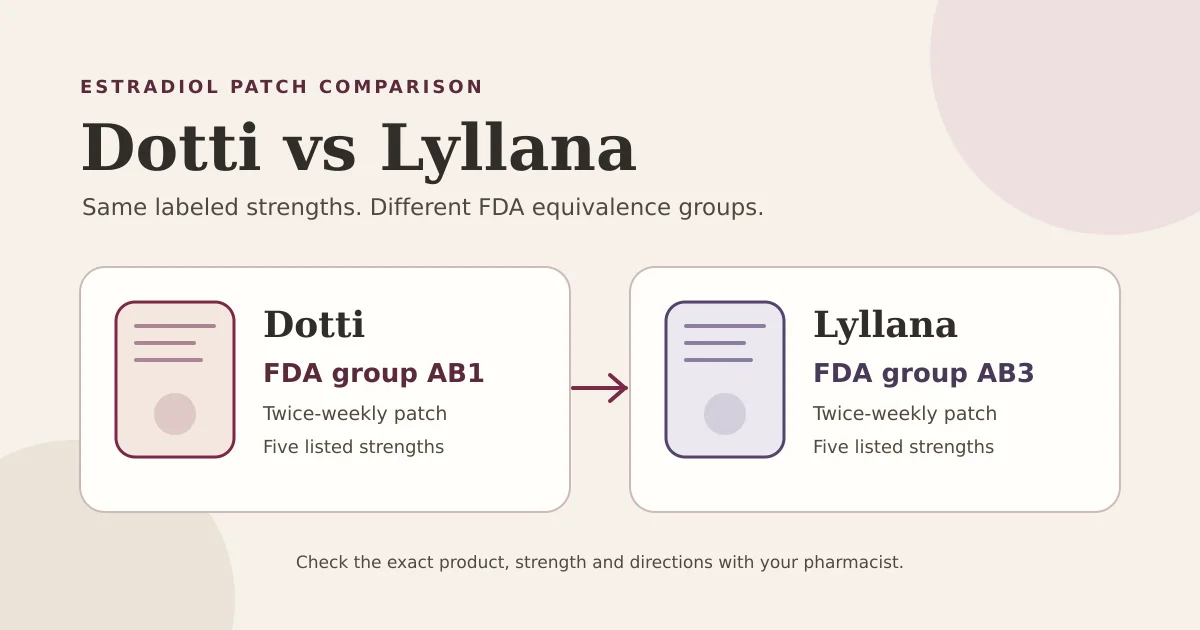
Lyllana and Dotti contain the same hormone, estradiol, at the same five daily doses, and both labels list the same patch sizes and inactive ingredients. Both labels name Amneal as the distributor. They are not officially "the same," though, because FDA judged each one against a different original patch, so FDA does not list them as substitutes for each other.
Let's define a few words once, so the rest of this page is easy.
Estradiol is the main estrogen your ovaries made before menopause. Both patches deliver it through your skin into your bloodstream. That's called transdermal, which means "through the skin."
Mg/day is the patch's labeled daily delivery rate. A 0.05 mg/day patch is designed for a nominal delivery of 0.05 milligrams a day; it does not measure exactly how much any one person absorbs. (We'll show how that number differs from the total amount sitting inside the patch in a moment.)
A generic is a copy of an original brand-name medicine that FDA approves through a shorter application, called an ANDA (Abbreviated New Drug Application). For these patches, the company has to meet FDA's generic-drug requirements, including evidence of bioequivalence to the reference product. Dotti and Lyllana both went through that process. They have their own names, but in FDA's records, both are generics.
So what are the originals?
- Dotti was compared to Vivelle-Dot, a twice-weekly patch now held by Sandoz.
- Lyllana sits in the group with Minivelle, a smaller twice-weekly patch from Noven. Noven says brand-name Minivelle is no longer being marketed and directs readers to its authorized generic. The manufacturer page does not give a discontinuation month.
One odd detail: Lyllana's label says it is bioequivalent to Vivelle, an older Noven patch. That line describes the study data behind the label. For pharmacy purposes, though, what counts is where FDA lists the product, and FDA lists Lyllana in the Minivelle group.
What's truly the same and what isn't
The same on the labels:
- Hormone (estradiol) and route (skin)
- Five strengths, from 0.025 to 0.1 mg/day
- Twice-weekly schedule
- Listed patch sizes and amount of estradiol inside each patch
- Inactive ingredients
- Labeler/distributor (Amneal) and the 8-patch carton compared here
Different:
- The original patch each one was measured against (Vivelle-Dot vs Minivelle)
- The FDA equivalence code (AB1 vs AB3)
- The uses printed on the label
- The sticking studies reported in each label
Why "Amneal" on both boxes isn't the whole answer
It's tempting to think, "Same company, same patch, done." Each patch still has its own FDA application, its own product codes and its own place in FDA's equivalence list. A pharmacist works from those records, not from the company logo. So when your pharmacist pauses before handing you Lyllana for a Dotti prescription, they aren't being difficult. They may be checking the product, prescription and dispensing requirements in the next section.
Can your pharmacist swap Dotti for Lyllana without asking your doctor?
Not on the basis of FDA therapeutic equivalence alone. Dotti and Lyllana are in different groups, so ask your pharmacist whether the proposed fill matches what your prescriber authorized or needs a prescriber check. The dispensing decision depends on your state's substitution law, how the prescription is written and the pharmacy's policy; insurance coverage is a separate check.
What AB1 and AB3 mean
FDA keeps a list called the Orange Book. It tells pharmacists which approved medicines FDA considers therapeutically equivalent — expected to work the same way and be just as safe when used as labeled.
Usually, a generic gets the simple code "AB." But sometimes there's more than one original brand of the same medicine, in the same form, at the same strength. Estradiol patches are one of those cases. Then FDA adds a number to the code.
In FDA's words, a generic shown to match a particular original "will be given the same three-character code as the RLD it was compared against." (RLD means reference listed drug, the original.) FDA also says "therapeutic equivalence has been established between products that have the same AB+number therapeutic equivalence code." (FDA Orange Book Preface)
Applied to your patches:
- Dotti is AB1, the Vivelle-Dot group.
- Lyllana is AB3, the Minivelle group.
- Different numbers mean FDA has not listed them as equivalent to each other.
The number is not a grade
This part matters for your peace of mind. AB1 is not "better" than AB3. FDA's preface says that assigning one numbered code or another "does not imply product preference." It's a group label, like a section number, not a ranking. A different group is a reason to check, not a reason to panic.
Which patches are in each group
Table B — Estradiol patch equivalence groups (FDA records, checked October 14, 2026)
| FDA group | Original (reference) patch | Other approved patches in the group | Change schedule |
|---|---|---|---|
| AB1 | Vivelle-Dot (Sandoz) | Dotti (Amneal); estradiol by Zydus (ANDA 206241); estradiol by Mylan/Viatris (ANDA 201675) | Twice weekly |
| AB3 | Minivelle (Noven says the brand is no longer marketed; authorized generic offered) | Lyllana (Amneal); estradiol by Mylan/Viatris (ANDA 206685) | Twice weekly |
| AB2 | Climara (Bayer) | estradiol by Zydus (ANDA 202985); estradiol by Mylan/Viatris (ANDA 075182) | Once weekly |
Notice that Mylan/Viatris has patches in all three groups. A box that just says "estradiol" and "Mylan" doesn't tell you the group by itself. Your pharmacist can look it up from the product code on the box.
Moving between once-weekly and twice-weekly patches changes the directions. Have your pharmacist and prescriber confirm the product and an updated treatment order rather than treating it as an unchanged refill. Our guide to once-weekly vs twice-weekly estradiol patches explains that change.
What FDA says to do when your usual patch isn't there
FDA's September 3, 2026 update says estradiol patches "remain available," even though specific brands vary by pharmacy and location. It says your pharmacist may be able to find "another available FDA-approved estradiol transdermal patch that can be substituted for your current product, when appropriate," and that your healthcare provider can talk with you about other options. (FDA update)
"When appropriate" includes more than the code: the exact product, prescription and applicable dispensing rules still matter. A product in your own group is a useful first question. A product in a different group needs a specific pharmacist check and may need your prescriber.
A quick way to read your situation
Here's a worked example. Your prescription says Dotti 0.05 mg/day, twice weekly. The pharmacy hands you Lyllana 0.05 mg/day.
- Strength: same. Good.
- Schedule: same. Good.
- Group: different (AB1 vs AB3). Ask whether this fill is already authorized or needs your prescriber's OK.
If your pharmacist confirms that the product and directions match what your prescriber authorized, the dispensing question is settled. If that hasn't been checked, ask.
Quick self-check: Look at your box. Does it say Dotti, Lyllana, or just estradiol with a maker's name? And does the mg/day number match your prescription? Those details are a useful start; the product code and directions may still need a check. If only the name changed, the next step is a simple question to your pharmacist. If the number or the schedule changed too, that's a prescription question for your clinician. Run the Patch Swap Check
Which one should you choose?
On paper, neither patch is stronger or better. The practical choice is usually the one your pharmacy can fill in your exact strength, with your prescriber's OK, that stays on your skin well. A few situations change that answer.
If your Dotti strength is back-ordered and the pharmacy can obtain Lyllana at that strength: ask whether the available product fits your prescription or needs your prescriber's approval. The matching strength does not make the two FDA groups equivalent. Use the message below, and have the pharmacy confirm actual stock and timing before you count on a refill.
If you're on Lyllana and it's working: nothing in this label comparison gives you a reason to switch to Dotti just for the name.
If you're on Dotti and it's working and in stock: a comparison page is not a reason to switch a patch that's doing its job.
If you take estrogen for low estrogen before menopause (for example, primary ovarian insufficiency or after your ovaries were removed): Dotti's label lists that use; Lyllana's doesn't. A clinician can still prescribe a medicine for a use not printed on its label. That's called off-label use. FDA says clinicians generally may prescribe an approved drug for an unapproved use when they judge it medically appropriate. But it's a decision for your clinician, so ask before your pharmacy switches you.
If you use it only for vaginal dryness or pain with sex: Dotti's label says to consider topical vaginal products first when treating vaginal atrophy alone. Lyllana's label does not list that indication. See vaginal estrogen for that conversation.
If your skin reacted to one of them: tell your prescriber which product and what happened. The labels list the same glue ingredients, so don't assume the other brand will fix it. Ask about other patch groups or other forms.
If your prescriber can't be reached, or you don't have one: the problem isn't the patch. It's access to someone who can write a new prescription. Skip to getting a new prescription.
A patch choice can quietly turn into a care-access question. The right online menopause care isn't the same for every woman — it depends on your symptoms, what you've already tried, your age, your state and your health history. Some situations belong with an in-person clinician first. Use The HRT Index's Find My HRT Path tool to explore a featured care option for your situation — and to flag when online care isn't the right starting point — before your first consult.
Free, about 60 seconds, no email required. It's a care finder, not a diagnosis or prescription. See how it works.
Are the dose, size and ingredients really the same?
Yes, on the labels. At each matching strength, Dotti and Lyllana list the same patch area, the same amount of estradiol inside the patch, and the same inactive ingredients. That's useful product information, but labels don't reveal every manufacturing detail, and they can't promise the same experience on your skin.
Match the daily dose, not the total inside the patch
Two numbers on a patch label confuse a lot of people. One is the daily delivery rate — the nominal amount the patch is designed to deliver each day. The other is the total estradiol packed into the patch, which is larger because the patch needs a supply to release steadily for 3 to 4 days. Your prescription is written in the daily rate.
Pharmacy boxes and some clinicians write the same daily rate in micrograms (mcg). 0.05 mg/day and 50 mcg/day are the same dose.
Table C — Strength and box reference (from the FDA labels)
| Daily rate (mg/day) | Same rate (mcg/day) | Listed patch area (cm²) | Total estradiol in each patch (mg) | Dotti 8-patch box NDC | Lyllana 8-patch box NDC |
|---|---|---|---|---|---|
| 0.025 | 25 | 1.89 | 0.314 | 65162-989-08 | 65162-126-08 |
| 0.0375 | 37.5 | 2.83 | 0.470 | 65162-992-08 | 65162-148-08 |
| 0.05 | 50 | 3.78 | 0.627 | 65162-993-08 | 65162-149-08 |
| 0.075 | 75 | 5.66 | 0.940 | 65162-995-08 | 65162-150-08 |
| 0.1 | 100 | 7.55 | 1.253 | 65162-997-08 | 65162-228-08 |
NDC means National Drug Code, the product number printed on the box. These are Amneal's own 8-patch box codes. Pharmacies that repackage patches print different codes. A code that isn't in this table doesn't mean anything is wrong. It just means you should ask the pharmacist which product it is. This is a label-reading table, not a dosing guide.
Example: your old Dotti box says 0.05 mg/day, and your new Lyllana box says 50 mcg/day. That's the same daily dose. If the new box instead says 0.627 mg somewhere, that's the total inside the patch, not a bigger daily dose.
If you're comparing a patch to a pill or gel, that's a different question. Our estradiol patch dose conversion chart covers it.
What the ingredient lists tell us — and what they don't
Both labels describe the patch in the same three layers:
- A see-through backing film made of polyester and ethylene vinyl acetate.
- A sticky layer that holds the estradiol, made with acrylic adhesive, silicone adhesive, oleyl alcohol, povidone and dipropylene glycol.
- A polyester liner you peel off before you put it on.
That's a word-for-word match in the ingredient names. What a label doesn't show is the exact amount of each ingredient or anything about latex or specific allergens. So we can say the lists match. We can't say the patches are identical down to the last detail, or that one is gentler on skin.
Some websites claim Dotti and Lyllana use different adhesives or "carrier systems." The labels we retrieved do not support that.
What to say to your pharmacist and prescriber
A useful fix is to ask your prescriber whether both products are appropriate for you and, if so, to authorize an available option at the prescribed strength and schedule. A short message with your product, strength and directions works better than asking which patch is "better." Copy the one that fits.
Message to your pharmacist
My last box was [Dotti / Lyllana], [strength] mg/day, changed twice a week. My refill is [product name], [strength] mg/day. Can you confirm the exact product and its NDC, the daily dose and the directions? Does this fill match my prescription, or do you need my prescriber's approval? Can my usual patch be ordered, and when? For each option you can fill, what is the number of patches, the days' supply and the amount I'd pay?
Message to your prescriber (patient portal)
My pharmacy has [brand] [strength] mg/day but can't get [my brand]. These products are in different FDA equivalence groups, so the pharmacy may need your authorization. Are both appropriate for me? If so, could you authorize the available product, or another suitable alternative, with clear strength and change-day directions? I have about [number] patches left and need a plan before they run out.
If you've noticed a change since the switch
Since [date], I've noticed [symptom or skin problem]. My refill changed from [product] to [product] on [date]. Other things that changed around the same time: [details, or "none"]. Could you review whether the product, how I'm applying it, my treatment plan or something else needs attention? And what should I do if my next refill isn't available?
These are for non-urgent questions. For urgent symptoms, see the safety note in the next section.
Three things not to do on your own
- Don't cut a patch to make your own dose. Matrix construction does not make cutting a labeled dosing method. Specialist pharmacy guidance treats patch modification as an off-label decision for professionals, not a patient workaround. See can you cut an estradiol patch?
- Don't double up two patches or change your strength without your clinician.
- Don't change treatment just because the box name worries you. The labels note that a gap can bring back spotting, bleeding or symptoms. Contact your care team for instructions; urgent symptoms need the care described in the safety note below.
Timing tip: ask your pharmacy how early your plan lets you refill, and send your prescriber message as soon as you know your brand is short. Starting early gives your pharmacy and prescriber more time; it does not guarantee stock or a refill date.
Why might you feel different after switching patches?
A change after a refill is worth noting, but timing alone doesn't prove the new patch is the cause. The labels show the same nominal strengths and ingredient names; the sources we reviewed did not establish a head-to-head symptom-relief winner. Things worth discussing include a late patch change, edges lifting, a new application site, heat exposure, another medicine, or symptoms changing for another reason.
Feeling off deserves attention. Women describe this both ways in an accessible reader discussion: some prefer Lyllana and others Dotti. These are self-reported experiences, not a trial or independently verified outcomes. The people posting are self-selected, the discussion is small, and the reasons people take estrogen differ.
What the evidence does say:
- Each patch had to show it delivers estradiol into the blood like its own original patch.
- The labels list the same estradiol amounts and ingredients.
- No study we found compared Dotti and Lyllana directly. That doesn't mean differences are impossible. It means this review cannot establish a comparative winner.
Separate what changed from what you suspect
A simple log helps your clinician much more than "the new one doesn't work." While arranging a review, jot down the following; do not delay contacting your clinician just to finish a log:
- Old and new product name and daily dose
- The date of the switch and your change days
- Whether any patch lifted, fell off or left redness
- Hot flashes, night sweats, sleep, mood — how often and how strong
- Any spotting or bleeding
- Any other changes: a new medicine, a different patch site, a hot tub or sauna, a lot of sweating
A made-up example: "The box changed from Dotti to Lyllana on March 3. Same 0.05 mg/day. Changed patches every Sunday and Wednesday. On March 7, I started waking up sweaty at night. The edges of the Wednesday patch were lifting." That note gives your clinician a specific adhesion issue to check without assuming it explains every symptom.
Use our perimenopause symptoms checklist if you want a ready-made tracker, and estradiol patch side effects for the full list.
Safety note — get care, not comparisons. Call 911 for chest pain, trouble breathing, sudden trouble speaking or seeing, sudden one-sided weakness, a sudden severe headache, or swelling of the face, tongue or throat. A painful or swollen leg needs urgent medical assessment, especially if you also have chest pain or breathlessness. Contact your clinician promptly about a new breast lump or unusual vaginal bleeding. Do not wait to finish a symptom log. Estradiol patch safety information; CDC stroke warning signs.
Which patch stays on better, and what about skin irritation?
The sources we reviewed do not establish which patch sticks better or causes less skin irritation. Matching glue-ingredient names do not prove matching performance; skin preparation, placement and the specific product all deserve a check.
Why the label numbers can't settle it
Each label reports a sticking result, and it's tempting to compare them. Please don't.
- Dotti's label reports that 85% of patches stayed fully on over 3.5 days, from 471 checks in three short-term clinical trials.
- Lyllana's label reports that about 98% of 208 checks scored at least 90% stuck over 84 hours, with one patch falling off completely.
These came from different studies, scored in different ways ("fully on" vs "at least 90% stuck"), with different groups of women. Putting them side by side as a contest would be misleading. They tell you both patches are designed to stay on for the full wear time. They don't tell you which one will stay on better on your skin.
Get the basics right first
These steps come straight from the labels:
- Clean, dry skin on the lower belly (below the belly button) or the buttocks. No lotion, oil or powder there.
- Never on the breasts.
- Avoid the waistline, where clothes rub.
- Open the pouch only when you're ready, and put the patch on right away.
- Press it firmly with your palm for about 10 seconds, especially around the edges.
- Rotate spots. Leave at least a week before using the same spot again.
- If it falls off, put the same patch back on or use a new one in a different spot — then keep your usual change days.
- Leftover glue: let the skin dry for 15 minutes, then gently rub with a little oil or lotion.
- Throwing it away: fold the sticky sides together and put it in a child-proof container in the trash. Don't flush it. Used patches still contain hormone.
Heat can also matter. See estradiol patch and a heating pad. For more help, read estradiol patch won't stick and how to apply an estradiol patch.
Bring skin problems to your clinician
Skin redness or irritation can happen with patches. A rash that keeps coming back, spreads, blisters or itches a lot needs a look. Take a photo for your clinician (keep it private — not in a comment section). Ask whether a different patch group or a different form of estradiol makes sense. Our estradiol patch rash guide covers what to ask.
Dotti vs Lyllana cost: which is cheaper?
On October 14, 2026, Drugs.com listed matching cash/discount starting prices for both: from $58.60 for eight 0.025 mg/day patches, and from $63.81 for eight patches at every other strength. With insurance, your price depends on how your plan covers each product, so ask the pharmacy to run both.
Eight patches lasts 28 days, not a month
For the 8-patch cartons compared here, continuous twice-weekly use of one patch at a time gives 4 weeks — 28 days. Cyclic regimens, replacement patches or different prescription directions change the supply. A 28-day carton should not silently be compared with a 30-day or calendar-month bill.
Table D — How long the patches last (continuous twice-weekly use, one patch at a time)
| Patches | Boxes | Days covered | What that means |
|---|---|---|---|
| 8 | 1 | 28 | Not quite a month |
| 24 | 3 | 84 | Not quite a 90-day supply |
| 104 | 13 | 364 | About a year |
This is arithmetic, not advice about how many to order. Your prescription and plan decide the quantity. Ask the pharmacy for the billed days' supply.
What the cash price adds up to
Table E — Cash cost of the patch alone (calculated from Drugs.com starting prices, Oct 14, 2026; not insurance; continuous twice-weekly use)
| Strength | Per box of 8 (28 days) | Per patch | Per day | 3 boxes (84 days) | 13 boxes (364 days) | Averaged per calendar month* |
|---|---|---|---|---|---|---|
| 0.025 mg/day (Dotti or Lyllana) | $58.60 | $7.33 | $2.09 | $175.80 | $761.80 | $63.66 |
| 0.0375, 0.05, 0.075 or 0.1 mg/day (Dotti or Lyllana) | $63.81 | $7.98 | $2.28 | $191.43 | $829.53 | $69.32 |
* Box price × 365 ÷ 28 ÷ 12. This is an average for comparing with monthly prices, not a real bill.
What's not in these numbers:
- The cost of a clinician visit to get or renew the prescription
- A progestogen, if you have a uterus (see below)
- Any insurance discount or copay
- Price changes — prices move. When we checked a Dotti price guide in August 2026, the same strengths were listed for less. Always ask for today's quote.
Drugs.com notes its prices are for cash-paying customers and aren't valid with insurance, and that shortages can affect them.
If you have insurance
Insurance can make one of these patches much cheaper than the other, depending on which one your plan prefers. You can't tell from a cash price. Ask the pharmacy to run both through your plan. If your plan needs extra paperwork, see estradiol patch prior authorization and does insurance cover the estradiol patch?
A quote worksheet you can use at the pharmacy counter
Comparing two "monthly" prices that cover different numbers of patches is how people get surprised. Fill this in for both products before you decide.
Table F — Pharmacy quote worksheet
| What to ask | Dotti | Lyllana | Why it matters |
|---|---|---|---|
| Pharmacy and date of quote | Prices and stock change | ||
| Exact product, NDC and mg/day | Make sure you're comparing the same dose | ||
| Number of patches and billed days' supply | "One month" can hide 28 vs 30 days | ||
| Price with my insurance | Your real cost if you use your plan | ||
| Cash or discount-card price, and its conditions | Don't mix a coupon with insurance | ||
| Any membership or program fee | A paid discount program isn't free | ||
| In stock now, orderable, or unavailable? | A low price on a patch you can't get doesn't help | ||
| Does my prescriber need to approve this product? | Tells you your next step |
Leave a box blank until the pharmacy gives you the answer. Unknown isn't zero.
Where an all-in online plan fits the math
If you're paying cash anyway, there's one comparison worth knowing. Gala's HRT offer, reached through our existing HRT referral link and checked October 14, 2026, now advertises a flat $69 per month, not an introductory or "from" price. It describes the online visit, prescribed treatment, shipping and ongoing support as included, with no separate membership fee. The exact treatment and order still need confirmation before you pay. See our Gala Health HRT review for the wider care comparison.
Here's how the numbers line up:
| Patch alone, cash (0.0375 mg and up) | Gala, as advertised | |
|---|---|---|
| Averaged per calendar month | $69.32 (patch only, normalized from the listed guide price) | $69 per month advertised; individual order not checked |
| Annual comparison arithmetic | $831.81 normalized to 365 days; 13 actual boxes cost $829.53 for 364 days | $828 for 12 advertised monthly payments; not a verified all-in treatment total |
| Includes a clinician visit | No | Yes, per Gala |
| Includes shipping | This quote does not establish a delivery fee; pharmacy pickup may be available | Yes, per Gala |
| Uses insurance | Can, if you have it | No |
| Specific Dotti or Lyllana product | Ask the dispensing pharmacy to confirm the product, prescription and stock | Not promised — Gala does not name a patch brand in the checked offer |
| Amount due at first purchase | Depends on the actual prescription quantity and payment method | Not verified in an individual checkout; the linked subscription policy describes an intake-time first charge, so confirm before completing intake |
This compares published prices, not two verified treatment bills. At the advertised rates, the base arithmetic is close. We did not verify an individual Gala patch order, its patch count, any required medication combination or lab charges, the amount charged at intake, or the exact billing dates. Those unknowns can change the total. For a cash-paying woman who needs both a clinician and treatment, the bundled offer is worth comparing—not a proven equal-cost replacement for a Dotti or Lyllana refill.
If that describes you, it's worth seeing Gala's plan for yourself.
Affiliate link. A Gala clinician decides whether treatment is right for you. A prescription, and any particular patch brand, isn't guaranteed.
What if neither Dotti nor Lyllana is in stock?
Ask the pharmacy for any twice-weekly estradiol patch at your exact strength, starting with patches in your own equivalence group. If none is available, your prescriber can review whether a patch in another group, a once-weekly patch, or another form of estradiol is appropriate. FDA says patches remain available overall even though specific brands vary by pharmacy.
Here's the order of questions that usually gets you there fastest:
- Same group, same strength, same schedule. On Dotti (AB1)? Ask about Vivelle-Dot or other AB1 patches. On Lyllana (AB3)? Ask about Noven's Minivelle authorized generic or other AB3 patches. Have the pharmacist check the exact product and prescription.
- Other twice-weekly group, same strength. Dotti to Lyllana or the reverse. Ask whether your prescriber needs to authorize this product.
- A once-weekly patch. Climara and its generics. The schedule changes, so your clinician and pharmacist need to confirm an updated treatment order.
- Another skin form, like estradiol gel or spray. See estradiol patch vs gel and switching from a patch to gel.
- A pill. Only with your clinician. If you and your clinician chose a patch for a specific health reason, like blood-clot risk, say so before any change of route. Our oral vs transdermal estrogen guide explains why that matters.
A few more things that help:
- Call more than one pharmacy. Stock really does vary by store. FDA says so.
- Ask your pharmacy to order it and give you a date.
- Avoid compounded estradiol as a first fix. Compounded products aren't FDA-approved. FDA does not review compounded finished products for safety, effectiveness or quality before they are marketed. See compounded vs FDA-approved HRT.
Why this is happening
FDA says demand for estradiol patches rose sharply. In its September 3, 2026 update, it said it's working with all six patch manufacturers, that the supply of FDA-approved patches has nearly doubled over the past year, and that availability of specific products varies. Overall supply and a particular pharmacy's inventory are different questions. FDA saying patches remain available and a pharmacist being unable to obtain your exact product can both be true.
For an official product-level resource, visit the ASHP estradiol patch bulletin; it is not a live pharmacy-inventory feed. For help preparing your next questions, see estradiol patch shortage alternatives.
When is this more than a patch-brand question?
Some problems need a treatment review, not a different brand name. Whether you have a uterus, why you're taking estrogen, unexplained bleeding, and your health history can all change the right next step. These matter no matter which patch you use.
Neither patch contains progesterone
Dotti and Lyllana contain estrogen only. If you still have a uterus, estrogen alone can thicken its lining, which raises the risk of endometrial cancer. Both labels say a clinician should generally consider adding a progestogen for a woman with a uterus. A progestogen is a hormone in the progesterone family. It includes micronized progesterone and synthetic versions called progestins. A woman without a uterus generally doesn't need one, though some exceptions exist, such as a history of endometriosis.
So if your brand changes, your progestogen plan doesn't. Keep taking it as prescribed, and ask your clinician if you're unsure. Our guide do you need progesterone if you have a uterus? covers this, and The Menopause Society's 2022 hormone therapy position statement explains the reasoning.
Why you take estrogen matters
The labeled-use difference from Table A becomes real here:
- Hot flashes and night sweats: both labels cover this.
- Preventing bone loss: both labels cover this. They also say that when bone protection is the only goal, clinicians should first consider medicines without estrogen.
- Vaginal dryness only: only Dotti's label lists it, and the label says to consider vaginal products first.
- Low estrogen before menopause: only Dotti's label lists it. Ask your specialist before a switch.
Health history this page can't clear you for
Lyllana's label, like other estrogen patch labels, says these patches shouldn't be used by people with certain conditions. These include undiagnosed abnormal genital bleeding, breast cancer or a history of it, estrogen-dependent cancers, past or current blood clots, stroke or heart attack, liver disease, and certain inherited clotting disorders. If any of those apply, or you aren't sure, the right step is a clinician who knows your full history. That's true for every patch brand.
The 2026 warning changes are product by product
In November 2025, FDA asked manufacturers to change boxed-warning language about cardiovascular disease, breast cancer and probable dementia on menopause hormone therapy labels. It retained the endometrial-cancer boxed warning for systemic estrogen-alone products. The request did not update every product label at once. On February 12, 2026, FDA approved updated labels for the first six products: Prometrium, Divigel, Cenestin, Enjuvia, Estring and Bijuva. (FDA list of updated labels)
Dotti and Lyllana weren't on that list, and the DailyMed labels we read on October 14, 2026 still carried the older boxed warning. A label-revision date alone does not show that one patch is riskier than the other; the warnings in the applicable label still matter. Either label may update later. Your clinician weighs your own risks either way. Our HRT benefits and risks guide has the bigger picture.
Do you need a new clinician, or just help with your refill?
A pharmacy swap problem doesn't automatically mean you need a new clinic. If your prescriber answers messages, they and your pharmacist may be able to resolve it without changing clinics; stock still needs confirmation. New care makes sense when you don't have a prescriber, can't reach yours before you run out, or want a fuller review of your treatment.
Pick the route by the problem you need solved
Table G — Which route fits your situation
| Your main need | Most useful route | What you still need to confirm |
|---|---|---|
| Keep a patch that works and understand a changed box | Your pharmacist and current prescriber | Product, directions, whether approval is needed, stock |
| A new online clinical review; paying cash; open to the patch or form a clinician chooses | Gala Health HRT | Exact treatment and total, state/age requirements, timing and cancellation terms |
| You need to use commercial insurance for a new online visit | An in-network clinician (Midi Health is one option to check) | Your plan, your state, medication coverage |
| Unexplained bleeding, a complicated history, or you need an exam | An in-person clinician | The right setting for your evaluation |
| You aren't sure which of these fits | The HRT Index's Find My HRT Path tool | It points you to a featured option or guidance; a clinician decides treatment |
These are editorial routes, not eligibility decisions. We don't score providers.
Where Gala fits — and the limit that matters for patch users
Gala is a strong option to compare for one specific woman reading this page: she needs a new clinician, is paying cash, and is open to the treatment that clinician finds appropriate. Its advertised monthly offer combines clinical review and prescribed treatment. It does not guarantee a named patch, urgent refill or a solution to local stock problems.
What Gala publishes, checked October 14, 2026:
| Item | What Gala says, or what's still unknown |
|---|---|
| Price | The linked HRT offer advertises a flat $69 per month, the same while you remain enrolled, without a dose-related price increase or separate membership fee. It describes an online visit, prescribed treatment and shipping as included. This is the HRT offer, not weight-loss pricing. |
| Billing and commitment | Monthly pricing is advertised; the landing says no contract and pause/cancel from your account. Exact billing dates, initial amount due and an individual order were not tested. |
| Medicines offered | Estradiol pill or patch, progesterone, vaginal estradiol and non-hormonal options |
| Who decides | A U.S.-licensed clinician reviews your assessment and decides whether to prescribe |
| Ongoing care | Provider messaging, symptom check-ins and dose adjustments included while you're treated |
| Shipping | Prescription ships free |
| Insurance | Not billed; FSA and HSA accepted |
| Cancellation and first charge | The HRT landing says cancel anytime. Its linked general subscription policy specifies 72-hour notice before billing and a first-month charge when intake is completed. Because the policy still contains weight-loss wording, confirm which conditions govern your HRT order before completing intake. |
| Refund if care is declined | The linked policy uses both full-refund and remaining-period wording, and elsewhere says a refund may be issued. Get the HRT-specific answer; we did not establish an unconditional refund promise. |
| Exact patch brand | Not published. Gala doesn't promise Dotti, Lyllana or any named patch. |
| Patch count, combinations and labs | The exact patch quantity, needed medication combination, required labs and any separate charges were not itemized in an individual order. Unknown extras are not zero. |
| Patch-plan price at checkout | Not confirmed by us; inspect the full plan and amount due before payment |
| FDA-approved vs compounded | The HRT pages say Gala prescribes FDA-approved bioidentical forms. We did not independently identify the exact finished HRT product for an individual order; confirm its name before paying. |
| States and age | The HRT landing says most U.S. states, confirmed during assessment. We did not verify a complete state list or an HRT-specific minimum age. |
Sources: Gala HRT offer; Gala hormone health; Gala estradiol; linked subscription policy; linked terms. See our Gala review for additional context.
Before completing intake, ask: “What exact medicine and quantity are included, what is charged now, do labs or combined treatment add a cost, and do the 72-hour cancellation rule and full-refund language apply to this HRT order?”
The honest limit: if what you need is Dotti or Lyllana by name, Gala can't promise that. A new prescriber may recommend a different patch or route, but that should be a discussion about your preferences and history, not an assumed substitute for the medicine you requested. If brand matters to you, ask before you pay.
Who should start somewhere else: women who need insurance to pay; women with a history of blood clots, stroke, heart attack, or breast or uterine cancer; and anyone with unexplained vaginal bleeding. Those need a clinician who can review your full history in person or through your insurance.
An excerpt from a testimonial Gala publishes reads: "Gala's provider walked me through the options" — Allison, 51 (testimonial published by Gala; not independently verified and not evidence of typical results).
If you need a clinician who can review your situation and write a new prescription, and you're paying cash anyway, Gala is the place we'd look first.
Affiliate link. Gala's clinician decides whether treatment is appropriate. Confirm the exact medicine and total price before paying.
If you need to use insurance
Midi Health is an online menopause clinic that bills insurance. Its HRT page says it's in-network with most PPO plans, though deductibles, coinsurance and copays may still apply. It also says Midi isn't covered by Medicare (Medicare patients can pay for themselves but can't submit claims), and that it can't treat Medicaid or Medi-Cal patients at this time, even as self-pay. Self-pay visits are listed at $250 for the first visit and $150 for follow-ups. The page explicitly lists estrogen patches among its treatment options. These are visit fees, not a complete medication-and-lab total; confirm any pharmacy coverage and separate charges for your plan. We checked this on October 14, 2026.
You can also compare other options in our best online HRT providers for menopause guide, or see online estradiol patch refills.
A non-affiliate place to find a menopause clinician
The Menopause Society keeps a public directory of menopause practitioners. A listing is a starting point. It doesn't promise insurance, open appointments or a particular treatment.
Patch Swap Check: is your new box in the same group?
Use this to find out whether the patch on your prescription and the patch your pharmacy offers are in the same FDA equivalence group, and what to ask next. It doesn't recommend a dose or a brand, and nothing you choose leaves your device.
LOCAL PRODUCT-RECORD CHECK
Compare the product records
The interactive check runs only in this browser. If it is unavailable, use the static FDA tables and message templates on this page; no answers need to be entered or sent.
Use the static FDA-group tableCheck without the tool: find your prescription's patch and the offered patch in Table B. A matching FDA group, daily rate and schedule is a useful starting point, not permission to switch. A different group needs a specific authorization check; a different strength or schedule needs clinical review. If the product is unclear or is not in the table, ask your pharmacist to identify it. Then use the messages above.
How we checked this comparison
This page separates three kinds of information: facts from FDA labels and records, statements published by providers, and our own editorial judgment. We reviewed documents and public web pages. We didn't test either patch, receive care, or audit any provider's results.
The HRT Index Verification Standard
For this comparison, we report The HRT Index Verification Standard under five pillars, in this order:
| Pillar | What it meant on this page |
|---|---|
| Clinical legitimacy | Matched each patch to its FDA application, approval date and equivalence code; kept FDA-approved products separate from compounded ones |
| Care quality | Described each provider's published follow-up and support without assuming response times or results |
| Medication fit | Compared product identity, labeled uses, route, schedule and whether a provider names the patch it ships |
| Price transparency | Showed box size, days covered, per-day and per-year math, what's excluded, and where a total is unknown |
| Access | Checked supply reports, insurance rules and when online care isn't the right starting point |
We do not publish provider scores on this page. Read our full methodology.
Read the dates correctly
- Our check date: October 14, 2026, for everything on this page unless noted.
- Label dates: both DailyMed labels show a May 2024 revision. A 2026 check date doesn't mean the labels changed in 2026.
- Supply date: FDA's availability update is dated September 3, 2026. Local pharmacy inventory was not verified.
- Price date: Drugs.com prices are a snapshot from October 14, 2026.
- Gala: HRT pages, the linked HRT offer and linked terms read October 14, 2026; our separate provider review is dated October 10, 2026.
We recheck top-provider prices monthly and the full set of sources quarterly, and sooner when something material changes. If you spot something out of date, tell us. We log corrections on our corrections page.
Frequently asked questions
These answers help you read the label and ask the right question. They don't choose a medicine, a dose or a substitution for you.
Is Dotti stronger than Lyllana?
Not on the label: at the same mg/day, the labels list the same nominal delivery rate and the same amount of estradiol in each patch. If a patch seems weaker for you, bring your notes to your clinician rather than changing the dose yourself.
Is Lyllana a generic of Minivelle?
FDA lists Lyllana in the AB3 group, the Minivelle group. Its label also says it's bioequivalent to Vivelle, an older patch whose study data Minivelle's label also uses. For pharmacy substitution, the FDA group is what counts.
Is Dotti a generic of Vivelle-Dot?
Yes. FDA lists Dotti in the AB1 group, the Vivelle-Dot group.
Are Dotti and Lyllana both generics?
Yes. Both were approved through FDA's generic application process (ANDA), even though they have brand-style names. That doesn't put them in the same equivalence group, and it doesn't mean a cheaper version is on your pharmacy's shelf.
Is either patch compounded?
No. Both are FDA-approved finished products. "Bioidentical" doesn't mean compounded. The estradiol in these patches is the same molecule your body makes, and both products went through FDA approval.
Do Dotti and Lyllana have different side effects?
Both labels carry estrogen-related warnings and report overlapping side effects; the lists and study results are not identical head-to-head evidence. We did not find a direct comparison establishing a side-effect winner. Track what you notice and share it with your clinician.
Can I wear Lyllana if my prescription says Dotti?
Have your pharmacist confirm that the exact product and directions are authorized under your prescription and applicable dispensing rules. Dotti and Lyllana are in different FDA groups, so matching strength alone does not authorize the swap; your prescriber may need to approve it.
Can I cut a patch to get my dose while my strength is out of stock?
Don't do it on your own. Matrix construction is not a labeled cutting instruction; patch modification is an off-label professional decision. Ask your clinician about an appropriate manufactured strength, another patch or another form.
Which is cheaper?
On October 14, 2026, Drugs.com listed matching cash/discount starting prices for both. With insurance, ask the pharmacy to run each one, since plans can prefer one over the other.
What about Mylan or Sandoz estradiol patches?
Mylan/Viatris makes patches in more than one FDA group, and Sandoz sells both Vivelle-Dot (twice weekly) and a once-weekly patch. The maker's name alone doesn't tell you the group. Ask the pharmacist to check the product on the box.
Does either patch contain progesterone?
No. Both are estrogen only. If you have a uterus, your clinician manages a separate progestogen plan.
Do I need a blood test to choose between them?
Not routinely for choosing between these brands for menopausal hot flashes. Lyllana's label says estradiol and FSH blood levels have not been shown useful for managing moderate to severe vasomotor symptoms. Testing for another condition is a separate clinical question; your clinician decides whether it would change your care.
Can Gala prescribe Dotti or Lyllana specifically?
Gala offers an estradiol patch but doesn't publish which brand it ships. If a specific patch matters to you, ask before you pay. A Gala clinician makes the prescribing decision.
The bottom line
- Many label details match. Same labeler/distributor, hormone, nominal strengths, change frequency, listed size and ingredient names; matching price-guide starting prices on the day we checked.
- The key refill difference is FDA's equivalence group. Dotti is AB1 (Vivelle-Dot group), Lyllana is AB3 (Minivelle group). Your pharmacist needs to check the specific fill, which may need your prescriber's OK.
- Start with one clear message. Ask whether the available product is appropriate and authorized, and keep notes if anything feels different. Confirm stock before relying on a refill date.
If you have a prescriber who answers, you may not need anything else from us. If you're still not sure who should help you next, we built a tool for exactly that.
The HRT Index's Find My HRT Path tool asks five questions — what's bothering you most, what you've tried, your age, your state and any health history a clinician should know about. It then points you to a featured online option or flags when online care isn't the right starting point. Free, about 60 seconds and no email required. The tool's how-it-works page says your answers stay in browser memory and are not sent to a server. We may earn a commission from featured partners, which affects which options appear. How it works.
Sources (checked October 14, 2026 unless noted)
- FDA label: Dotti (estradiol transdermal system), Amneal — DailyMed, revised May 2024
- FDA label: Lyllana (estradiol transdermal system), Amneal — DailyMed, revised May 2024
- FDA application and equivalence records: Drugs@FDA / openFDA for ANDA 211293 (Dotti), ANDA 211396 (Lyllana), NDA 020538 (Vivelle-Dot), NDA 203752 (Minivelle), NDA 020375 (Climara), and the listed Zydus and Mylan generics; FDA Orange Book
- FDA Orange Book Preface
- FDA Update on Estradiol Transdermal Patch Availability, September 3, 2026
- FDA Approves Labeling Changes to Menopausal Hormone Therapy Products, February 12, 2026, and Menopausal Hormone Therapies with Updated Prescribing Information
- ASHP Drug Shortage Bulletin: Estradiol Transdermal System, linked as an official resource; its inventory table is not reproduced here
- Noven manufacturer product-status page and Noven authorized-generic information
- NHS Specialist Pharmacy Service: cutting or masking transdermal patches, professional guidance; not a U.S. dispensing-law source
- MedlinePlus: estradiol transdermal patch
- CDC: stroke warning signs, updated May 19, 2026
- The Menopause Society, 2022 hormone therapy position statement; patient hormone-therapy guidance checked for this audit
- Drugs.com price guides: Dotti, Lyllana
- Gala Health: HRT offer reached through the approved referral, Hormone health, Estradiol, linked refund policy, linked terms; The HRT Index Gala Health HRT review, separate review dated October 10, 2026
- Midi Health HRT
- The Menopause Society practitioner directory
- Direct Orange Book product records: Dotti / ANDA 211293; Lyllana / ANDA 211396
- FDA generic-drug questions and answers
- FDA: unapproved uses of approved drugs
- FDA: risks of compounded drugs
- Reader discussion: Dotti vs Lyllana experience, used only for reader language and self-reported experiences, not medical evidence
Educational content only. Not medical advice. The HRT Index is not a healthcare provider, pharmacy or telehealth service. For decisions about starting, stopping or changing hormone therapy, talk with a licensed clinician who knows your medical history. Consumer health data privacy policy.