
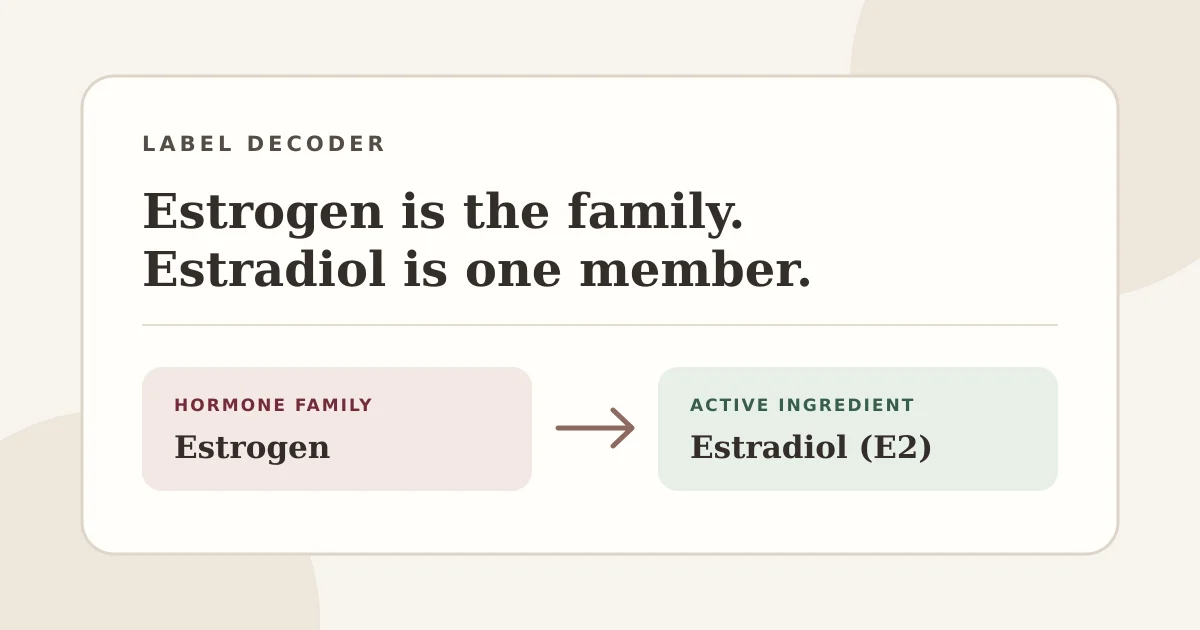
Estradiol vs estrogen comes down to one idea: estrogen is a family of hormones, and estradiol is one member of that family, the strongest one your ovaries make before menopause. So every estradiol prescription is an estrogen, but not every "estrogen" prescription is estradiol. Premarin, for example, is a mix of other estrogens, mainly estrone and equilin.
What the word on your label usually means:
- "Estradiol" — the same hormone your ovaries made. It comes in FDA-approved pills, patches, gels, creams, inserts and rings.
- "Conjugated estrogens" (Premarin) — a blend that is mostly not estradiol. Also FDA-approved.
- "Ethinyl estradiol" — a lab-made cousin used in many combined birth control pills. More potent per milligram than oral estradiol. Not the same as estradiol.
- "Biest," "Triest" or "estriol" — compounded mixes made at a pharmacy. Not FDA-approved.
- "Estradiol (E2)" on a lab report — a blood test for one estrogen, not a medicine and not your "total estrogen."
Start where you are:
- Holding a prescription? Keep the label next to you and jump to the label decoder.
- Looking at a lab result? Go to estradiol on a lab report.
- Trying to figure out what care you need? Read the decoder first, then which path fits your situation.
The HRT Index is the independent decision resource for online menopause and HRT care — comparing telehealth providers on clinical legitimacy, care quality, medication fit, price transparency, and access, with every claim verified and dated, so women can choose the path that fits their situation before their first consult.
What we actually verified · Last verified October 2026
We read on October 19, 2026: the FDA's hormone-therapy label announcement and updated-label list; the product labels used for the named examples below; FDA, MedlinePlus and The Menopause Society guidance; original reports from KEEPS and a comparative observational study of oral estrogens; and Gala's HRT pages, linked terms and refund policy.
We confirmed: the ingredients and approval records of the named medication examples; the FDA's statement that no approved drug contains estriol; and that Gala lists estradiol pills and patches, micronized progesterone, vaginal estradiol cream or tablets and non-hormonal options. Its dedicated HRT landing page advertises $69 a month, and Gala says it does not bill insurance.
We did not: take any of these medicines, sign up with any provider, pay, or have a clinician review this page.
We could not confirm: the exact brand any online provider will dispense to you, or that every brand named here is stocked at every U.S. pharmacy today.
One honest limit before we start. Knowing the hormone's name can't tell you whether a product is right for you, or whether two prescriptions can be swapped. Your full label, your pharmacist and your clinician settle those questions. This page helps you ask them the right ones.
On this page: The difference · Four types of estrogen · Label decoder · Pills, patches, rings and creams · Estradiol vs Premarin · Bioidentical and compounded · Birth control estrogen · Lab reports · Progesterone · Which path fits · Online care with Gala · Cost · 2026 label changes · Questions to ask · How we checked · Quick answers
Estradiol vs estrogen: what's the actual difference?
Estrogen is the name for a group of hormones. Estradiol is one hormone in that group, and it's the strongest and most common one during the years you have periods. People say "estrogen" when they mean estradiol all the time, which is where most of the confusion starts.
Think of "estrogen" like the word "fruit" and "estradiol" like "apple." Every apple is a fruit. But when someone hands you "fruit," it isn't always an apple.
In everyday menopause talk, "low estrogen" mostly means "low estradiol." Your ovaries make most of your estradiol. Ovarian estradiol production can swing during perimenopause and falls after menopause. That drop is behind many of the changes women notice, like hot flashes and vaginal dryness.
Your body doesn't run out of estrogen completely after menopause, though. The Premarin prescribing label explains that after menopause, most of the body's own estrogen comes from estrone, which is made in body tissues from a hormone the adrenal glands release. Estrone and its stored form, estrone sulfate, become the most common estrogens in the blood. (Premarin label, section 12.1; MedlinePlus)
Why your clinician says "estrogen" and your label says "estradiol"
Both are correct. They're just different levels of detail. A treatment name, an ingredient name and a product name can all describe the same prescription.
Here's how the three layers stack up:
| Layer | Example | What it tells you | What it doesn't tell you |
|---|---|---|---|
| Treatment type | "Estrogen therapy" | You're getting an estrogen | Which estrogen, which form, what strength |
| Active ingredient | "Estradiol" | The exact hormone | Pill or patch, the dose, what it's meant to treat |
| Finished product | "Climara (estradiol transdermal system) 0.05 mg/day" | Hormone, form and strength | Whether it's right for you |
So if your doctor said "I'm starting you on estrogen" and the box says estradiol, the different wording alone doesn't mean anything went wrong. The box is just being more specific. The opposite isn't always true, though. A box that says "estrogens, conjugated" is an estrogen product, but it isn't estradiol.
What do "E2" and "17β-estradiol" mean?
They're two more names for estradiol. Scientists number the main estrogens by how many small chemical groups (called hydroxyl groups) they carry: estrone has one (E1), estradiol has two (E2) and estriol has three (E3). "17β-estradiol" is the full chemical name for the estradiol your body makes and the estradiol in FDA-approved menopause products. You'll see "E2" most often on lab reports.
What are the four main types of estrogen?
The four estrogens you'll hear about are estrone (E1), estradiol (E2), estriol (E3) and estetrol (E4). Estradiol leads during the years you have periods, estrone becomes the main one after menopause, and estriol and estetrol rise mostly during pregnancy. Which one your body makes most at a given age doesn't tell you which medicine you should take.
| Estrone (E1) | Estradiol (E2) | Estriol (E3) | Estetrol (E4) | |
|---|---|---|---|---|
| Life stage where it stands out | Main circulating estrogen after menopause | Main estrogen during nonpregnant reproductive years | Rises greatly in pregnancy | Produced during pregnancy |
| Mostly made by | Body tissue (including fat) and, before menopause, the ovaries | Ovaries outside pregnancy | Placenta, using hormone precursors from the fetus | Fetal liver during pregnancy |
| Activity at the estrogen receptor | Less potent than estradiol | More potent than estrone and estriol | Less potent than estradiol | Weaker activity than estradiol in laboratory tests; effects vary by tissue |
| In FDA-approved U.S. menopause medicines? | Yes, as part of conjugated estrogens like Premarin | Yes, in many products | No. FDA: no approved drug contains estriol | Nextstellis is approved for birth control, not menopause treatment |
Sources: MedlinePlus; Premarin label §12.1, which states estradiol is "substantially more potent than its metabolites, estrone and estriol, at the receptor level"; FDA menopause page on estriol; FDA Nextstellis review on estetrol and Nextstellis label on its approved use.
Two things worth knowing here.
First, "strongest" doesn't mean "most dangerous" or "best." A medicine's effect depends on the dose, the form and your body, not just which estrogen it is.
Second, some websites say estrone is "the only" estrogen made after menopause. That's an oversimplification. Estrone becomes the main one, but the body keeps converting estrogens back and forth.
What's in your prescription? The estrogen label decoder
Look at the "active ingredient" line on your pharmacy label or box, not just the brand name. If it says estradiol (or estradiol acetate, which the body turns into estradiol), you have estradiol. If it says conjugated estrogens or ethinyl estradiol, it is not an estradiol-only product. A compounded preparation may contain estradiol alone, other estrogens or a mix; the table below shows what to check.
Quick 3-question check (no one sees your answers):
- Does the active-ingredient line say estradiol? (yes / no / something else)
- Do you swallow it, put it on your skin, or use it in the vagina?
- Do you still have a uterus, and is a progestogen (progesterone or a similar hormone) part of your plan?
Your answers point you to the right row below, the forms section and the progesterone section.
The estrogen label decoder
Brand names are examples to help you recognize a label, not recommendations. The approval column applies to the named, checked examples—not every preparation with that ingredient or form. A plain ingredient name cannot confirm your own product's approval. Check your full label, and ask your pharmacist if a name isn't listed. "Whole body" (systemic) means enough reaches the bloodstream to treat symptoms like hot flashes. "Mostly local" means aimed at vaginal and nearby tissue; it does not mean zero absorption.
Match a name on your label
This tool explains label wording; it never recommends a medicine, dose, switch or treatment plan. The full decoder table below stays visible with or without JavaScript.
Use a medicine name only. Do not enter your name, prescription number, symptoms or other personal information. Matching stays in this page and is not saved or sent. A number after a brand is used only to recognize the name; it is not interpreted as a dose.
| What your label says | What's actually inside | Is it estradiol? | Named example FDA-approved? | Works where | Example names | Ask this |
|---|---|---|---|---|---|---|
| Estradiol tablets | Estradiol | Yes | Yes | Whole body | Generic estradiol tablets | "Do I need a progestogen with this?" |
| Estradiol transdermal system (patch) | Estradiol | Yes | Yes | Whole body | Climara; other brand and generic patches | "Weekly or twice-weekly, and what if my brand changes?" |
| Estradiol gel or spray | Estradiol | Yes | Yes | Whole body | Divigel (label updated Feb 2026); other gels and sprays | "Where do I apply it, and how do I keep others from touching it?" |
| Estradiol vaginal cream | Estradiol | Yes | Yes | Mostly local; some absorption can occur | Estrace vaginal cream 0.01% | "How much, how often, and is local treatment enough for me?" |
| Estradiol vaginal insert or tablet | Estradiol | Yes | Yes | Mostly local | Vagifem (10 micrograms per insert); generics | "Is this meant for vaginal symptoms, not hot flashes?" |
| Estradiol vaginal ring, low dose | Estradiol | Yes | Yes | Mostly local | Estring (current label revised Apr 2026) | "Is this the local ring my clinician meant?" |
| Estradiol acetate vaginal ring | Estradiol acetate, which releases the equivalent of estradiol | Yes (as estradiol acetate) | Yes | Whole body | Femring (0.05 or 0.10 mg/day) | "This one treats my whole body, so how is my uterus protected?" |
| Estradiol + progesterone capsule | Estradiol + progesterone | Yes, plus progesterone | Yes | Whole body | Bijuva (label updated Feb 2026) | "Does this cover my uterine protection?" |
| Estradiol + a progestin | Estradiol + norethindrone acetate or levonorgestrel | Yes, plus a progestin | Yes | Whole body | Estradiol/norethindrone acetate tablets; combination patches | "Why this progestin rather than progesterone?" |
| Conjugated estrogens | A blend, mainly estrone sulfate and equilin sulfate, plus smaller amounts of related estrogens | Not estradiol-only | Yes | Pill: whole body. Cream: mostly local | Premarin tablets; Premarin Vaginal Cream | "Would estradiol work as well for me?" |
| Conjugated estrogens + medroxyprogesterone | Blend + a progestin | Not estradiol-only | Yes | Whole body | Prempro, Premphase | "How does my product's dose and schedule compare with the treatment studied in WHI?" |
| Conjugated estrogens + bazedoxifene | Blend + bazedoxifene, an estrogen agonist/antagonist | Not estradiol-only | Yes | Whole body | Duavee | "Is this specific combination appropriate for me?" |
| Synthetic conjugated estrogens | A blend of synthetic conjugated estrogens | Not estradiol-only | Yes | Whole body | Cenestin, Enjuvia (labels updated Feb 2026) | "Is this still dispensed, and why this over estradiol?" |
| Ethinyl estradiol | A lab-made cousin of estradiol, more potent per milligram than oral estradiol | No — different molecule | Yes | Whole body | Many combined birth control pills; Fyavolv (a menopause product) | "Is this a birth control dose or a menopause dose?" |
| Biest, Triest, estriol cream, "custom" estradiol | A pharmacy-prepared product; ingredients depend on the prescription | Yes, partly, or no—check the listed ingredients | No — compounded preparations aren't FDA-approved | Can't tell from the name | Compounded only | "What exactly is in it, and why wouldn't an approved product work for me?" |
| Lab report: "Estradiol (E2)," "Estrogens, total" or "fractionated" | A blood test, not a medicine | — | — | — | — | "Will this result change my treatment?" |
Row sources: Premarin label (conjugated estrogens composition and uses); Femring on DailyMed (estradiol acetate, 0.05 and 0.10 mg/day, hot flashes and vaginal symptoms); FDA updated-label list (Divigel, Estring, Bijuva, Cenestin, Enjuvia, Prometrium); FDA menopause page (compounded and estriol); Climara, Vagifem, Estrace vaginal cream, Duavee and Fyavolv labels. Additional exact labels are listed under Sources. Checked October 19, 2026.
Read the whole label, not just the hormone name
Five details tell you what you really have: the full product name, the active ingredient, the form (how it goes in), the strength with its units, and the schedule on your label. Find those five before you compare two products.
A few things that trip people up:
- A cream isn't automatically compounded. Estrace and Premarin vaginal creams are FDA-approved products.
- A skin product isn't automatically local. A patch sits on a small spot of skin but treats your whole body.
- A vaginal ring isn't automatically low-dose. Estring is a local ring. Femring treats the whole body. More on that below.
- A new box isn't proof of a new treatment. Refills sometimes come from a different maker. Compare the five details, and ask your pharmacist if anything changed.
If a refill looks different, you're not being fussy by asking. One woman in a menopause forum discussion described her doctor and pharmacist giving her opposite answers about her generic estradiol and wrote, "I'm so confused." That's exactly the moment to bring both labels to the pharmacy counter.
What if your product isn't in the table?
That doesn't mean it's unusual or unsafe. There are many brands and generic versions. You can look up many U.S. prescription labels on DailyMed, the National Library of Medicine's label library, or ask your pharmacist to read the label with you.
One caution: a label being listed online isn't, on its own, proof of FDA approval. If a product claims approval, the pharmacist can confirm it. And please don't guess from a partial brand name, a photo or a phrase like "hormone cream."
Is an estradiol patch the same as an estrogen patch?
For menopause products such as Climara, yes: the estrogen in the patch is estradiol. Some combination patches also contain a progestin. Ask for the product name, because a birth-control patch is a different treatment. Brands differ in size, stickiness and how often you change them. For brand-by-brand differences and refill problems, see our estradiol patch reviews.
Estradiol cream vs conjugated estrogen cream
These are two different FDA-approved vaginal creams. Estrace cream contains estradiol. Premarin Vaginal Cream contains conjugated estrogens. Both are mostly local treatments for vaginal and vulvar changes after menopause, and some of each can reach the bloodstream. Which one you get often depends on what your clinician prefers and what your insurance covers. For more, read what estradiol vaginal cream is used for and estradiol vaginal cream reviews.
Now you know what's on the label. The next question is what kind of care fits you. The right online menopause care isn't the same for every woman — it depends on your symptoms, what you've already tried, your age, your state and your health history. Some situations belong with an in-person clinician first. Use The HRT Index's Find My HRT Path tool to explore a featured care option for your situation — and to flag when online care isn't the right starting point — before your first consult.
It's free, takes about 60 seconds and doesn't ask for your email. It asks five questions, then shows a featured online option or guidance about a different starting point. It doesn't diagnose anything or decide whether you should take hormones. A clinician does that. We may earn a commission from featured providers, and that affects which ones appear.
Do estradiol pills, patches, rings and vaginal products do the same job?
No. The form changes how much estradiol reaches your bloodstream, and that changes what it can treat. Pills, patches, gels, sprays and some rings are whole-body (systemic) treatments used for hot flashes and night sweats. Low-dose vaginal creams, inserts and rings mostly treat vaginal and nearby symptoms.
The Menopause Society puts it simply: systemic hormones are absorbed "at high-enough levels to have significant effects in widespread areas, which is needed to treat symptoms of menopause such as hot flashes." Low-dose vaginal estrogen is "effective for both moisturizing and rebuilding tissue," and "very little goes into blood circulation, so the risks are far lower." (The Menopause Society)
Pills, patches, gels and sprays: treatment through the bloodstream
All of these deliver estradiol to your whole body. The difference is the path it takes.
- Oral means swallowed. A pill passes through your liver before reaching the rest of your body.
- Transdermal means through the skin. Patches, gels and sprays skip that first trip through the liver.
That route difference matters for one big reason: blood clots. The Menopause Society says clot risk increases when you take hormones by mouth and "may be lower if you use a transdermal estrogen, such as a patch, gel, or spray." Notice the word "may." Skin estrogen isn't risk-free, and no form is the safest choice for everyone. Your history decides.
Everyday life matters too. A pill is one swallow. A patch stays on for days but can peel or irritate skin. A gel needs time to dry. Follow its own instructions for washing your hands, covering the site and preventing transfer to other people or pets; drying alone doesn't end every product's contact precautions. (Divigel label)
| Form | Whole body or local | Why someone might choose it | One thing to ask |
|---|---|---|---|
| Pill | Whole body | Simple, often low-cost as a generic | "Given my history, is a skin form a better fit?" |
| Patch | Whole body | No daily dose to remember; skips the liver's first pass | "How often do I change it, and what if it falls off?" |
| Gel or spray | Whole body | Skips the liver's first pass; no adhesive | "Where do I apply it, and how long until it's dry?" |
| Systemic ring (Femring) | Whole body | One ring for about three months | "How is my uterus protected?" |
| Vaginal cream | Mostly local | Dryness, painful sex; flexible amounts | "How much, how often, and for how long?" |
| Vaginal insert or tablet | Mostly local | Pre-measured, less mess | "Is this enough, or do I also need systemic therapy?" |
| Low-dose ring (Estring) | Mostly local | One ring for about three months | "Is this the local ring?" |
Sources: The Menopause Society; Femring label.
Low-dose vaginal estrogen: care for vaginal symptoms
Low-dose vaginal estrogen treats what doctors call genitourinary syndrome of menopause (GSM): the group of vaginal, sexual and urinary changes that come with lower estrogen. That includes dryness, burning, painful sex and some bladder symptoms. The Menopause Society also notes women may see relief from urinary frequency "and maybe even recurring urinary tract infections with vaginal estrogen."
Preventing repeat UTIs is different from treating an active infection. UTI prevention is an off-label use for the Estring and Vagifem products reviewed here, supported for some postmenopausal women by clinical guidance. (The Menopause Society's position statement)
It won't fix hot flashes. It's easy to mix up local and whole-body treatment. If night sweats are your main problem and you've been offered only a vaginal cream, that's worth raising. If dryness is your only problem, you may not need whole-body therapy at all.
And "local" isn't "zero." Some product pages say vaginal estradiol works "without systemic hormone exposure." Drug labels are more careful: systemic absorption can occur, and the amount depends on the product and how it is used. Low-dose inserts and rings generally produce low exposure; don't assume every cream or vaginal dose has the same absorption.
For the deeper guide, see our vaginal estrogen guide.
Why two vaginal rings can do completely different jobs
Here's a real example of why the full product name matters.
Say you read about a "vaginal estrogen ring" on two different websites and assume they're the same thing. They might not be.
- Estring is a low-dose estradiol ring used for local vaginal and vulvar symptoms.
- Femring is an estradiol acetate ring that releases the equivalent of 0.05 or 0.10 mg of estradiol a day for 3 months. Its label shows it reduced moderate to severe hot flashes compared with placebo. That makes it a whole-body treatment, even though it sits in the vagina. (Femring label)
Same shape. Same place. Different job. If you have a uterus, Femring raises the same uterine-protection question as a pill or patch. Ask which ring is being prescribed and what it's meant to treat.
Same number, different job: reading the strength on your label
Strength numbers can fool you, because labels measure different things. Here's a worked example using real label units.
| Label wording | What the number measures | Math | What you can safely conclude | What you can't conclude |
|---|---|---|---|---|
| Estradiol patch, 0.05 mg/day (for example, Climara) | How much estradiol the patch delivers each day | 0.05 mg = 50 micrograms, so 50 micrograms a day | It's a whole-body dose delivered through the skin | That some number of pills or grams of cream equals it |
| Femring, 0.05 mg/day | How much estradiol the ring releases each day | Also 50 micrograms a day | It's also a whole-body dose, this time through the vaginal wall | That it's a "vaginal-only" treatment |
| Vagifem, 10 micrograms | The amount in each insert, not per day | 10 micrograms per insert | It's a low-dose product for vaginal symptoms | That it's "one fifth as strong" as the patch, or a swap for it |
The patch and Femring show the same daily number, and both treat the whole body. The insert shows a smaller number measured a different way, for a different job. Converting milligrams to micrograms is just math. It doesn't make two products interchangeable. Only your prescriber can change your regimen, and please don't cut patches or combine products on your own.
Estradiol vs Premarin (conjugated estrogens): what's really different?
Premarin is a blend of estrogens purified from pregnant mares' urine, made mostly of estrone sulfate and equilin sulfate. Estradiol is a single hormone, made in a lab to match what your ovaries made. Approved oral products of both types treat hot flashes. The studies discussed below do not establish one as safer overall, though they suggest some differences.
This is one useful comparison behind "estradiol vs estrogen": estradiol and conjugated estrogens are actual alternative ingredients that can appear on a prescription.
Where each one comes from
Premarin's label describes it as "a mixture of CE [conjugated estrogens] purified from pregnant mares' urine." It's mainly sodium estrone sulfate and sodium equilin sulfate, with smaller amounts of related compounds, including a form called 17α-estradiol. Equilin is a horse estrogen that humans don't make. (Premarin label, section 11)
Estradiol products contain 17β-estradiol, the same molecule your ovaries make. It's produced in a lab, often starting from plant material.
If the "horse" part bothers you, that's a fair feeling and a fair thing to tell your clinician. It isn't, by itself, a medical reason Premarin is worse. It's a reason to ask whether estradiol is an option for you.
What the research actually says
Here's an honest ledger of what's known, what's suggestive and what isn't settled.
| Question | What the evidence shows | How solid | Source |
|---|---|---|---|
| Are they the same hormone? | No. Estradiol is one hormone. Premarin is a blend led by estrone and equilin. | Settled | Premarin label |
| Are both FDA-approved for hot flashes? | Yes: Premarin tablets and approved oral estradiol tablets have this indication, along with specified vaginal-symptom and bone-loss-prevention uses. Other forms have their own indications. | Settled for these products | Premarin tablet and oral estradiol labels |
| Which one did the big Women's Health Initiative (WHI) study use? | Conjugated estrogens, alone or with the progestin medroxyprogesterone. | Settled | Premarin label §14.5 |
| Has a head-to-head trial compared them? | Yes. KEEPS randomized 727 women within 3 years of their last period to 0.45 mg/day oral conjugated estrogens, a 50 microgram/day estradiol patch or placebo for 4 years. Both hormone groups also received cyclic micronized progesterone. Both regimens reduced hot flashes and night sweats, with no clear difference between them. Separate KEEPS studies found benefits for some bone, sleep and mood measures, but did not establish one regimen as the overall winner. | Moderate (one trial with several ancillary studies; it also changed the route) | Original symptoms report; bone substudy; original reports below |
| Blood clots: any difference? | A 2014 study of 384 women taking hormone pills in one health system found oral conjugated estrogens were linked to about twice the odds of a vein clot compared with oral estradiol (odds ratio 2.08; 95% confidence interval 1.02–4.27). This is a comparison of odds, not an absolute risk. The authors called for the finding to be repeated. | Suggestive, not proof | Smith et al., JAMA Internal Medicine, 2014 |
| Heart attack and stroke differences? | Same study: neither the higher heart-attack estimate nor the stroke estimate was statistically clear. The stroke odds ratio was 1.13, with a 95% confidence interval of 0.55–2.31. | Uncertain | Smith et al. |
| Uterine lining risk | The label says there's "no evidence that the use of natural estrogens results in a different endometrial risk profile than synthetic estrogens of equivalent estrogen dose." With systemic estrogen and a uterus, a progestogen is generally used; the low-dose vaginal and Duavee exceptions are explained below. | Settled for practice | Premarin label §5.2 |
| Breast cancer by estrogen type | The label notes observational studies "have not found significant variation" in breast cancer risk across different estrogen-plus-progestin combinations, doses or routes. | Limited | Premarin label §5.2 |
The details matter. Both regimens improved overall sleep scores, while the patch did better on one measure of sleep disturbance. Oral conjugated estrogens improved some mood scores compared with placebo. The patch improved overall sexual-function scores compared with placebo, but the direct comparison between the two hormone groups was not statistically clear. KEEPS changed both the estrogen and its route, so it cannot tell us that the ingredient alone caused a difference. (Sleep report; mood report; sexual-function report)
An "observational" study compares people who were already using different treatments. It can spot a pattern, but it can't prove the medicine caused it, because the groups may differ in other ways. A "randomized" trial like KEEPS assigns treatments by chance, which is stronger.
What this means for you. These are two tested, FDA-approved options with different ingredients. The route (pill or skin), the dose and your own health history matter alongside the ingredient. If you take Premarin and it works for you, this isn't a reason to stop. If you're starting fresh, or you've had a clot risk raised, it's a fair question: "Would estradiol, or a skin form, make sense for me?"
Why someone might be switched from one to the other
People get switched for ordinary reasons: a shortage, an insurance formulary change, a new prescriber with different habits, or side effects on one product. If a proposed switch surprises you, ask what prompted it and what the new product is meant to improve.
A switch is a prescriber's decision, because doses of different estrogens don't convert one-to-one. Please don't swap products on your own. If you were switched and don't feel right, call the prescriber and bring both labels.
Combination products with conjugated estrogens
Some products pair conjugated estrogens with something that protects the uterus:
- Prempro and Premphase add medroxyprogesterone acetate, a progestin, but their schedules differ. The WHI estrogen-plus-progestin trial studied daily oral conjugated estrogens 0.625 mg plus medroxyprogesterone acetate 2.5 mg; it did not test every dose or schedule. (Product label)
- Duavee adds bazedoxifene, which isn't a progestogen. It acts on estrogen receptors to limit uterine-lining growth in this specific combination. That does not mean it can replace progesterone in any other regimen. (Duavee label)
For a side-by-side on one of these, see Bijuva vs Prempro.
Is estradiol "bioidentical," and is bioidentical better?
Yes, estradiol is bioidentical: it has the same molecular structure as the estradiol your body makes. But "bioidentical" describes the molecule, not whether a product was tested. FDA-approved estradiol pills, patches, gels and creams are bioidentical and tested; compounded "bioidentical" mixes are not FDA-approved.
Bioidentical describes the molecule
The Menopause Society explains that "bioidentical hormone therapy began as a marketing term for custom-compounded hormones," but most people now use it to mean hormones with "the same chemical and molecular structure as the body's natural hormones." By that definition, "there are many well-tested, FDA-approved hormone therapy products" that qualify, sold at regular pharmacies in many doses. (The Menopause Society)
So you don't need a specialty pharmacy to get bioidentical estradiol. And "natural" isn't a safety rating. FDA-approved estradiol is made in a lab, often from plant starting material. What matters is whether the finished product was tested, and whether it fits you.
FDA-approved and compounded are different things
FDA-approved means the finished medicine, the actual pill, patch or cream, was reviewed for safety, effectiveness and consistent quality.
Compounded means a pharmacy mixes a medicine for an individual prescription. A compounded product can contain estradiol and still not be FDA-approved, because approval belongs to a finished product, not to an ingredient.
The FDA says it "does not have evidence that compounded 'bioidentical hormones' are safe and effective, or safer or more effective than FDA-approved hormone therapy." (FDA) The Menopause Society adds that custom-compounded hormones "are not safer or more effective than approved bioidentical hormones," and "may not even contain the prescribed amounts of hormones." When progesterone is too low, for example, the uterine lining may not be protected.
That doesn't make every compounded prescription wrong. Sometimes a clinician has a specific reason, like an allergy to an ingredient in every approved version. The question to ask is simple: "Why wouldn't an FDA-approved product work for me?"
For more, see compounded vs FDA-approved HRT and our list of FDA-approved HRT medications.
What about Biest, Triest and estriol?
"Biest" usually means a compounded mix of estriol and estradiol. "Triest" usually adds estrone. The FDA is direct: "There are no FDA-approved drugs containing estriol," and it has no evidence that estriol is a "safer form of estrogen."
The names also don't tell you the recipe. Ratios and strengths vary from pharmacy to pharmacy. If you're offered one, ask for the full ingredient list, the amount of each, and how it will be used. Then ask whether an FDA-approved estradiol product could do the same job.
Ethinyl estradiol vs estradiol: is birth control estrogen the same as HRT?
No. Many combined birth control pills use ethinyl estradiol, a lab-made cousin of estradiol that is more potent per milligram than oral estradiol. Menopause estradiol treatment is meant to ease symptoms, not provide reliable pregnancy prevention; some estradiol products also use microgram units.
The "ethinyl" part is a small chemical change that slows how fast the liver breaks the hormone down. That increases its oral potency compared with oral estradiol, so smaller oral amounts can have substantial effects. How much stronger depends on which effect you measure, so be wary of any single "X times stronger" number. (Estradiol: micrograms or milligrams, Endocrinology, Diabetes & Metabolism Case Reports)
A few clarifications:
- Ethinyl estradiol isn't only in birth control. Fyavolv, for example, is a menopause product that combines ethinyl estradiol with norethindrone acetate.
- Some women in perimenopause stay on birth control for cycle control and pregnancy prevention. That's a reasonable choice to make with a clinician.
- Menopause hormone therapy isn't birth control. If pregnancy is still possible, ask about contraception separately. The FDA also warns not to stop birth control just because a home menopause test is positive, since pregnancy may still be possible. (FDA)
If you're moving from the pill to menopause care, see switching from birth control to HRT.
Estradiol vs estrogen on a lab report: which test is which?
An "estradiol (E2)" test measures one estrogen. Tests labeled "estrogens, total" or "fractionated" may combine or separately report selected estrogens; the exact panel depends on the lab. For managing menopause symptoms, the Premarin label says blood estradiol and FSH levels "have not been shown to be useful" for treating hot flashes or vaginal symptoms.
MedlinePlus explains that many estrogens exist but only three are commonly tested: estrone (E1), estradiol (E2) and estriol (E3). Doctors use these tests for things like early or late puberty, fertility problems, certain tumors and sometimes perimenopause questions. (MedlinePlus)
| What the lab report says | What it measures | When it's typically used |
|---|---|---|
| Estradiol, E2 | Estradiol only | Fertility, puberty, some perimenopause questions, monitoring certain therapies |
| Estrone, E1 | Estrone only | Some postmenopausal and specialized evaluations |
| Estriol, E3 | Estriol | Mainly pregnancy screening |
| Estrogens, total or fractionated | A lab-specific panel; for example, Mayo reports E1 and E2, while Warde also reports their calculated total | Specialized evaluations; check which hormones were actually measured |
Sources: MedlinePlus; Mayo Clinic Laboratories' fractionated-estrogen panel; Warde Medical Laboratory's assay explanation. "Total" does not automatically mean every estrogen in your body.
Three practical points:
Menopause is usually diagnosed by your history, not a blood level. The FDA defines menopause as 12 months in a row without a period. During perimenopause, levels swing so much that MedlinePlus notes you may need repeated tests just to see a trend.
A single number isn't a target dose. The Premarin label states that blood FSH and estradiol levels "have not been shown to be useful in the management of moderate to severe vasomotor symptoms and moderate to severe symptoms of vulvar and vaginal atrophy." (Premarin label §5.18) Your clinician may still order labs for other reasons, like thyroid problems that can look like menopause.
An E2 test can't show everything in a mixed product. An estradiol test is built to measure estradiol. When the Premarin label describes what its tablets do in the blood, it tracks estrone and equilin, not estradiol. So if you take conjugated estrogens, an E2 result alone won't tell the whole story.
Saliva and at-home tests exist, but ask your clinician before paying for one. If a result won't change your plan, you may not need it. Our perimenopause symptoms checklist is often more useful to bring to a first visit.
Do you need progesterone with estradiol?
If you still have a uterus and use whole-body estrogen, including estradiol, you generally need a progestogen too, to protect the uterine lining from overgrowth and cancer. If you've had a hysterectomy, you usually don't. Low-dose vaginal estrogen generally doesn't need one, but that's a conversation to have with your clinician.
A few definitions first. Progesterone is the hormone your ovaries made after ovulation. A progestin is a lab-made relative. Progestogen is the umbrella word for both.
Why it matters. Estrogen makes the lining of the uterus (the endometrium) grow. Without a balancing hormone, that lining can overgrow, and the risk of uterine cancer rises. The Premarin label says "adding a progestin to postmenopausal estrogen therapy has been shown to reduce the risk of endometrial hyperplasia," meaning overgrowth that may lead to cancer. The Menopause Society says women who still have a uterus and take systemic estrogen "must use EPT" (estrogen plus progestogen) "to protect against uterine cancer."
This is true no matter which estrogen you use. Estradiol isn't "gentler" on the uterus than other estrogens. Being natural or bioidentical does not remove estrogen's effect on the uterine lining.
Ways the protection can come:
- A separate progesterone or progestin pill
- A combination product, like Bijuva (estradiol + progesterone) or a patch that includes a progestin
- Duavee, which uses bazedoxifene instead of a progestogen
- Sometimes a suitable levonorgestrel IUD, used off-label in the U.S. for this purpose, which is a clinician's call for your specific case
Exceptions to know about:
- No uterus: usually no progestogen needed. The label notes that some women who had a hysterectomy because of endometriosis may still need one.
- Low-dose vaginal estrogen: usually no progestogen needed, but your clinician decides.
- New or unexplained bleeding after menopause needs prompt medical evaluation. Tell the clinician before starting or changing HRT; an examination or testing may be needed.
Please don't stop a progestogen on your own because you read that estradiol is "bioidentical." Its purpose is to protect the uterine lining, but its own benefits and risks still need to be considered. For more, see who needs progesterone for menopause.
Which estrogen path fits your situation?
For most women starting hormone therapy today, the real choice isn't "estradiol or estrogen." It's which form, which dose and whether you need a progestogen, decided with a clinician who knows your history. The table below shows which kind of option usually comes up in which situation, and the most direct next step.
| Your situation | What usually comes up | Most direct next step |
|---|---|---|
| Hot flashes or night sweats, no red-flag history, want a tested bioidentical product | FDA-approved estradiol pill, patch or gel, plus a progestogen if you have a uterus | Your own clinician; Gala for a pill or patch if you pay cash and confirm the exact approved product; Midi or your doctor if you want insurance |
| Only vaginal dryness, painful sex or bladder symptoms | Low-dose vaginal estradiol or conjugated-estrogen cream | Your own clinician, Gala's vaginal estradiol, or our vaginal estrogen guide |
| Already on Premarin and it works well | Usually no reason to change on your own | Stay with your prescriber; ask whether a switch makes sense |
| Told to avoid estrogen, or don't want hormones | Non-hormonal medicines, such as fezolinetant | Non-hormonal options and fezolinetant for hot flashes |
| Want insurance to pay | In-network visit and a covered generic | Midi or your own doctor |
| Offered Biest, Triest or estriol | Compounded, not FDA-approved | Ask whether an approved estradiol product fits |
| Unexplained bleeding; past blood clot, stroke or heart attack; breast or uterine cancer; liver disease | These can rule out systemic estrogen or need specialist review | An in-person clinician first |
| Not sure what fits | — | The HRT Index's Find My HRT Path tool |
The red-flag row follows The Menopause Society and FDA lists of situations where women generally shouldn't use hormone therapy. (The Menopause Society; FDA)
Timing matters too. The Menopause Society says that for most women, hormone therapy helps control moderate to severe symptoms "when initiated within 10 years of onset of menopause or under age 60 years." Outside that window, the decision is more individual. It isn't an automatic no. It's a more careful conversation.
To find a menopause-focused clinician near you, The Menopause Society keeps a public practitioner directory. Listings aren't endorsements, but it's a good place to start.
A quick self-check
Three questions, just for you. Your honest answers point to the right next step.
- Has a clinician said estradiol is reasonable for you, or are you open to it?
- Are you fine paying cash instead of using insurance?
- Are you free of the red flags in the last row of the table above?
Yes to all three? A cash-pay online service that prescribes estradiol is a reasonable place to start. Gala is the one we feature for that. Its strengths and its open questions are right below, so you can decide with both in view.
We may earn a commission if you start care with Gala through our link. That doesn't change what we report. How we make money.
If you've settled on estradiol and would rather pay one monthly price than go through insurance, Gala lists estradiol pills and patches, plus micronized progesterone and vaginal estradiol, and a licensed clinician decides what fits you. Ask which exact product you'd receive before you pay.
Want your insurance involved? Gala doesn't bill insurance. Midi Health says it's in-network with many PPO plans and lets you check your plan by state. A covered visit doesn't guarantee your medicine is covered, so ask about both.
A "no" to question 3? Start with an in-person clinician. Neither an online service nor a quiz can clear a medical red flag.
Getting estradiol through online care: what Gala offers, and what to confirm
Gala lists four menopause treatment categories: estradiol pills or patches, micronized progesterone, vaginal estradiol cream or tablets, and non-hormonal options including fezolinetant. Its dedicated HRT landing page advertises $69 a month, with no insurance billing, and a licensed clinician decides whether to prescribe. It doesn't name the exact brands it dispenses, and its published HRT menu does not list Premarin.
Where Gala fits this page's reader
If you've read this far, you may have decided estradiol is what you want to discuss. Gala's hormone menu is built around exactly that: estradiol for whole-body symptoms, progesterone to protect the uterus, local estradiol for vaginal symptoms, and a non-hormonal option for women who can't or don't want to use hormones.
What Gala lists (its own pages, read October 19, 2026)
| Category | What Gala says | Generally used for | What to confirm |
|---|---|---|---|
| Estradiol pill or patch | "Bioidentical estradiol (the same molecule your body produces)," oral or transdermal | Hot flashes, night sweats and other whole-body symptoms | Exact product, strength and maker |
| Micronized progesterone | "Bioidentical micronized progesterone"; "required alongside estrogen if you still have a uterus" | Protecting the uterine lining during systemic estrogen | Whether it's included in the same monthly price |
| Vaginal estradiol cream or tablet | "Low-dose local treatment, minimal systemic absorption" | Dryness, painful sex; Gala also cites recurrent UTIs | Cream or tablet, which product, how often |
| Non-hormonal options, including fezolinetant | "Effective relief when hormones aren't right for you" | Hot flashes without estrogen | Monitoring: fezolinetant's label carries a boxed warning about serious liver injury and requires liver blood tests. Ask who orders them and who pays. (Veozah label) |
Sources: Gala hormone health, estradiol, progesterone and vaginal estradiol pages, read October 19, 2026. All treatments require clinician approval.
What Gala says comes with care: online assessment, review by a U.S.-licensed clinician, prescription delivery with free shipping, provider messaging, symptom check-ins and dose adjustments "for as long as you're treated." It accepts HSA and FSA cards. These are Gala's statements. We haven't been a patient.
A potential advantage for estradiol readers. If you have a uterus and need estradiol plus progesterone, Gala says its monthly price is "all included." If that one price really covers both medicines in FDA-approved forms, that could make the cost of combined treatment simpler. It's also exactly the thing to confirm in writing before you pay.
What to know before you pay
We'd rather you hear these from us than discover them later.
- The exact product isn't named. Gala's FAQ says it prescribes "FDA-approved bioidentical forms." On October 19, 2026, its alternate HRT landing page still carried a general note about compounded medication. That doesn't prove Gala dispenses compounded HRT. It means you should ask for the product name.
- Cash only. No insurance billing. Medicare and Medicaid aren't billed either.
- No published state list or HRT age range. Gala says it serves most U.S. states.
- Cancellation fine print. Gala's hub page says "Cancel anytime." Its general written policy, rechecked October 19, 2026, requires a cancellation request at least 72 hours before your billing date to avoid the next charge. Ask which rule governs your plan.
- Its pages show numbers we can't use. Gala's pages show outcome percentages and patient counts without linked sources. We don't use those numbers to judge treatment results.
- Premarin isn't listed. If you specifically want conjugated estrogens, confirm availability with your prescriber.
These are questions to settle before deciding whether Gala fits. Clear answers on the product, full cost and terms can make that decision easier.
What the first months could cost (example, not a quote)
Gala's dedicated HRT landing page advertises $69 a month and says the exact plan and price are shown before you pay. Here's the math if your charge is $69.
For this example, the first payment is October 19, 2026. Calendar-month bills fall on the 19th; the other scenario bills every 28 days. These are illustrations, not confirmed Gala billing schedules.
| Period | Calendar-month illustration, starting October 19, 2026 | Every-28-day illustration, starting October 19, 2026 | Could add to it |
|---|---|---|---|
| First payment | $69 assumed for the example; actual amount and timing unconfirmed | Same assumption | Required extras, if any, are unknown |
| First 90 days: October 19, 2026–January 16, 2027 | October 19, November 19, December 19: 3 charges = $207 | October 19, November 16, December 14, January 11: 4 charges = $276 | Labs if ordered (unknown); any medicine not included (unknown) |
| First 365 days: October 19, 2026–October 18, 2027 | 12 charges = $828 | 14 charges, including day 365 = $966 | Same unknowns |
Hypothetical example based on Gala's advertised $69 price, checked October 19, 2026. An unknown cost isn't zero; if anything required is unknown, your total is incomplete. Ask for your billing interval, next billing date and any minimum commitment.
The public pages don't settle when the first charge happens: one HRT page says after approval, while the linked general policy says when intake is completed. That policy also uses different wording for medical-disqualification refunds and includes weight-loss language. Confirm the terms for your HRT plan before paying.
Three questions to send Gala before you pay
- "If I'm prescribed estradiol, what is the exact product name and maker, and is it an FDA-approved product or compounded?"
- "Does the monthly price cover every medicine I'm prescribed, including progesterone, and are labs ever extra?"
- "What will I be charged today, how often after that, and what is my last day to cancel before the next charge?"
What one patient says, as Gala presents it
On its hormone-health page, Gala shares a quote from a patient it identifies as Allison, 51: "Gala's provider walked me through the options." That's a provider-published testimonial. We can't verify it, and it isn't evidence of how any treatment will work for you.
If Gala isn't the right fit
- You want insurance to pay: Midi Health or your own clinician.
- You want a public menu of forms and prices: Alloy lists pills, gels, patches and Evamist. Ask it to confirm the exact product before paying. We don't earn a commission from this direct link.
- You're 35 to 39: Find My HRT Path shows a different featured option first for that age group.
- You have a red-flag history: in-person care first.
For Gala's full documentation review, including complaints and refund terms, read our Gala Health HRT review. For a side-by-side with another cash-pay service, see Gala Health vs Winona.
If those answers come back clear and they work for you, Gala is a simple way to get a licensed clinician's eyes on your symptoms and talk through estradiol.
Gala may pay The HRT Index if you enroll. A prescription is never guaranteed. A licensed clinician decides what's right for you.
How do you compare the cost of two estrogen prescriptions?
There's no single price difference between "estradiol" and "estrogen," because cost depends on the exact product, the quantity, your pharmacy, your insurance and any care fees. Many estradiol forms are available as generics, which often costs less than a brand, but your plan's formulary decides what you actually pay.
The fair way to compare is to write down every piece, for each option, and only then add it up.
| What to record | What to write down |
|---|---|
| Medicine | Full product name, strength, quantity and days' supply |
| Coverage | Is it on your plan's formulary? What's your actual pharmacy price? (Visit coverage and medicine coverage are separate.) |
| Care fees | First visit, follow-ups, or a monthly membership if there is one |
| Extras | A second medicine like progesterone, any labs, shipping |
| Billing | Amount due now, recurring amount, how often (calendar month or every 28 or 30 days), any minimum commitment, when an intro offer ends |
| Continuity | How refills work, the cancellation deadline, and how to reach someone |
The rule we use: your first-period total is every charge that actually lands in that period, plus every required extra. If anything required is unknown, the total is incomplete. Don't write $0 for it.
Ask your pharmacist whether a generic exists for your exact product. For a broader look at what women pay, see HRT cost in 2026.
What changed for estrogen labels in 2026?
On February 12, 2026, the FDA approved label changes for six menopausal hormone therapy products, removing boxed-warning statements about cardiovascular disease, breast cancer and probable dementia. The updates are product-specific. The Premarin tablet label we read still carries those boxed-warning statements.
A boxed warning is the FDA's most prominent safety warning, printed in a box at the top of a drug label. The FDA said it started the process of updating these specific warnings in November 2025 after reviewing the research, and that 29 drug companies had submitted proposed label changes. (FDA announcement, Feb 12, 2026)
The first six products with updated labels, by type (FDA list):
| Type | Product | Estrogen inside |
|---|---|---|
| Progestogen alone | Prometrium | None (progesterone) |
| Systemic estrogen alone | Divigel | Estradiol |
| Systemic estrogen alone | Cenestin | Synthetic conjugated estrogens |
| Systemic estrogen alone | Enjuvia | Synthetic conjugated estrogens |
| Vaginal estrogen | Estring | Estradiol |
| Estrogen + progestogen | Bijuva | Estradiol (+ progesterone) |
What this does and doesn't mean:
- It's a labeling change, not a finding that hormones are risk-free. Updated labels still carry warnings. Divigel's updated label, for example, keeps a boxed warning about uterine cancer with estrogen alone in women who have a uterus.
- It doesn't make one estrogen safer than another. A label's update status depends on when the company's change was approved, not on a safety ranking.
- It doesn't change compounded products. They have no FDA label to update.
- Check your own product's current label on DailyMed or with your pharmacist.
The FDA also stated that "randomized studies show that women who initiate HRT within 10 years of the onset of menopause (generally before age 60) have a reduction in all-cause mortality and fractures." For the full background, see our 2026 HRT label changes explainer.
What should you ask your pharmacist or clinician?
The best question depends on what's still unclear. A pharmacist can tell you exactly what was dispensed and what the label means. A clinician can tell you whether the medicine, the form and your health history fit together.
If the name or the box changed: compare the old and new labels side by side before assuming your treatment changed. Ask the pharmacy whether the ingredient, form, strength and directions still match your prescription.
If your symptoms, side effects or health changed: that belongs with the clinician who prescribes your medicine. Bring the exact product names and what you noticed, with dates if you can.
You don't need to know the answers to all seven questions below. Circle the one you still need explained, and start there.
MY ESTROGEN QUESTIONS (keep this private)

1. What is the full name of my medicine, and which estrogen does it contain?
2. Is it meant to work through my whole body, or mainly treat vaginal symptoms?
3. Is this exact product FDA-approved, or compounded?
4. What do the strength, units and schedule on my label mean?
5. I [do / don't] have a uterus. What protects my uterine lining in this plan,
   or why isn't that needed?
6. Which health changes or new symptoms should make me call you, and how do I reach you?
7. What do I pay now and at each refill, and what else could be charged?

My notes:
Product name: ____________________   Ingredient: ______________
Form: ___________   Strength and units: ___________   Schedule: ___________
What it's meant to treat: ___________________________________
Date I asked: __________   Still unanswered: ____________________
How we checked this guide
We used drug labels, the FDA, MedlinePlus, The Menopause Society and peer-reviewed studies for medical facts, and Gala's own public pages for its service details. We didn't take any medicine, sign up or receive care. Our comparisons and suggested next steps are editorial judgments.
Three kinds of statements on this page, kept separate:
- Medical and regulatory facts come from drug labels, the FDA, MedlinePlus and The Menopause Society, linked next to each claim.
- Provider facts (Gala, Midi, Alloy) are what those companies publish. We say so each time, with the date we read them.
- Our judgments, like which path usually fits which reader, are labeled as ours.
The HRT Index Verification Standard
We show five public pillars, in this order. They group the more detailed criteria in our site methodology. On a medication explainer like this one, they shape what we check when a provider comes up. They are not a score, and we don't give one.
| Pillar | What it means on this page |
|---|---|
| 1. Clinical legitimacy | Who prescribes, and is a clinician's review required? We separate a provider's statement from an independently confirmed license. |
| 2. Care quality | Published follow-up, messaging and refill policies, labeled as advertised rather than tested. |
| 3. Medication fit | Which estrogen, which form, whole-body or local, and FDA-approved or compounded. This pillar does most of the work on this page. |
| 4. Price transparency | Medicine kept separate from care fees; amount due now, recurring charges, extras and exit terms kept distinct. No unknown counted as zero. |
| 5. Access | States, ages, insurance and the situations that need a different kind of care. |
This page is editorial research. It has not been reviewed by a clinician. Read our medical review policy and affiliate disclosure.
Estradiol vs estrogen: quick answers
Is estradiol the same as estrogen? Estradiol is one type of estrogen. "Estrogen" can also mean other members of the family, like estrone or the blend in Premarin. So all estradiol is estrogen, but not all estrogen is estradiol.
Is estradiol stronger than estrogen? "Estrogen" isn't one strength, so the comparison doesn't quite work. Among the body's main estrogens, estradiol is the strongest at the receptor. A medicine's real effect depends on its dose and form.
Is Premarin estradiol? No. Premarin is conjugated estrogens, mainly estrone sulfate and equilin sulfate. It contains only small amounts of related estradiol forms.
Is estradiol a hormone or a drug? Both. It's a hormone your body makes, and it's also the active ingredient in many prescription medicines.
Do I still have estrogen after menopause? Yes. Your body keeps making some, mostly estrone, from tissues outside the ovaries.
Is the estrogen in birth control the same as estradiol? Usually not. Many combined pills use ethinyl estradiol, a different molecule with greater oral potency than oral estradiol.
Can I swap an estrogen pill for an estradiol patch? A clinician can make that change, but names and label numbers alone can't tell you an equal dose. Bring both products to your prescriber rather than working it out yourself.
Does estradiol cause weight gain? The Menopause Society says hormone therapy "is not associated with weight gain." Midlife weight changes are common for other reasons.
Does estradiol help with memory or prevent Alzheimer's? The FDA says not to use hormone therapy to prevent memory loss or Alzheimer's disease.
What about estradiol and estrogen in men? Men make estradiol too. This page covers menopause care for women.
Does everyone need estrogen after menopause? No. Menopause alone doesn't mean you need treatment. Your symptoms, history and preferences decide whether any treatment makes sense, and some women need none.
Bottom line
Estrogen is the family. Estradiol is a potent member and the one in many menopause prescriptions. The word that matters most is on your label's active-ingredient line, along with the form and strength, and the right choice depends on your symptoms, whether you have a uterus, and your health history.
If you know what you want and you're paying cash, the questions in the Gala section will tell you quickly whether it fits. If your next step still isn't clear, that's normal, and it's what our matching quiz is for.
Still not sure which path fits? The free Find My HRT Path matching quiz asks about your symptoms, what you've already tried, your age, your state and your health history. Then it shows a featured care option, or guidance when online care isn't the right starting point. A clinician, not the quiz, decides whether any treatment is right for you.
And if you already have a clinician who knows your history, it's always fair to ask them first.
Sources
Medical and regulatory (checked October 19, 2026)
- U.S. FDA — FDA Approves Labeling Changes to Menopausal Hormone Therapy Products, February 12, 2026
- U.S. FDA — Menopausal Hormone Therapies with Updated Prescribing Information
- U.S. FDA — Menopause
- Premarin (conjugated estrogens) tablets prescribing information, Pfizer, revised April 2025
- Femring (estradiol acetate vaginal ring) label, DailyMed
- Veozah (fezolinetant) label, DailyMed
- Systemic estradiol labels: generic oral estradiol, Climara patch, Divigel gel
- Vaginal product labels: Vagifem inserts, Estrace vaginal cream, Estring (revised April 2026), Premarin vaginal cream
- Combination product labels: Bijuva, Climara Pro, estradiol/norethindrone acetate, Prempro/Premphase, Duavee
- Synthetic conjugated estrogen labels: Cenestin, Enjuvia
- Ethinyl estradiol product labels: Fyavolv, Lo Loestrin Fe
- Estetrol sources: Nextstellis label, FDA multidisciplinary review
- U.S. FDA — Compounding and the FDA: Questions and Answers
- MedlinePlus — Estrogen Levels Test
- Lab-specific examples: Mayo Clinic Laboratories — Estrogens, Estrone (E1) and Estradiol (E2), Fractionated, Serum, Warde Medical Laboratory — Fractionated Estrogens Performed by LC/MS/MS
- The Menopause Society — Hormone Therapy
- The 2022 Hormone Therapy Position Statement of The North American Menopause Society
- NHS — Common questions about oestrogen tablets, patches, gel and spray
- KEEPS primary reports: menopause symptoms, Santoro et al.; cognition and mood, Gleason et al.; sexual function, Taylor et al.; sleep, Cintron et al.; bone, Farr et al.
- Miller VM et al. — Lessons from KEEPS: the Kronos Early Estrogen Prevention Study
- Smith NL et al. — Lower Risk of Cardiovascular Events in Postmenopausal Women Taking Oral Estradiol Compared With Oral Conjugated Equine Estrogens, JAMA Internal Medicine, 2014
- Estradiol: micrograms or milligrams, Endocrinology, Diabetes & Metabolism Case Reports
- The Menopause Society — Find a Menopause Practitioner
Providers (read or rechecked October 19, 2026)
- Gala — Hormone Health
- Gala — Estradiol
- Gala — Progesterone
- Gala — Vaginal estradiol
- Gala — Non-hormonal options
- Gala — $69 HRT landing page
- Gala — Alternate HRT landing page
- Gala — Refund policy, policy dated February 2026
- Gala — Terms and conditions, dated September 22, 2026
- The HRT Index — Gala Health HRT review (editorial context and existing affiliate destination)
- Midi Health — Pricing and insurance
- Alloy — HRT
The HRT Index is an independent editorial publication. We are not a healthcare provider, pharmacy or telehealth service. Nothing here is medical advice, a diagnosis or a treatment plan. For decisions about starting, stopping or changing hormone therapy, talk with a licensed clinician who knows your history. In an emergency, call 911.